JCC Signals Shift to Recovery in Flood-Hit Areas as France Expands Crisis-Tech Support for Kurdistan
JCC declares flood emergency over, shifting to aid for thousands. France to provide new tech for crisis forecasting as death toll rises to five.
ERBIL (Kurdistan24) – In a decisive pivot from immediate disaster response to sustained recovery, the Kurdistan Regional Government’s Joint Crisis Coordination Centre (JCC) declared on Sunday that the acute emergency phase following the recent catastrophic floods has officially concluded, signaling a shift toward the intensive rehabilitation of displaced families and the distribution of aid to those who have lost everything.
As the waters recede and the scale of the devastation becomes clear, officials have simultaneously revealed a strategic partnership with France to deploy advanced meteorological and crisis-management technology, aiming to fortify the region against future climatic volatility.
The announcement comes as the death toll from the torrential rains across the Kurdistan Region and Kirkuk was confirmed at five, with nearly two dozen others injured, underscoring the lethal severity of the weather system that has battered the area over the past week.
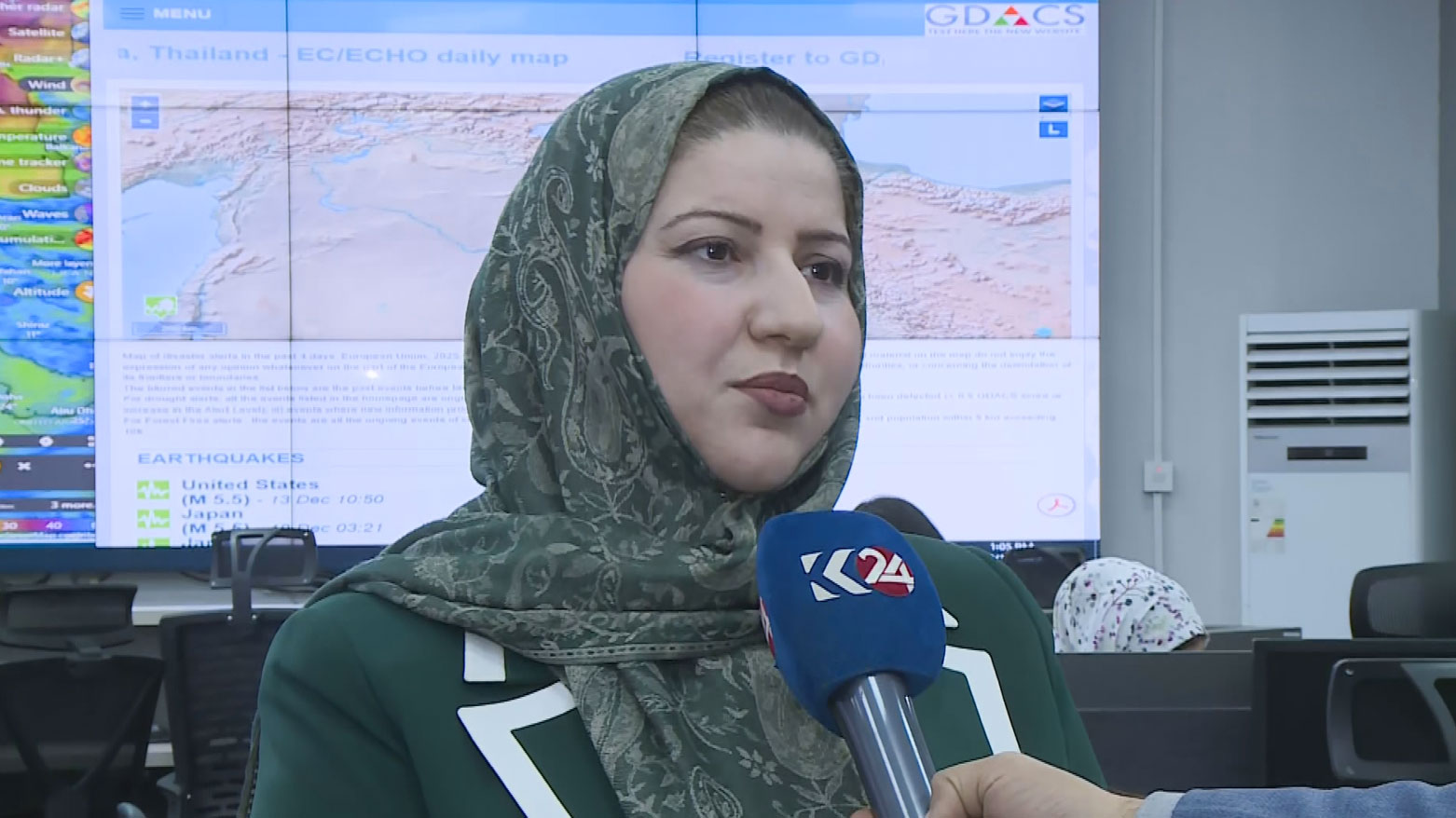
Speaking to Kurdistan24 on Sunday, Srwa Rasul, the Head of the Joint Crisis Coordination Centre at the Ministry of Interior, outlined the government’s transition from rescue operations to stabilization.
"We can say that we have finished the emergency phase," Rasul stated, defining the current objective as ensuring that families can fully return to their homes and resume normal lives.
This transition marks the end of the frantic search-and-rescue period and the beginning of a logistical marathon to provide material support to those whose livelihoods were washed away.
According to Rasul, the JCC is now in a phase of "intensive aid distribution," specifically targeting families who sustained "total damage," a classification that implies the complete loss of property and shelter.
The scope of the destruction facing the JCC is immense.
A comprehensive report released by the Centre detailed the toll of the floods, which were triggered by heavy torrential rain that overwhelmed infrastructure in cities and towns, most notably in the Chamchamal district and its surrounding areas.
Preliminary statistics paint a grim picture of the physical cost: more than 500 residential houses and 100 commercial shops sustained significant damage in Chamchamal alone.
Across the broader Kurdistan Region, the human cost was finalized at five lives lost and 19 individuals injured. Beyond these personal tragedies, the floods inflicted significant material damage on thousands of houses, shops, and various development projects, necessitating a recovery effort that will require substantial resources and coordination.
Rasul emphasized that the response to this crisis was not reactive but the result of meticulous planning. At the onset of the rainfall wave, the JCC’s operations room convened an extraordinary meeting involving representatives from relevant ministries to draw up a contingency plan.
This pre-emptive coordination allowed for a rapid mobilization of resources once the disaster struck. In her statement, the JCC Head extended gratitude to the network of institutions and charitable organizations that formed the backbone of this response.
She indicated that most of these entities were on high alert alongside government forces even before the disasters occurred.
The coalition of support included the Barzani Charity Foundation, Rwanga Foundation, Kurdistan Foundation, Haji Idris Surchi Foundation, and the Red Crescent, alongside private sector partners such as Gali and Qaiwan companies.
A critical component of the JCC’s current mandate involves addressing the humanitarian fallout in the disputed territories, particularly Kirkuk.
Rasul revealed that she had personally led a delegation to Kirkuk on Saturday, December 13, to closely observe the condition of citizens affected by the storms. Her assessment of the situation on the ground was sobering.
"Families there are in a bad situation," she reported, noting that the aid provided thus far had been insufficient, with many victims receiving only a basic food basket despite their dire circumstances. To rectify this, the JCC has orchestrated a targeted intervention.
In coordination with the Barzani Charity Foundation, the Kurdistan Foundation, and the Haji Idris Surchi Foundation, and working through the Directorate of Migration and Displacement and Crisis Response in Kirkuk, a decision has been made to deliver a substantial aid package within the next 48 hours.
This relief effort is specifically aimed at the Shoraw neighborhood and other districts populated by Turkmen and Arab residents, whose conditions were identified as particularly poor. This move underscores the JCC’s commitment to providing non-discriminatory aid across the region's diverse demographic landscape.
Looking beyond the immediate recovery, the JCC is actively upgrading its technological capabilities to better manage future threats.
Srwa Rasul emphasized that the Centre is constantly engaged in developing its preparedness and crisis response frameworks.
In a significant disclosure regarding international cooperation, she indicated that the Kurdistan Regional Government is currently working closely with France to introduce several new technologies designed to advance the forecasting and preparedness phases of crisis management.
This partnership aims to modernize the region’s ability to predict weather events and coordinate responses, potentially saving lives in future emergencies by providing earlier and more accurate warnings.
The urgency of such modernization is highlighted by the continuing instability of the weather patterns. Rasul noted that another wave of rainfall is currently approaching the region.
While reports from the General Directorate of Meteorology suggest that there is currently no imminent threat comparable to the recent floods, the JCC remains vigilant. "We are monitoring intensively," Rasul assured the public, adding that if any danger is detected, the Centre will immediately notify all relevant parties and begin preparations.
As the emergency phase closes and the rebuilding begins, the integration of French technology and the continued mobilization of local aid foundations signal a determined effort by the Kurdistan Region to adapt to an era of increasingly unpredictable climate challenges.