German-Kurdish Business Community Anchors Expanding Strategic Ties
German CG Albrecht von Wittke said Germany’s role in Kurdistan goes beyond trade, with companies supporting sustainable development, economic diversification, and a long-term strategic partnership aligned with KRG goals.
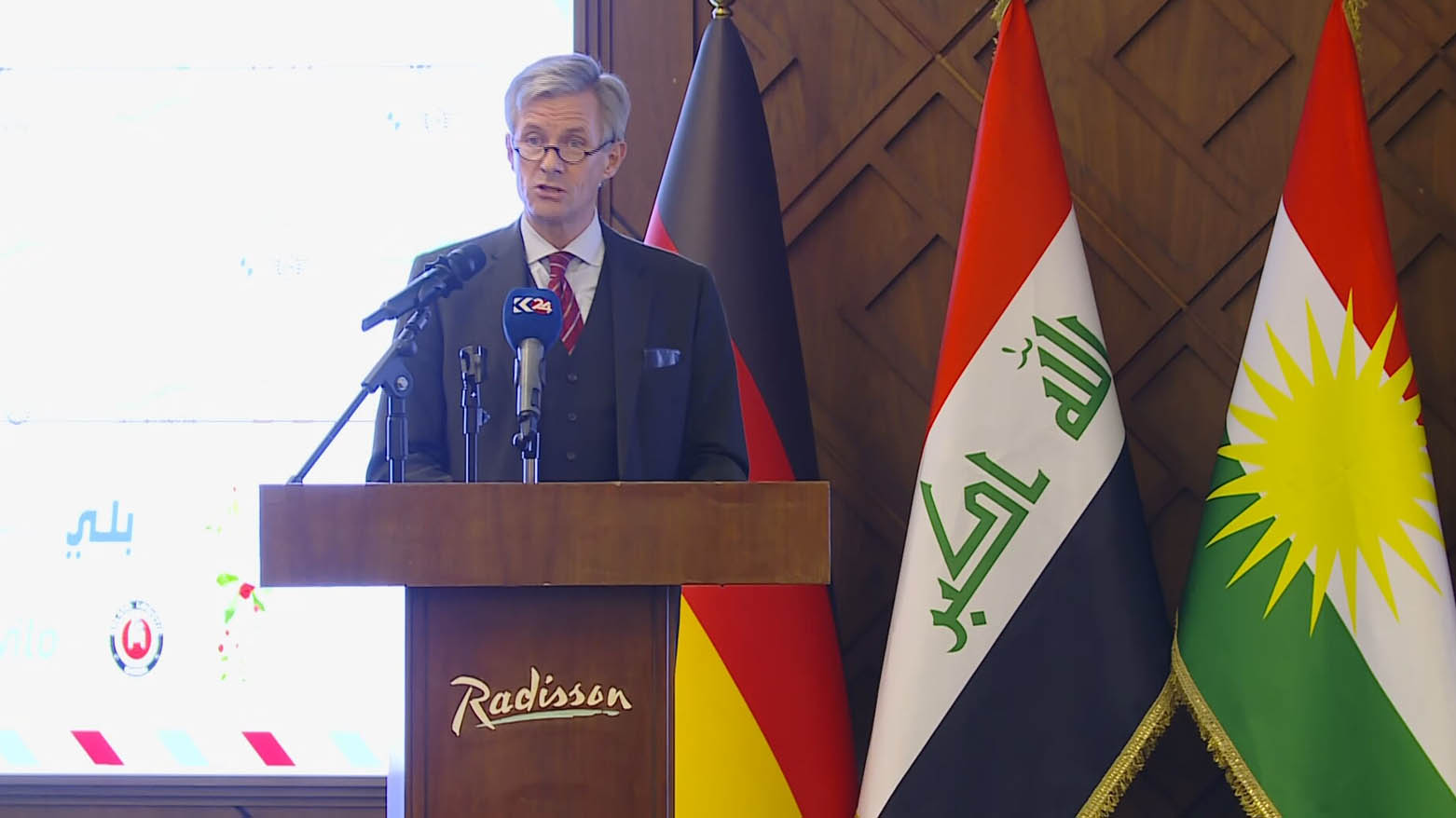
ERBIL (Kurdistan24) – German exports to Iraq have surged by a substantial 9.8 percent over the past year, solidifying Berlin’s position as the European Union’s primary commercial supplier to the nation and signaling a deepening economic integration with the Kurdistan Region that extends far beyond traditional transactional ties.
The announcement was made on Thursday evening by Albrecht von Wittke, the German Consul in Erbil, during a dinner conference hosted by the German Chamber of Commerce in Iraq.
Addressing a gathering of business leaders and diplomats, the Consul outlined a trajectory of robust growth and unveiled the imminent operationalization of a massive financial instrument designed to further accelerate trade between the two economies.
Speaking on Thursday, Consul von Wittke provided a detailed assessment of the commercial landscape, revealing that Germany continues to hold the distinction of being the largest country of origin within the European Union for exports destined for the Iraqi market.
However, the diplomat noted that the official statistics likely underrepresent the true scale of the economic relationship. In a revealing insight into regional logistics, von Wittke explained that a significant volume of goods entering Iraq via intermediaries such as Türkiye or the United Arab Emirates actually originates in Germany.
He characterized these complex trade flows as "very welcome signs of trust in German products" among consumers and businesses in both federal Iraq and the Kurdistan Region, suggesting that the appetite for German engineering and manufacturing remains a dominant force in the local economy.
The dinner conference served as a platform not only to review past performance but to articulate a forward-looking strategy centered on financial security and infrastructure. Central to this vision is a major fiscal development involving the Trade Bank of Iraq and Euler Hermes, the German export credit agency.
Consul von Wittke expressed hope that the positive trade trends would be bolstered significantly once a planned export credit guarantee instrument finally becomes operational.
The scope of this financial mechanism is staggering, with an overall volume of 1 billion Euros. Once active, this facility is expected to mitigate risks for German exporters and Iraqi importers alike, providing the financial liquidity and insurance necessary to underpin large-scale projects and sustain the flow of goods during periods of market volatility.
The Consul’s remarks also highlighted the qualitative nature of Germany’s engagement with the Kurdistan Region. Beyond the raw metrics of trade volume, Berlin views its role as a partner in the region's structural evolution.
Von Wittke emphasized that German companies are not merely vendors but are active supporters of sustainable development and economic diversification.
This alignment with the Kurdistan Regional Government’s long-term goals suggests a strategic partnership aimed at moving the local economy away from a singular reliance on hydrocarbons and toward a more varied industrial and service-based model.
The German-Kurdish business community was described by the Consul as an "integral part" of the overall partnership, reinforcing the idea that private sector engagement is the bedrock of diplomatic relations between Erbil and Berlin.
Looking toward the immediate future, the German diplomatic mission expressed high confidence that the momentum generated in 2025 will carry over into an "equally dynamic" 2026. The Consul previewed a robust calendar of business activities scheduled for the coming year, signaling that Berlin intends to intensify its commercial footprint on the ground.
This renewed engagement will commence in February with the arrival of a large "mixed sector delegation." Organized by the German Chamber of Commerce abroad (AHK) in cooperation with the German Expert Forum Iraq and the Consulate General, this delegation represents a coordinated effort to foster innovation and deepen cooperation across multiple industries simultaneously.
The initiative to bring a diverse array of German expertise to Erbil underscores a shared ambition to build "sustainable long-term partnerships" rather than pursuing short-term gains. By facilitating direct interaction between German experts and their Kurdish counterparts, the consulate aims to bridge the gap between European technical standards and local market needs.
In his concluding remarks to the assembled guests, Consul von Wittke framed the evening as a "strong signal of trust and shared vision." He thanked the attendees for their continued engagement, acknowledging that their presence was a testament to the resilience and strength of the bilateral business community.
As the holiday season approaches, the message from the German Consulate was unequivocal: the commercial bridge between Germany and the Kurdistan Region is expanding, backed by rising export figures, upcoming high-level delegations, and the promise of a billion-euro financial safety net that could redefine the economic landscape of the region in the year to come.