U.S. Congressman Joe Wilson Accuses Iraq’s Judiciary of Ties With Armed Factions
The remarks follow the Supreme Judicial Council chief’s public praise of militias over weapons coordination, raising concerns over judicial neutrality and the rule of law.
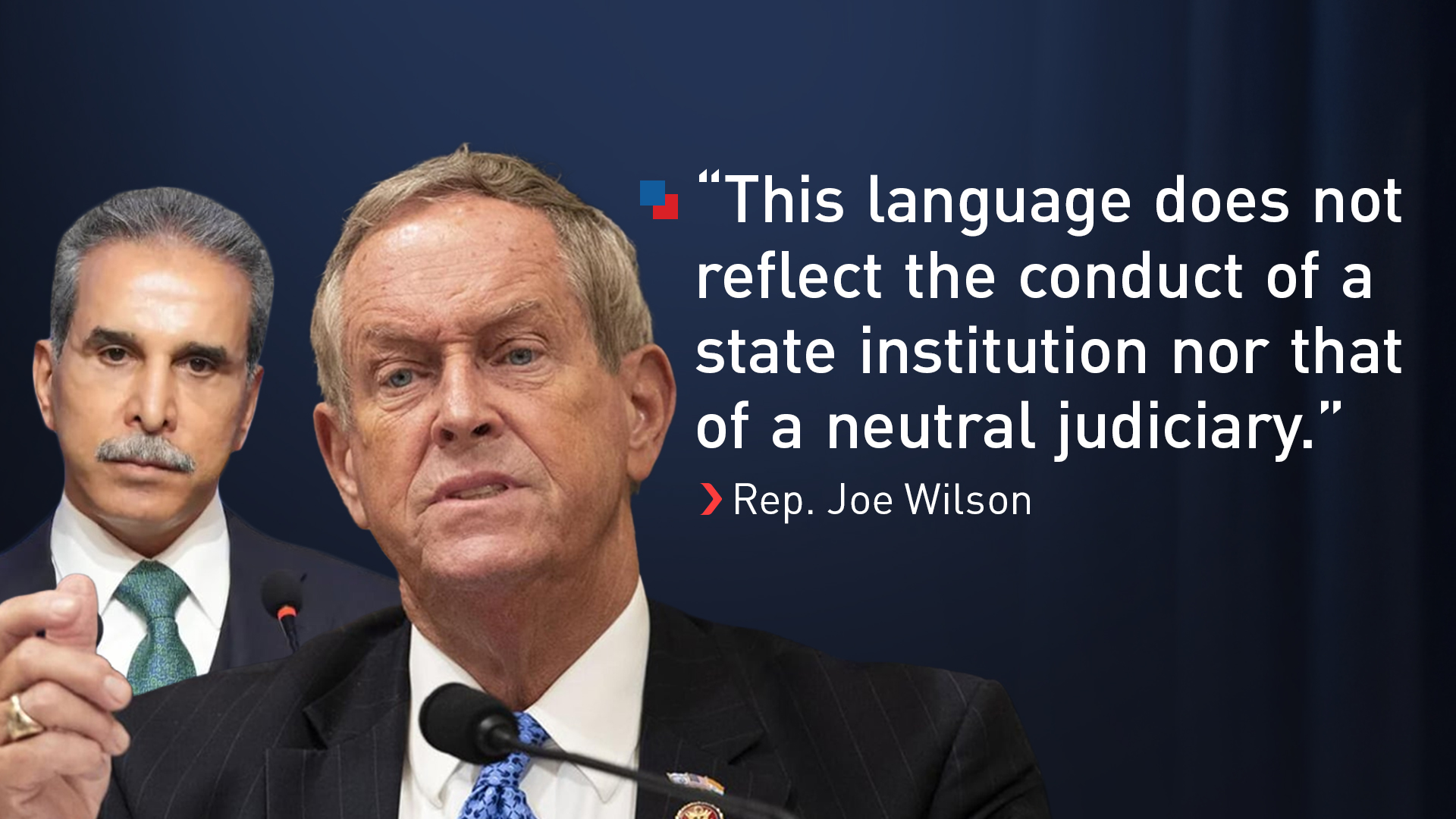
ERBIL (Kurdistan24) — U.S. Representative Joe Wilson sharply criticized Iraq’s judicial leadership on Sunday, accusing the head of the Supreme Judicial Council of undermining judicial independence by publicly engaging with armed factions over the sensitive issue of weapons control.
In a post on his official X account, Wilson said the Iraqi judiciary’s conduct reflected “a communication channel and an ongoing relationship between the judiciary leadership and militia factions,” rather than the neutrality expected of a state institution.
He described the rhetoric used by the council’s president as incompatible with constitutional norms and warned it posed a direct threat to justice and state authority.
“The corrupt president of the Iraqi Supreme Judicial Council publicly thanked armed factions for their stated intention to disarm,” Wilson wrote. “This language does not reflect the conduct of a state institution nor that of a neutral judiciary.”
He added that an independent judiciary “does not thank armed groups for following its advice nor assess their political or military actions,” arguing that such behavior signals role overlap and the use of judicial authority to transmit political messages.
Wilson’s remarks came a day after Faiq Zidan, head of Iraq’s Supreme Judicial Council, announced that leaders of armed factions had agreed to coordinate on restricting weapons to state control. In a statement on Saturday, Zidan thanked faction leaders “for heeding his advice” and for expressing readiness to enforce the rule of law, limit weapons to the state, and transition toward political activity once military action is no longer deemed necessary.
The announcement was met with mixed reactions from Iraq’s powerful armed groups. Kataeb Hezbollah, one of the most influential pro-Iran factions, said it would only consider relinquishing its weapons after the withdrawal of foreign troops from Iraq.
“The resistance is a right, and its weapons will remain in the hands of its fighters,” the group said in a separate statement.
Other Iran-aligned factions designated as terrorist organizations by Washington—including Asaib Ahl al-Haq, Harakat Ansar Allah al-Awfiya, and Kataeb Imam Ali—signaled support for restricting weapons to state control. However, none issued binding commitments to disarm, a longstanding demand of the United States and its allies.
The controversy unfolded in the aftermath of Iraq’s November general elections. Following the vote, U.S. officials urged the formation of a government that would exclude six blacklisted factions and dismantle their militias, according to Iraqi officials and diplomats.
Despite this pressure, several of these groups expanded their parliamentary presence and remain active within the Coordination Framework, the ruling Shiite alliance with close ties to Iran that currently holds a parliamentary majority.
Many of the factions involved are formally part of the Popular Mobilization Forces (PMF), a former paramilitary umbrella that was later integrated into Iraq’s security apparatus. While officially under state authority, PMF-affiliated groups have frequently acted independently, maintaining autonomous command structures and substantial arsenals.
They also form a central pillar of the Iran-backed “axis of resistance,” which calls for the withdrawal of U.S. troops and has carried out attacks against coalition forces.
Asaib Ahl al-Haq leader Qais al-Khazali, a prominent figure within the Coordination Framework, said earlier this week that his group supports the principle of limiting weapons to the state, emphasizing that it is now “part of the state.” His faction won 27 seats in the November elections, further consolidating its political influence.
Iraq’s struggle to impose a monopoly on the use of force has persisted since the aftermath of the 2003 U.S.-led Operation Iraqi Freedom (OIF), which saw the emergence of numerous militias later absorbed, at least formally, into state structures. Successive governments have sought to consolidate military authority under the defense and interior ministries, with no success.
Against this backdrop, the judiciary’s involvement in mediating with armed factions has intensified debate over institutional boundaries. While some view the coordination initiative as a rare attempt to steer militias toward state authority, critics—echoing Wilson’s warning—argue that judicial engagement with armed groups risks eroding the separation of powers and further blurring the line between state institutions and militia influence.