Kurdistan Region Reports Strengthening Trade Ties With Egypt as Leaders Convene in Cairo
KRG reports strong trade ties with Egypt, citing $15M in registered capital from 23 firms, as PM Barzani and President Sisi meet to expand cooperation.
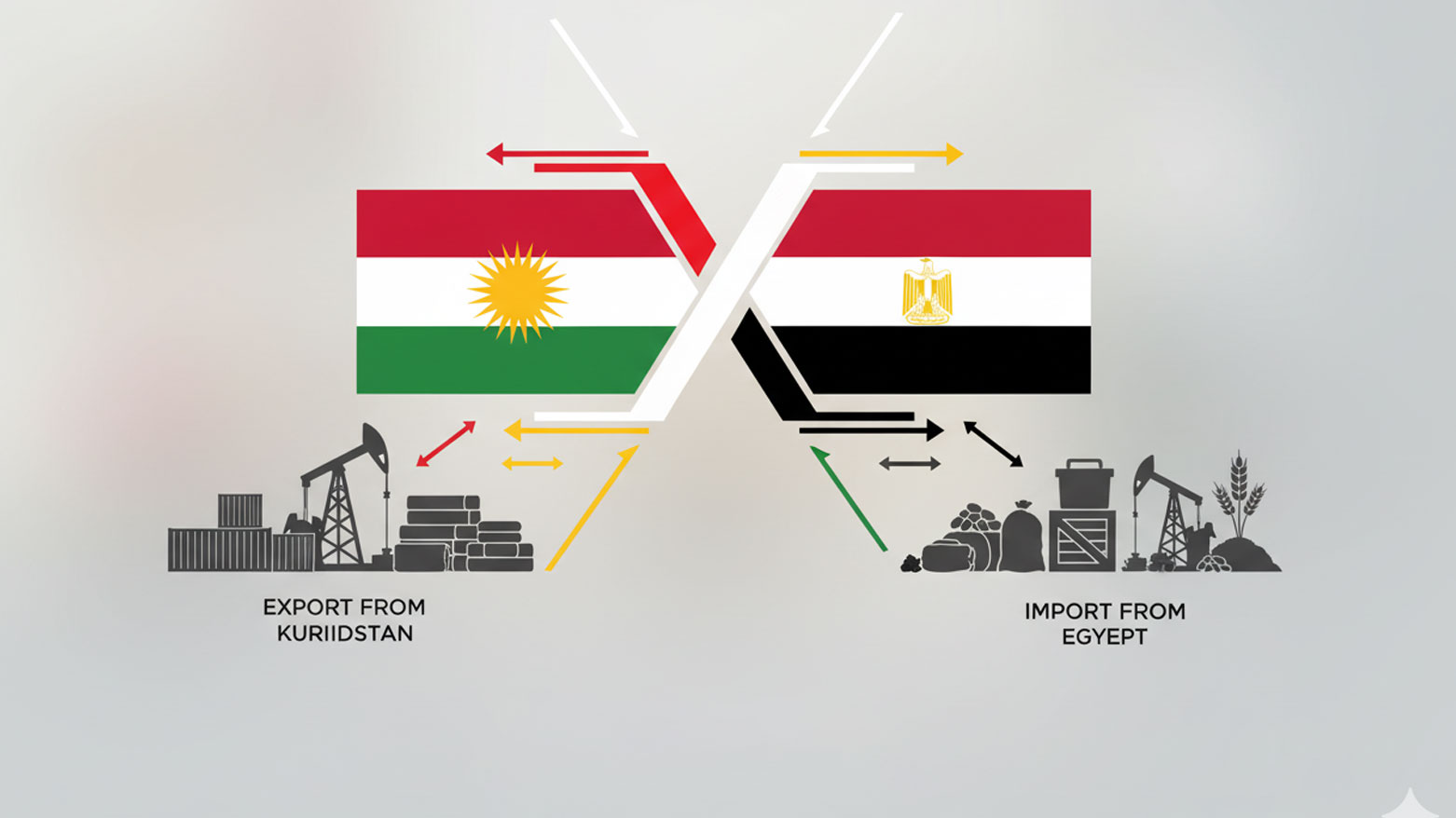
ERBIL (Kurdistan24) — The Kurdistan Region’s trade directorate announced on Sunday that commercial relations with Egypt are robust and expanding, with registered capital from Egyptian firms now exceeding $15 million, as officials in Erbil and Cairo move to deepen economic integration following high-level diplomatic talks.
Nawzad Sheikh Kamil, the General Director of Trade for the Kurdistan Region, told Kurdistan24 on Sunday that the economic landscape between the two governments is characterized by strong trade relations that both sides are actively seeking to promote.
The announcement came as Prime Minister Masrour Barzani conducted an official visit to Cairo, where he met with Egyptian leadership to discuss the trajectory of bilateral cooperation.
According to data released by the Ministry of Trade and Industry of the Kurdistan Region, the commercial footprint of Egyptian enterprise in the region has become increasingly visible over the past year.
Kamil disclosed that 23 Egyptian companies successfully imported goods from Egypt to the Kurdistan Region in 2025. The registered capital of these companies, as recorded by the Ministry of Trade, currently stands at more than $15 million.
Kamil provided a breakdown of the primary commodities driving this exchange, indicating that the flow of goods is diversified across several critical sectors.
The materials imported from Egypt largely consist of agricultural supplies, medical supplies, and electrical appliances, reflecting a broad-based demand for Egyptian industrial and agricultural output within the Kurdistan Region.
The trade official explicitly linked the positive economic outlook to the diplomatic engagement at the executive level.
Kamil noted that based on the official visit conducted by the Prime Minister of the Kurdistan Region to Egypt, both countries are looking forward to a "better future" for their relations, with a specific emphasis on the fields of trade and economy.
High-Level Talks in Cairo
The release of the trade statistics coincided with a significant diplomatic summit in the Egyptian capital. On Sunday, Prime Minister Masrour Barzani met with Egyptian President Abdel Fattah el-Sisi at the Presidential Palace in Cairo.
According to a statement issued by the Kurdistan Regional Government (KRG), the two leaders engaged in comprehensive discussions aimed at expanding bilateral relations and enhancing coordination on regional security.
President el-Sisi welcomed Prime Minister Barzani and reaffirmed Egypt’s commitment to expanding relations with the Kurdistan Region across multiple sectors. In turn, PM Barzani praised Egypt’s role as a key regional partner and highlighted President el-Sisi’s efforts in promoting peace and stability in the Middle East.
The meeting placed a particular emphasis on the very economic issues highlighted by the trade ministry in Erbil.
Both leaders underscored the potential for expanding economic cooperation, specifically in investment and trade, signaling a top-down political will to increase the volume of commerce beyond current levels.
Following the meeting, Prime Minister Barzani stated on the social media platform X, "We stressed closer ties between the Kurdistan Region and Egypt, particularly in investment and trade," adding that they had also agreed to enhance coordination to protect stability in the Kurdistan Region, Iraq, and the wider region.
A Multidimensional Partnership
The strengthening of commercial ties is underpinned by a relationship that has steadily developed over the past two decades.
According to information gathered by Kurdistan24, Cairo has consistently viewed the Kurdistan Region as a stabilizing and constructive actor within Iraq.
The KRG regards Egypt as a pivotal Arab partner with significant diplomatic weight in Middle Eastern affairs.
While the trade ministry highlighted agricultural and medical imports, the scope of Egyptian economic activity in the region is broad.
Egyptian companies have become increasingly active in the Kurdistan Region across sectors including construction, housing, infrastructure, energy services, and consumer goods.
Additionally, the region has become an important destination for Egyptian labor and investment, as Erbil seeks to leverage Egypt’s expertise in large-scale development projects and industrial production.
The partnership also extends into cultural and educational spheres. Egypt’s status as an intellectual center of the Arab world has resonated in the Kurdistan Region, facilitating academic exchanges where Kurdish students have studied in Egyptian universities.
Security and Regional Stability
Beyond economics, the talks in Cairo addressed shared security concerns.
Prime Minister Barzani and President el-Sisi discussed the persistent threats posed by extremism and political fragmentation in the Middle East.
The KRG statement noted that both sides agreed on the importance of enhancing coordination to safeguard security and stability in the Kurdistan Region and Iraq.
The Kurdistan Region’s role in the fight against the Islamic State group and Egypt’s broader counterterrorism efforts have provided common ground for this political alignment.
Cairo has repeatedly expressed support for stability in the Kurdistan Region, viewing it as essential to the security of the wider region.
Prime Minister Barzani arrived in Cairo on Saturday, where he was received by Egyptian Minister of Culture Ahmed Fouad Henu and other senior officials.
The visit and the subsequent release of positive trade data underscore the Kurdistan Region’s strategy to expand diplomatic engagement with key regional partners, deepening cooperation across political, economic, and cultural fields amid ongoing shifts in the region's internal dynamics.