U.S. Demands Zero Enrichment as Condition for Iran Talks at UN Security Council
"Step away from the fire, sir, and take President Trump’s hand of diplomacy. It’s extended to you,” said Morgan Ortagus, U.S. President Trump's Deputy Middle East Envoy.
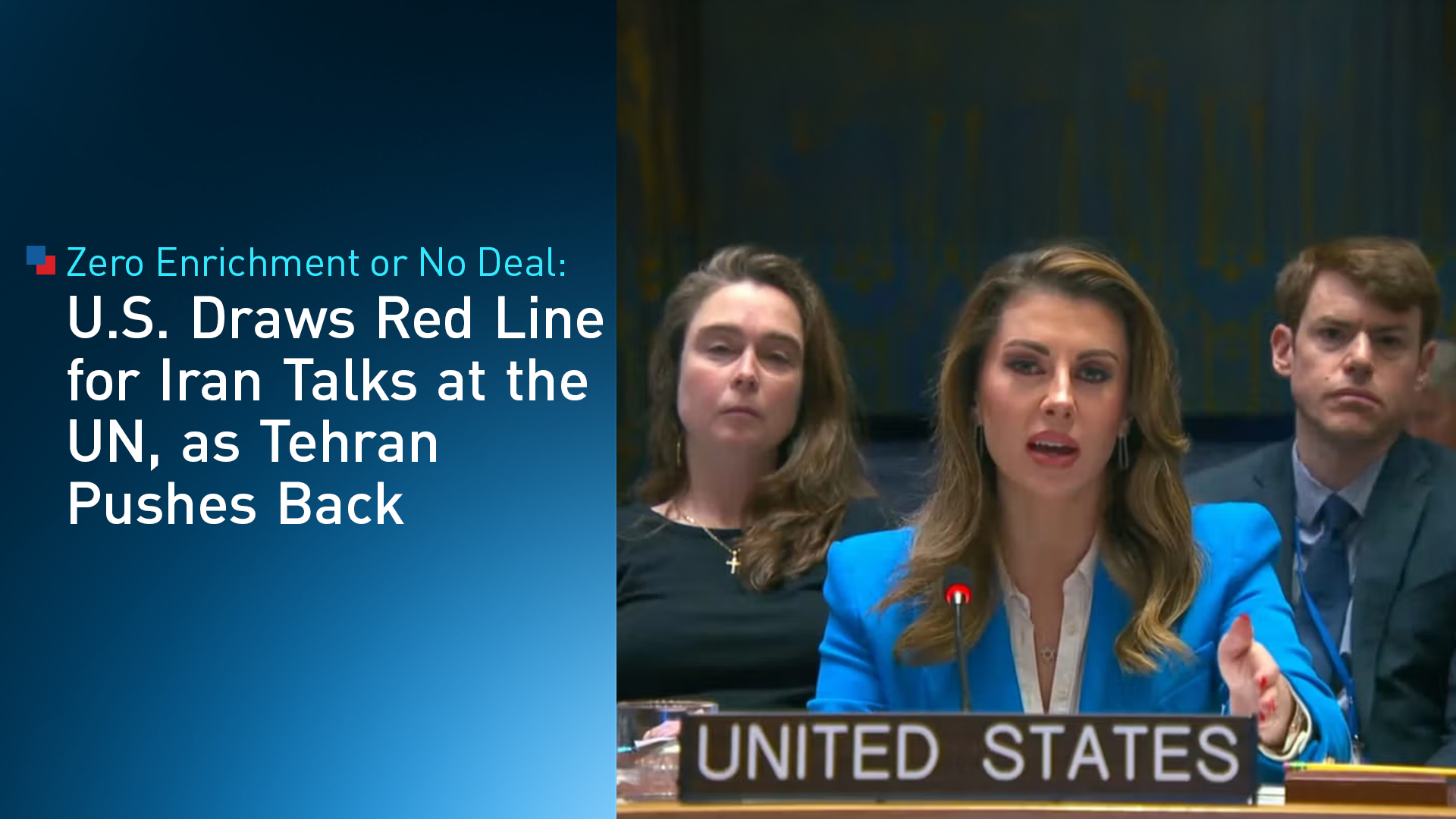
ERBIL (Kurdistan24) — The United States reiterated its hardline stance on Iran’s nuclear program at a United Nations Security Council briefing on nonproliferation on Tuesday, saying it remains open to negotiations with Tehran only if Iran agrees to direct talks and abandons uranium enrichment entirely—a position firmly rejected by Iranian officials.
Speaking at the Council, Morgan Ortagus, Counselor at the U.S. Mission to the United Nations and deputy Middle East envoy under President Donald Trump, pushed back against remarks by Iran’s representative regarding the status of UN Security Council Resolution 2231, which underpinned the 2015 nuclear deal.
Ortagus said the resolution “did not expire with the conclusion of the snapback process, nor the original termination day of October 18,” arguing that key restrictions on Iran must be reinstated and enforced following the reimposition of sanctions.
“Our focus, however, the United States of America's focus, is on the more relevant and comprehensive restrictions that need to be reinstated,” she told the Council, emphasizing Washington’s interpretation that Resolution 2231 remains legally active despite objections from Russia and China.
Addressing Tehran directly, Ortagus said the United States was willing to engage in diplomacy, but only under strict conditions. “The United States remains available for formal talks with Iran, but only if Tehran is prepared for direct and meaningful dialogue. Direct and meaningful,” she said.
She stressed that Washington would not negotiate publicly and outlined what she described as non-negotiable expectations for any future agreement.
“Foremost, there can be no enrichment inside of Iran, and that remains our principle,” Ortagus said.
Drawing on her experience working with Trump across two administrations, Ortagus said the U.S. president had repeatedly offered diplomacy to Iran.
“Instead of taking that hand of diplomacy, you continue to put your hand in the fire,” she said. “Step away from the fire, sir, and take President Trump’s hand of diplomacy. It’s extended to you.”
Iran’s U.N. Ambassador, Amir Saeid Iravani, sharply rejected the U.S. position, accusing Washington of undermining the possibility of genuine negotiations by insisting on a zero-enrichment policy.
“We appreciate any fair and meaningful negotiation, but insisting on a zero enrichment policy is contrary to our rights as a member of the NPT,” Iravani said, referring to the Treaty on the Non-Proliferation of Nuclear Weapons. “It means that they are not pursuing fair negotiation.”
Iravani accused the United States of attempting to impose predetermined outcomes on Iran and said Tehran would not yield to pressure.
“They want to dictate their predetermined intention on Iran. Iran will not bow down to any pressure and intimidation,” he told the Council.
The exchange comes against the backdrop of heightened international tensions following the UN’s reinstatement of an arms embargo and other sanctions on Iran in late September through the so-called snapback mechanism.
The process was triggered by Britain, France, and Germany, which accused Iran of violating the 2015 nuclear agreement designed to prevent it from developing a nuclear weapon.
Iran denies seeking nuclear arms and insists its nuclear activities are for peaceful purposes. Russia and China have disputed the snapback process, arguing that all provisions of Resolution 2231 expired on October 18.
Both countries objected to Tuesday’s briefing, though the meeting went ahead at the request of Britain, France, the United States, Denmark, Greece, Slovenia, and South Korea.
The Security Council, which has met twice annually to review implementation of the 2015 resolution, remains deeply divided, with diplomatic prospects clouded by conflicting legal interpretations and Washington’s insistence on zero enrichment as the price for renewed talks.