Yazidi Spiritual Leadership Convenes at Lalish Temple to Observe Sacred Winter Forty Days Fasting
Yazidi leaders, led by Baba Sheikh, began the sacred 40-day Winter Fast at Lalish Temple, a ritual symbolizing the earth's renewal and seasonal cycle.
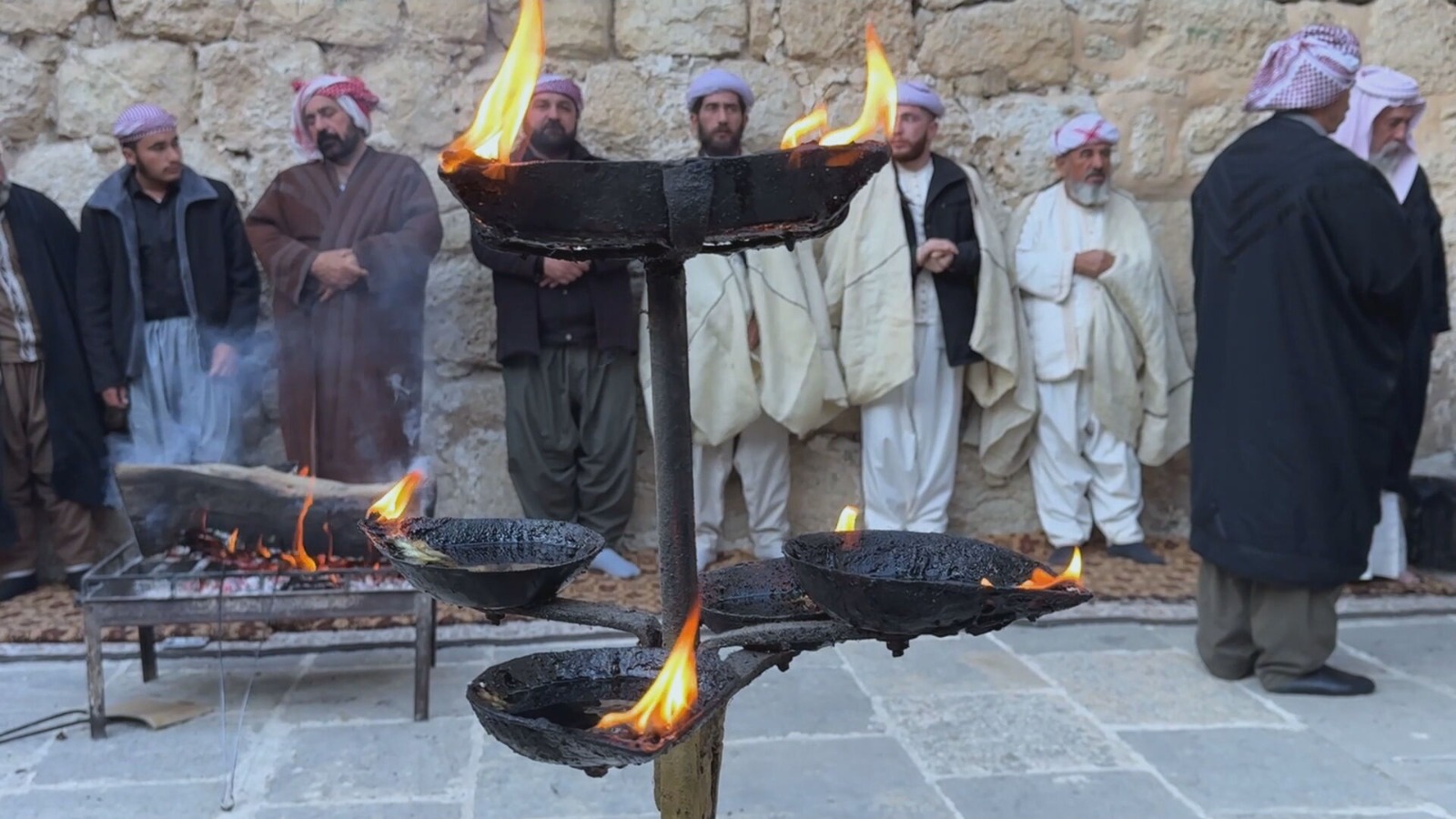
ERBIL (Kurdistan24) – In a solemn observance deeply rooted in the history and mythology of the Yazidi faith, the holy Lalish Temple has commenced the rituals of the "Winter Forty Days," a period of fasting and spiritual devotion led by the community’s supreme religious authority.
The gathering, characterized by a majestic spiritual atmosphere, has drawn the participation of Baba Sheikh, alongside high-ranking clergymen and ascetics known as Çilager (those who observe the Forty Days ritual), to the sanctuary located in the Sheikhan district.
The event marks the beginning of one of the most sacred religious obligations within the Yazidi belief system, emphasizing the connection between spiritual service and the cycles of the natural world.
The commencement of the Winter Forty Days, referred to locally as Çile, represents a critical juncture in the Yazidi religious calendar. The ritual is designated specifically for the religious elite, including the Baba Sheikh and the ascetics, who engage in a rigorous fast lasting forty continuous days.
According to the traditions observed at the temple, the fasting protocol requires the faithful to abstain completely from food and drink from sunrise until sunset. This period of abstinence is observed annually during the coldest segment of the winter season, beginning on December 21 and concluding on February 1.
Prominent among the regular participants in these rites is Prince Mahmoud Sido Beg, a notable member of the Yazidi Princely Family.
Prince Mahmoud has established a reputation for his steadfast dedication to the tradition, having committed for many years to observing the forty-day fast in both the winter and summer seasons.
His participation is viewed as a form of spiritual service and a demonstration of deep religious devotion. In comments detailing the structure of the observance, Prince Mahmoud Sido Beg provided insight into the strict protocols governing the initial days of the gathering at Lalish.
"On the first and second days of the Forty Days, attendance is mandatory for Baba Sheikh and his entourage, and the Peshimam - these are responsible for holding wedding ceremonies, and are appointed by the Mîr amongst the family of the Peshimams - and his entourage inside the temple," Prince Mahmoud explained, referring to the requisite presence of the faith's highest spiritual leaders at the onset of the fast.
He elaborated on the logistical and ceremonial progression that occurs following this initial assembly. "After that, and specifically on the second day, the families of the Feqirs - those who devote their entire lives to the service of religion and may observe all rituals, taboos and religious acts - come to provide service in Lalish, then each person returns to practice his spiritual rituals, whether by staying in the temple or at his home; the matter is left to choice."
This element of choice regarding the location of the fast—whether to remain within the sanctified grounds of Lalish or to return to one’s private residence—allows for a degree of flexibility once the mandatory opening ceremonies are concluded. However, the obligation itself remains stringent for the leadership.
The fasting of forty days in both summer and winter is considered a religious duty imposed exclusively on Baba Sheikh and the Yazidi clergymen. This exclusivity stems from the ritual's profound philosophical and spiritual connotations, which are intricately tied to the changing of the seasons and the broader cycle of life central to Yazidi theology.
Jamal Feqir, a servant of the Lalish Temple, offered further clarification on the timeline and the composition of the faithful involved in the process.
He noted that the fasting "begins with the first day of the Winter Forty Days and continues until the eve of the feast." During this culmination, the various orders of the clergy reunite. "The Feqirs, the ascetics, Baba Sheikh, and the Peshimam gather in Lalish to perform this spiritual obligation," Jamal Feqir stated, highlighting the communal aspect of the ritual's conclusion.
The timing of the Winter Forty Days is not arbitrary but is deeply intertwined with the meteorological and cosmological understanding of the world found in Yazidi mythology. Spanning from late December through the end of January, the fast occupies the period considered the coldest of the winter season.
The conclusion of the fast leads directly into the Feast of the Forty Days on February 2. According to religious beliefs, this date signals a pivot in the natural order, marking the beginning of nature's gradual transformation toward the spring season.
This transition is given significant weight in Yazidi religious texts. The passing of the forty days is interpreted as the earth’s emergence from its winter slumber, symbolizing the commencement of a new cycle of life.
It is this connection between the physical awakening of the earth and the spiritual discipline of the clergy that explains the high status Baba Sheikh and the clergymen accord to this fasting period. In both winter and summer, these forty-day spans are revered as some of the most sacred religious obligations, acting as a bridge between the divine and the natural world.
The Lalish Temple, situated in the Sheikhan district, serves as the indispensable backdrop for these rites. Recognized as the holiest religious site for Yazidis, it provides the sanctuary necessary for the ascetics and leaders to perform the Çile.
While the fasting period is fundamentally an act of physical deprivation—abstaining from sustenance during daylight hours—it is contextualized as a time of intense spiritual reflection and renewal.
The dedication of figures such as Prince Mahmoud Sido Beg, who observes the fast in both extreme seasons, underscores the endurance of these traditions.
By maintaining the "Winter Forty Days," the Yazidi leadership preserves a ritual that is etched into the collective memory of the community.
The convergence of the Baba Sheikh, the Peshimam, the Feqirs, and the Çilager at Lalish reaffirms the continuity of a faith that views the turning of the seasons not merely as climatic events, but as spiritual milestones requiring acknowledgment, service, and devotion. As the current fast progresses toward its conclusion in February, the community anticipates the symbolic awakening of the earth, guided by the prayers and discipline of its most revered spiritual guardians.
Kurdistan24 correspondent Derman Ba'adri contributed to this report.