Badr Organization Says Second Deputy Speaker Post Will Go to KDP
The Badr Organization expects the KDP to win the Second Deputy Speaker post in Tuesday's vote, while KDP officials warn of a "new decision" if agreements are violated following Monday's deadlock.
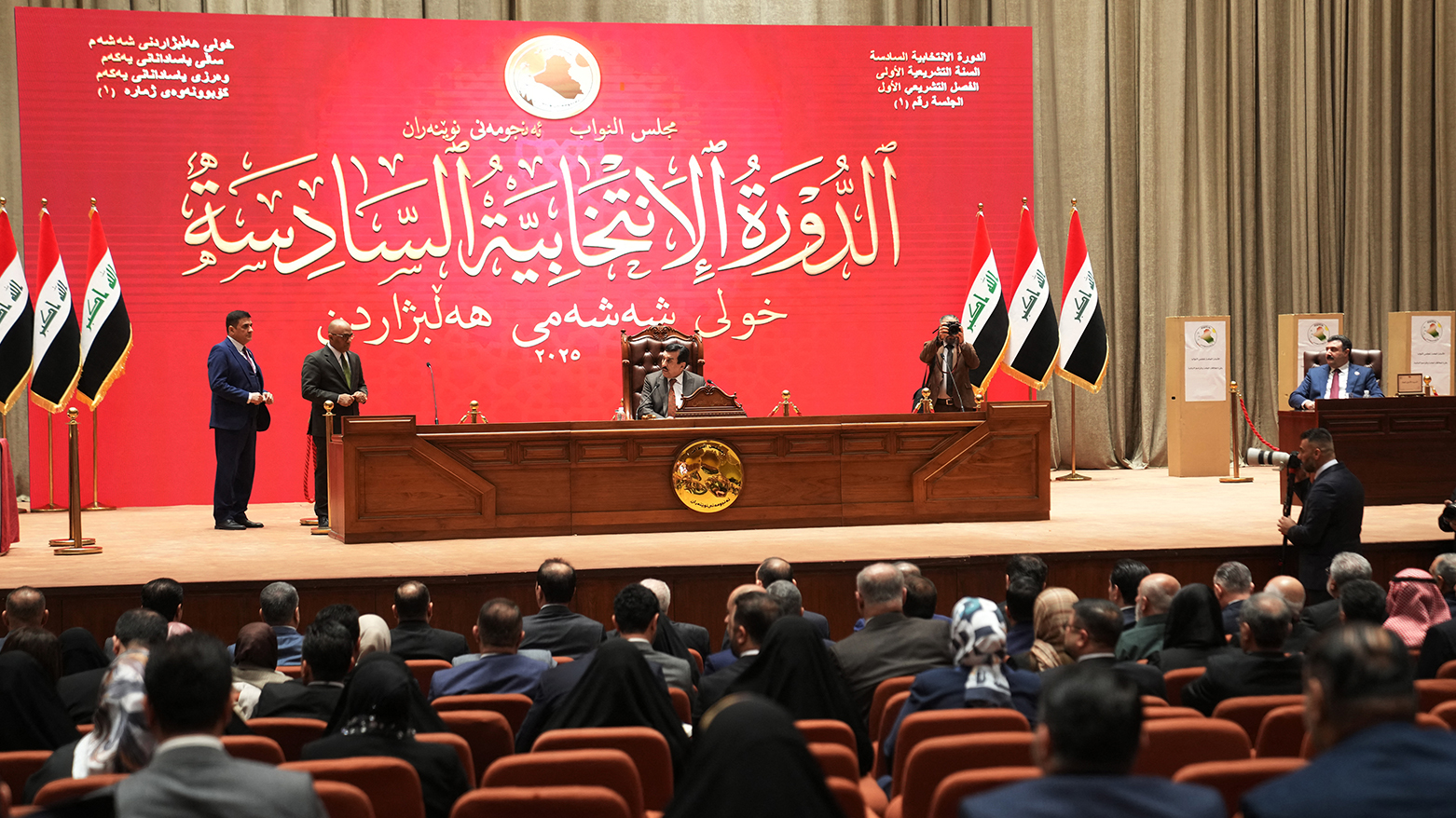
ERBIL (Kurdistan24) – A senior leader in the influential Badr Organization expressed confidence on Tuesday that the contentious election for the Second Deputy Speaker of the Iraqi Parliament will be resolved in favor of the Kurdistan Democratic Party (KDP), signaling a potential breakthrough in the political deadlock that marred the legislature's opening session. However, KDP officials concurrently warned that failure to implement prior agreements could compel the party to make a "new decision" regarding its participation in the political process.
Abu Mithaq Masari, a leader in the Shiite Badr Organization, told Kurdistan24 on Tuesday, Dec. 30, 2025, that the prolonged stalemate over the deputy speaker role is untenable.
"The meeting cannot continue in this manner; the Judicial Council and the Federal Court are monitoring the issue so that the process of forming the government proceeds quickly," Masari stated. He predicted that the third round of voting, scheduled for Tuesday afternoon, would see the post "settled in favor of the Party [KDP]."
According to Masari, the emerging consensus among the Shiite forces of the Coordination Framework aligns with the KDP's claim to the seat. "The majority of the Shiite forces of the Coordination Framework want the post of Second Deputy Speaker of Parliament to go to the party that is the majority within the components, just as the other posts were settled," he explained.
This assurance comes after a chaotic initial session on Monday, Dec. 29, 2025, which saw the successful election of Sunni lawmaker Haibet al-Halbousi as Speaker and Shiite representative Adnan Fayhan as First Deputy Speaker.
However, the vote for the Second Deputy—traditionally reserved for a Kurdish representative—ended in a stalemate after two rounds. The KDP’s candidate, Shakhawan Abdullah, faced unexpectedly strong competition from Rebwar Karim of the Halwest Front, with neither securing the necessary 166-vote majority.
KDP Warns of "New Decisions"
While the Badr Organization projected optimism, KDP officials adopted a sterner tone, reflecting frustration with what they perceive as the violation of political agreements. Ahmed Kani, a member of the KDP Central Committee, issued a special statement to Kurdistan24 on Tuesday criticizing the previous day's proceedings.
"What happened yesterday was far from the agreements that were made previously," Kani said. He emphasized that the KDP, as the leading Kurdish party in the national elections, holds a "legitimate right" to the deputy speaker position. "We had agreed with those parties that had an inclination for alliance with the Party, but a change occurred that should not have been so."
Kani reiterated the party's strategic approach, noting that KDP candidates are instructed by President Masoud Barzani to represent the entire nation. "The goal is to work with the mentality of statecraft and logic, to lead Iraq towards the better," he said. However, he warned that the party’s patience is not limitless.
"If the agreements are implemented, the Party will be committed, but if the parties do not adhere to their promises, then it is the Party's right to make a new decision and it opens another door for deciding on how to deal with the political future of Iraq," Kani declared.
This warning echoes earlier statements by senior KDP figures.
Following Monday's deadlock, Rebaz Hamlan, Assistant to the Prime Minister of the Kurdistan Regional Government, characterized the parliamentary maneuvering as a "conspiracy" involving "tame Kurdish parties" working in concert with Baghdad-based forces to weaken the Kurdistan Region.
Similarly, Bangin Rekani, a member of the KDP delegation in Baghdad, issued a stark ultimatum, stating, "If the results are not to the KDP's liking... it is possible it will withdraw from the political process."
Parliamentary Maneuvering
The deadlock stems from deep fragmentation within the Kurdish political house, mirrored by similar divisions among other blocs. In Monday's second round of voting, Rebwar Karim, supported by non-KDP factions including the Patriotic Union of Kurdistan (PUK), actually led the vote count with 156 votes compared to Shakhawan Abdullah's 102.
KDP Member of Parliament Sherwan Dubardani accused Sunni leader Mohammed al-Halbousi of actively lobbying against the KDP candidate, describing a "political and treacherous lobby." Dubardani also criticized the PUK for failing to support the KDP, terming it a "repetition of treachery."
Despite these tensions, the political machinery in Baghdad appears to be grinding toward a resolution. The Iraqi Council of Representatives is scheduled to hold an open session at 2:00 PM on Tuesday for the decisive third round of voting.
The Badr Organization’s comments suggest that the Coordination Framework—the powerful Shiite bloc—may have consolidated its position to back the KDP candidate, viewing a swift resolution as essential for the broader government formation process.
Ahmed Kani summarized the KDP's expectations for the upcoming session: "The third round of voting still remains, and we hope the process concludes according to the agreements."
The article was corrected and updated on Tuesday, Dec. 30, 2025 at 03:53pm.
Kurdistan24 correspondent Zeryan Taha Qader contributed to this report.