Trump Announces Capture of Venezuela's Maduro Following Large-Scale Military Strikes
U.S. President Donald Trump announces large-scale US strike on Venezuela, confirming capture of President Maduro and his wife; Mar-a-Lago press conference set for 11 AM EST (07:00 PM Erbil time).
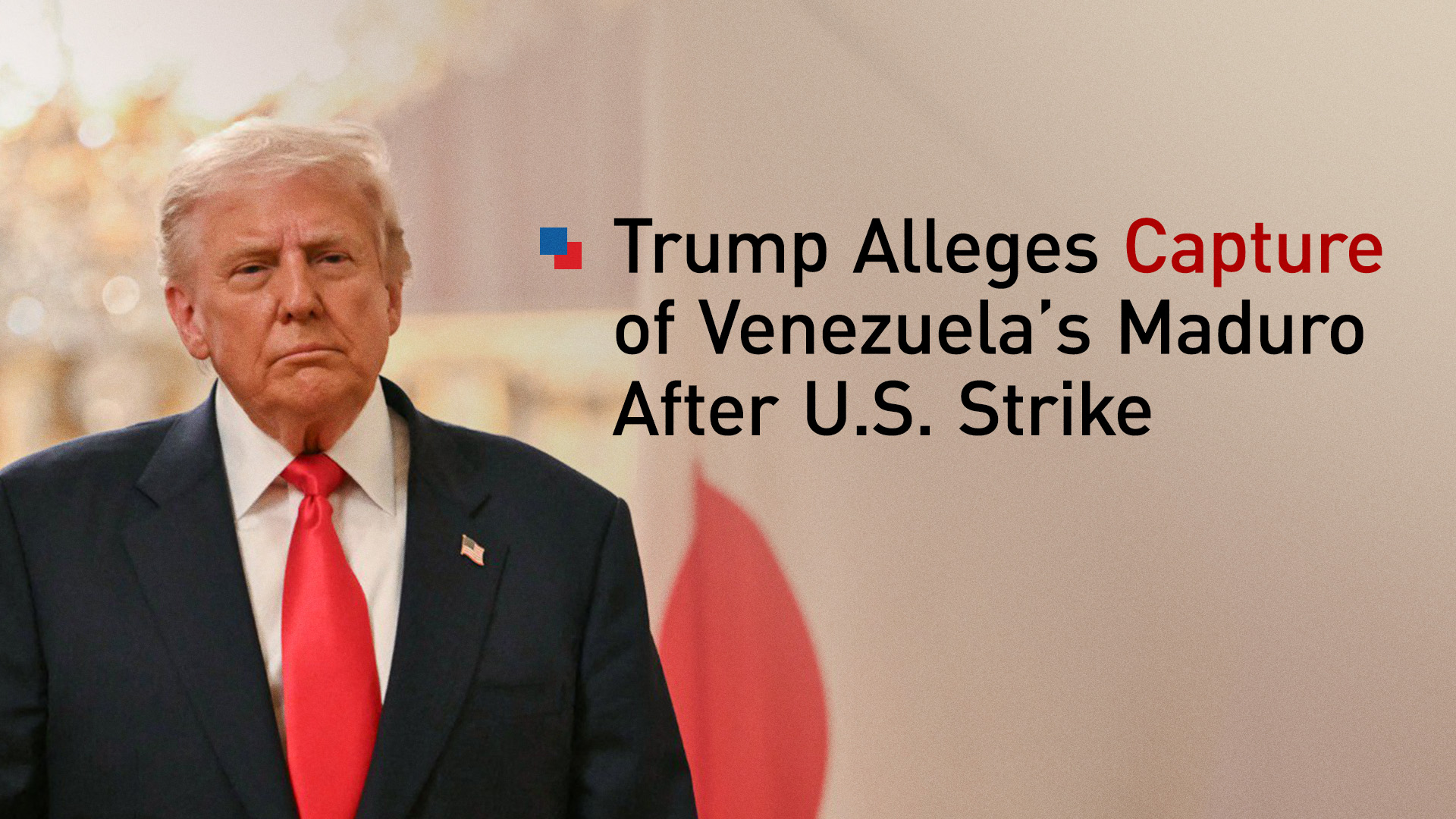
ERBIL (Kurdistan24) — President Donald J. Trump announced on Saturday that the United States had successfully executed a "large scale strike" against Venezuela, resulting in the capture and extradition of Venezuelan President Nicolás Maduro and his wife. In a statement posted to his Truth Social platform on Saturday, Trump declared that the operation was conducted in conjunction with U.S. law enforcement, marking a dramatic culmination to months of escalating military and diplomatic pressure on the Caracas government.
"The United States of America has successfully carried out a large scale strike against Venezuela and its leader, President Nicolas Maduro, who has been, along with his wife, captured and flown out of the Country," Trump wrote. He indicated that further details would be provided during a news conference scheduled for 11:00 a.m. EST at his Mar-a-Lago resort in Florida.
The announcement followed a chaotic morning of military activity in the Venezuelan capital. According to CBS News, the U.S. military launched airstrikes on multiple strategic targets inside Venezuela in the early hours of Saturday, including major military facilities.
David Smolansky, a spokesman for Venezuelan opposition leader María Corina Machado, told CBS News that the targets included Fuerte Tiuna, the main military base in Caracas; La Carlota, the city’s primary airbase; the El Volcán signal antenna; and the port of La Guaira on the Caribbean coast. Images broadcast by international media showed smoke rising from military hangars and fires burning at Fuerte Tiuna, confirming the scale of the bombardment.
The operation appears to have been approved days in advance. Two U.S. officials, speaking to CBS News on condition of anonymity, revealed that President Trump had given the green light for land strikes days prior to the actual mission.
Military planners had initially considered launching the operation on Christmas Day, but weather conditions and competing operational priorities—specifically airstrikes against ISIS targets in Nigeria—delayed the action until favorable weather presented a window for success.
The immediate aftermath of the strikes plunged Caracas into uncertainty.
The Venezuelan government, prior to the announcement of Maduro's capture, had declared a "state of external disturbance" and called on supporters to mobilize.
"The Bolivarian Government calls on all social and political forces in the country to activate mobilization plans and repudiate this imperialist attack," read a government statement cited by The Associated Press. However, with the confirmation of the president’s removal, the operational command of the Venezuelan state remains unclear.
The State Department issued an urgent warning to American citizens in Venezuela early Saturday, advising them to "shelter in place."
A notice posted on the department’s website confirmed that the U.S. Embassy in Bogota, Colombia, was monitoring reports of explosions in and around Caracas. The Federal Aviation Administration (FAA) also took immediate action, issuing a ban on all U.S. commercial flights over Venezuelan airspace due to "safety-of-flight risks associated with ongoing military activity."
International reaction to the strikes was swift and polarized. Cuban President Miguel Díaz-Canel Bermúdez denounced the operation as a "criminal attack" and an act of "State terrorism," calling for urgent condemnation from the international community.
Conversely, Colombian President Gustavo Petro, while confirming the missile attacks on social media, called for an emergency meeting of the United Nations, alerting the world to the bombardment of his neighbor.
Within the United States, the military action sparked immediate constitutional debate.
Democratic Senator Ruben Gallego of Arizona, a Marine Corps veteran, condemned the strikes on social media, stating, "This war is illegal," and characterizing it as the second "unjustified war" of his lifetime. Republican Senator Mike Lee of Utah also expressed skepticism, questioning the constitutional justification for the action in the absence of a declaration of war or congressional authorization.
The strikes and subsequent capture of Maduro represent the apex of a months-long pressure campaign by the Trump administration.
Since September, the U.S. military has maintained a significant presence in the Caribbean, amassing approximately 15,000 troops and deploying a naval armada that includes the USS Gerald R. Ford aircraft carrier group. This buildup facilitated more than 30 strikes on alleged drug smuggling vessels and the seizure of oil tankers accused of violating sanctions.
The administration has consistently justified its aggressive posture by citing the involvement of the Maduro government in narcoterrorism. In 2020, the U.S. Justice Department indicted Maduro and top officials on charges of drug trafficking, accusing them of conspiring to flood the United States with cocaine.
The reward for information leading to Maduro’s arrest was recently doubled to $50 million. Secretary of State Marco Rubio, speaking in May, reiterated the administration's view that criminal groups like Tren de Aragua serve as tools of the Venezuelan regime to project power and destabilize the region.
Venezuelan opposition figures have largely aligned themselves with Trump's aggressive strategy. María Corina Machado, a prominent opposition leader and recent Nobel Peace Prize laureate, told CBS News in mid-December that she was "absolutely" supportive of the president's approach, describing him as a "champion of freedom."
While she had not explicitly called for a ground invasion at that time, she welcomed increased pressure to force a transition of power.
The events of January 3, 2026, fundamentally alter the geopolitical landscape of the Western Hemisphere. With Maduro now in U.S. custody, the path forward for Venezuela remains fraught with uncertainty as power vacuums emerge and the international community grapples with the precedent set by the direct removal of a foreign head of state through military action.