Maduro Detained in New York After U.S. Operation; Trump Signals Role in Venezuelan Leadership
Nicolás Maduro is jailed in NYC after a US raid. Trump vowed to "run" Venezuela but the Supreme Court named VP Delcy Rodriguez acting leader. Confusion reigns as US troops may deploy amid global outcry.
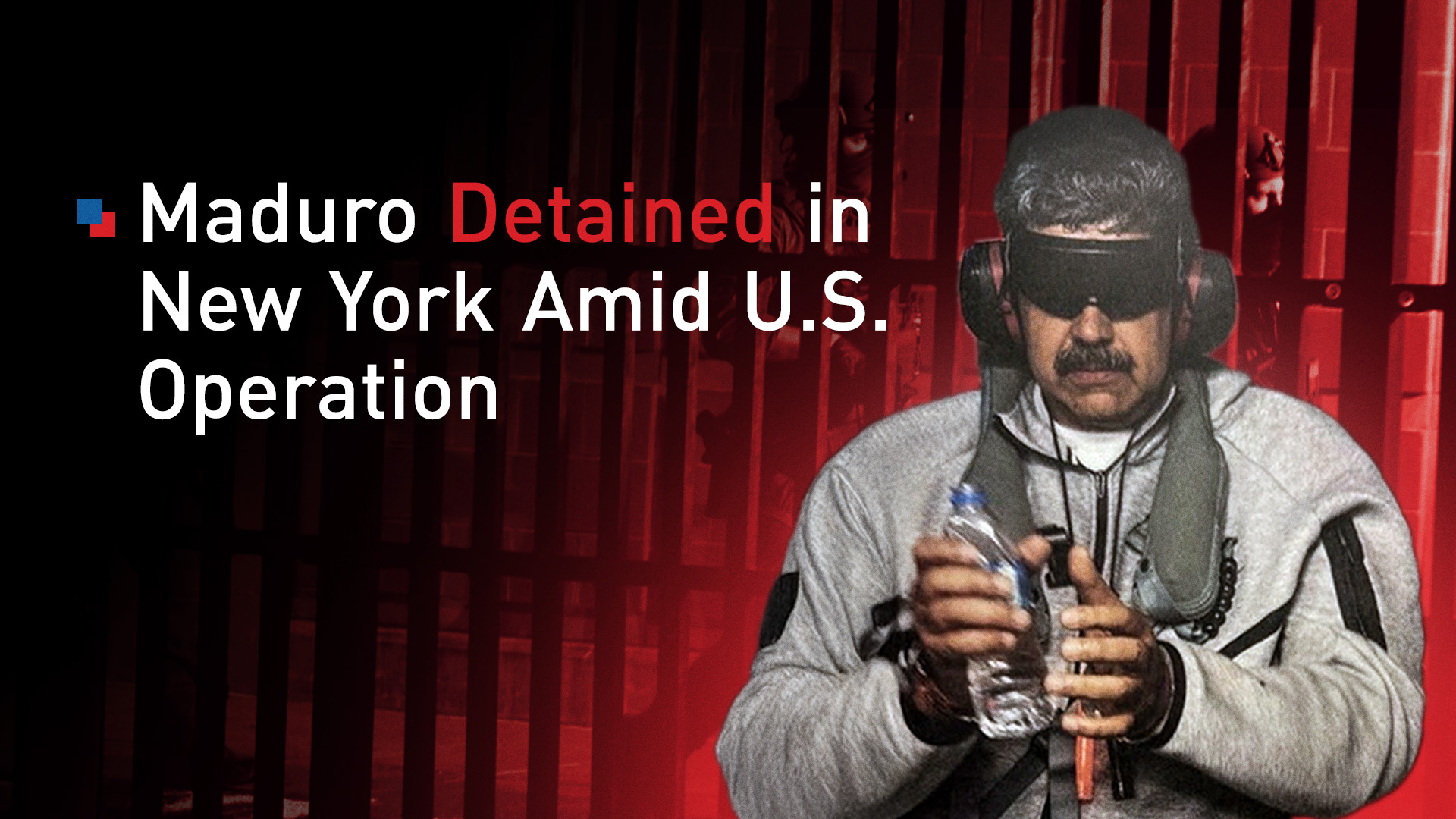
ERBIL (Kurdistan24) — The captured Venezuelan President Nicolás Maduro was incarcerated in a New York City jail on Saturday, hours after American special forces seized the authoritarian leader in a lightning pre-dawn raid that shattered the political status quo in Caracas.
As images of the handcuffed leader circulated globally, President Donald Trump declared that the United States would effectively assume control of the South American nation, asserting that Washington is prepared to "run" Venezuela until a transition can take place.
However, the path to that transition appeared immediately fractured. While Trump signaled a willingness to work with figures from the deposed administration, Venezuela’s Supreme Court moved late Saturday to order Vice President Delcy Rodríguez to assume the presidency in an "acting capacity."
The conflicting directives from Washington and the judicial authorities in Caracas have plunged the oil-rich nation into a state of profound uncertainty, leaving its 29 million citizens and the international community scrambling to interpret who is in charge.
The Operation and Arraignment
The U.S. military operation, which Trump described as a decisive move against a government Washington has long accused of narcotics trafficking and electoral theft, unfolded with overwhelming force.
According to General Dan Caine, the top U.S. military officer involved, approximately 150 aircraft participated in the mission. The strikes began around 2:00 a.m. local time, pounding military installations and airbases around Caracas, including sites in La Guaira, Maracay, and Higuerote.
Amid the bombardment, U.S. commandos executed a targeted extraction of Maduro and his wife, Cilia Flores, utilizing months of intelligence that reportedly tracked the leader’s daily habits down to his dietary preferences and pets.
General Caine reported that the couple "gave up" without a struggle and that there was "no loss of U.S. life" during the incursion. Trump, speaking to the New York Post, stated that "many" Cubans in Maduro’s security detail were killed in the firefight.
Following his capture, Maduro was flown by a U.S. government plane to a military base and subsequently transported by helicopter to New York City.
He and his wife are set to be arraigned on drug trafficking and weapons charges.
The White House released video footage on the social media platform X showing the 63-year-old captured leader, handcuffed and wearing sandals, being escorted by federal agents through a Drug Enforcement Administration facility. In the clip, Maduro is heard saying in English, "Good night, happy new year."
A Power Vacuum and Divergent Paths
The removal of Maduro has not resulted in an immediate handover to the traditional opposition, as many international observers might have anticipated. Instead, Trump outlined a strategy that involves direct U.S. oversight and a surprising potential partnership with high-ranking officials from the ousted regime.
"We’re going to stay until such time as the proper transition can take place," Trump said, adding that he was "designating people" from his cabinet to manage affairs in Venezuela. He emphasized that the U.S. is "not afraid of boots on the ground" to secure the situation.
In a move that shocked the Venezuelan opposition, Trump publicly rejected the leadership prospects of María Corina Machado, the U.S.-backed opposition leader who won last year’s Nobel Peace Prize.
Machado had taken to social media to declare that "the hour of freedom has arrived" and urged her coalition’s 2024 candidate, Edmundo González Urrutia, to "immediately" assume the presidency. Trump, however, dismissed Machado, stating she lacks "support or respect" within the country.
Conversely, the U.S. President expressed openness to working with Delcy Rodríguez, Maduro’s vice president.
"She’s essentially willing to do what we think is necessary to make Venezuela great again," Trump told reporters, claiming that Rodríguez had held a conversation with U.S. Secretary of State Marco Rubio in which she allegedly said, "We’ll do whatever you need."
The Regime’s Defiance
Despite Trump’s characterization of Rodríguez as a cooperative partner, her public actions in Caracas suggested a different stance. In a televised address surrounded by top civilian and military officials, Rodríguez denounced the U.S. operation as a "flagrant violation" of international law and demanded the release of Maduro.
"There is only one president in this country, and his name is Nicolás Maduro," she declared.
Late Saturday, Venezuela’s Supreme Court formalized her position, ordering her to "assume and exercise, in an acting capacity, all the attributes, duties and powers inherent to the office of President."
The court’s ruling was carefully calibrated: by stopping short of declaring Maduro permanently absent, the judges avoided triggering a constitutional requirement to hold new elections within 30 days.
Rodríguez, a lawyer educated in London and Paris, has historically maintained strong ties to the "Bolivarian revolution" initiated by the late Hugo Chávez.
However, reports indicate she also possesses connections to Wall Street and Republicans in the U.S. oil industry, having previously engaged with figures such as Blackwater founder Erik Prince during attempts to negotiate with Washington.
Key elements of the regime’s security apparatus also remain in place.
Defense Minister General Vladimir Padrino López appeared in military fatigues to deliver a defiant message, asserting, "They have attacked us but will not break us."
Interior Minister Diosdado Cabello, a hard-line enforcer wanted in the U.S. on drug trafficking charges, urged Venezuelans to "get out on the streets" to defend their sovereignty, calling the attackers "rats" who would regret their actions.
Strategic Interests and Oil
A central theme in Trump’s justification for the operation was Venezuela’s vast natural resources.
"We’re going to have our very large United States oil companies... go in, spend billions of dollars, fix the badly broken infrastructure," Trump said. "We'll be selling large amounts of oil."
This explicit focus on resource control has drawn historical comparisons to the 2003 U.S. invasion of Iraq.
Analysts and former diplomats expressed concern that the removal of a dictator without a comprehensive stabilization plan could lead to chaos.
Brian Naranjo, a former deputy chief of mission at the U.S. Embassy in Caracas, noted the danger of assuming a smooth transition. "This has been my fear from Day 1, that Trump thought this was going to be easy, that once Maduro goes there will be pixie dust, rainbows and everyone is happy," Naranjo said.
Fear and Silence in Caracas
On the ground in the Venezuelan capital, the atmosphere was one of shock and apprehension rather than widespread jubilation. Residents awoke to the sound of explosions and the vibration of shockwaves rattling windows.
Witness accounts described columns of smoke rising from military sites and a lingering smell of explosives hanging over the city.
While small groups of Maduro supporters gathered to chant "Long live Nicolás Maduro" and burn American flags, the streets were largely empty. Many stores remained closed, and black-clad security agents patrolled the city center.
"I felt the explosions lift me out of bed," said Maria Eugenia Escobar, 58. "In that instant I thought: 'My God, the day has come,' and I cried."
For many Venezuelans who had opposed Maduro’s rule, the news brought a complex mix of emotions.
José, an entrepreneur currently in Mexico City, expressed dread regarding the potential for further instability. "The first thing on my mind isn’t, ‘We are free and I’m so happy,’" he said. "It is, ‘What will happen tomorrow?’ Maduro is just one part of a much bigger machine."
Others, like Katia Briceño, a university professor, condemned the intervention.
"How is it that a foreign government comes into the country and removes the president? It’s absurd!" she said.
Conversely, a teacher in Maracaibo whose brother was killed by pro-government forces said she initially wept with joy at the news of Maduro’s ouster, only to despair upon learning that Rodríguez would remain in power.
Regional and International Fallout
The international community reacted swiftly to the unprecedented operation.
China’s Foreign Affairs Ministry issued a statement regarding the operation, saying it "strongly condemns" the move and demanding Maduro's release. "The U.S.'s move is in clear violation of international law, basic norms in international relations, and the purposes and principles of the UN Charter," the statement read.
France warned that a solution cannot be "imposed from outside," while United Nations Secretary-General Antonio Guterres expressed deep concern that "the rules of international law have not been respected."
The U.N. Security Council is scheduled to meet Monday to discuss the crisis, according to the Somali presidency of the Council.
Regionally, the shockwaves were felt immediately in neighboring Colombia.
Leftist President Gustavo Petro, who has clashed with Trump over military build-ups, ordered security forces to reinforce the border. Tanks and armed soldiers usually tasked with fighting guerrillas were deployed to crossings.
While the Simon Bolivar bridge saw lower-than-average foot traffic, the Colombian government warned of a potential humanitarian crisis should migration surge due to instability.
Uncertain Future
As Maduro awaits arraignment in New York, the governance of Venezuela remains in a precarious limbo. The U.S. administration insists it will "run" the country, yet the regime’s hierarchy, led by Rodríguez and backed by the military high command, maintains its grip on the instruments of state power.
With Trump mooting the possibility of a "much bigger" second wave of strikes and promising to stay for the long haul, the specter of a prolonged conflict looms.
As one Caracas resident, Yanire Lucas, observed while cleaning up glass from her home near a targeted military base: "We’re still on edge, and now we’re unsure what to do."