Netherlands Forms Centrist-Right Coalition Under Rob Jetten Following Snap Election
Rob Jetten was sworn in as the Netherlands’ youngest and first openly gay Prime Minister, leading a three-party coalition after a snap election ended the previous far-right government, AFP reported.
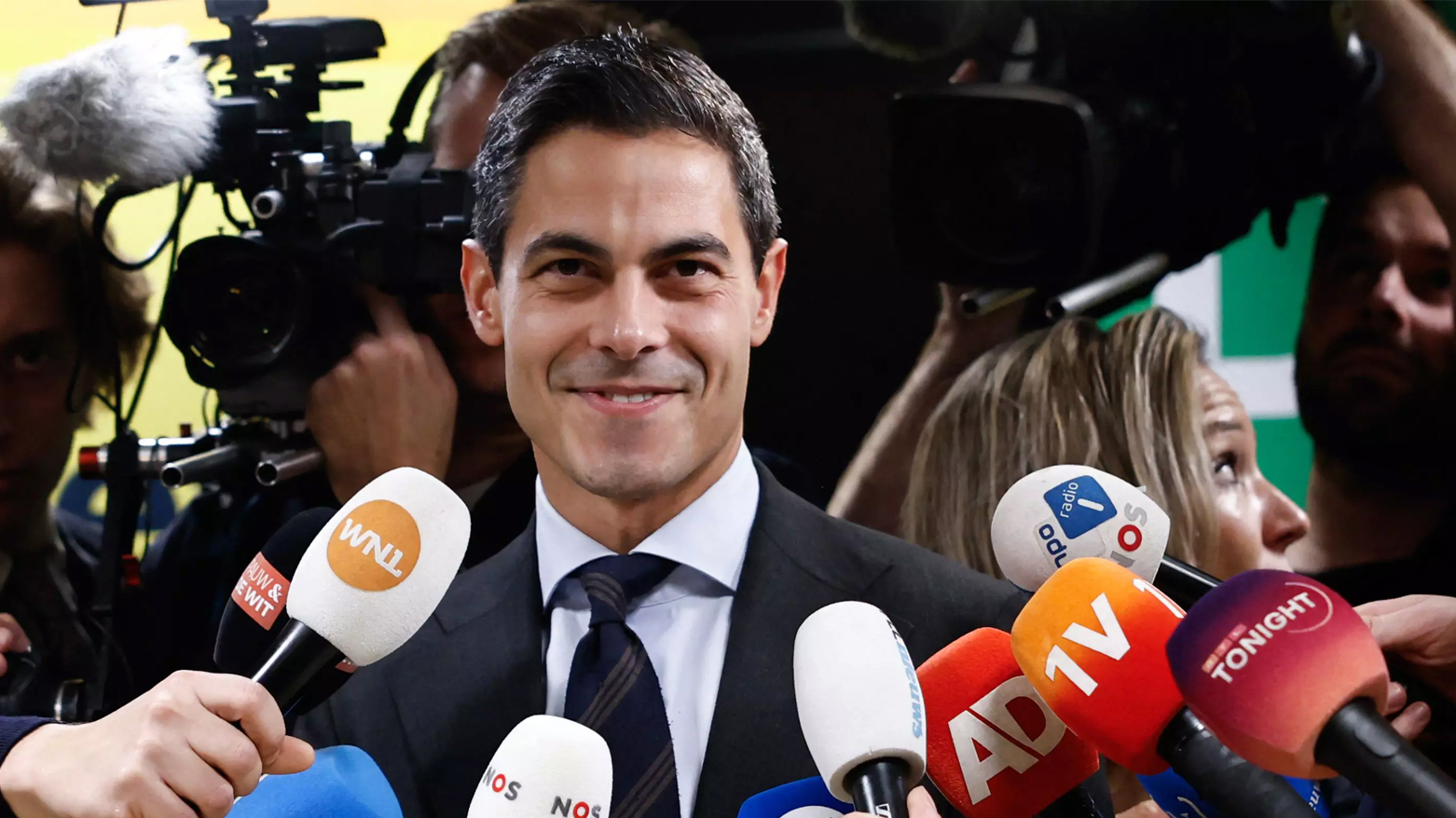
ERBIL (Kurdistan24) - A new Dutch government was sworn in on Monday, February 23, 2026, with 38-year-old Rob Jetten taking office as the youngest-ever Prime Minister of the Netherlands and the first openly gay person to hold the position, AFP reported. The centrist leader’s assumption of power follows a snap election held last October, which ended the tenure of the far-right Freedom Party (PVV) led by Geert Wilders.
The snap election was triggered after the PVV withdrew from the previous coalition government, which had been the most right-wing administration in the Netherlands in recent history and lasted only 11 months. Jetten, representing the Democrats 66 (D66), secured a narrow victory, overcoming Wilders in a close contest and positioning his party to form a new coalition government.
Jetten’s D66 has joined with the centre-right Christian Democratic Appeal (CDA) and the liberal People's Party for Freedom and Democracy (VVD) to form a coalition government. Collectively, the three parties hold 66 seats, falling nine short of a parliamentary majority. According to AFP, the coalition formation process lasted 117 days, significantly shorter than the 223 days taken to establish the previous government.
In a statement after his election, Jetten emphasized a campaign strategy focused on positive messaging for the country. “It is possible to beat populist movements if you campaign with a positive message for your country,” he said. On the campaign trail, he also stressed the importance of European cooperation, noting that he wanted to “bring the Netherlands back to the heart of Europe because without European cooperation, we are nowhere,” AFP reported.
The coalition’s policy platform, as outlined in a manifesto published in January, commits the government to full support for Ukraine and adherence to NATO spending obligations. While the administration is not positioned as far to the right as the previous PVV-led government, experts have noted that it maintains a “right-wing signature.” Sarah de Lange, professor of politics at Leiden University, told AFP that the coalition intends to prioritize budget cuts over running deficits to fund investment initiatives and that there is substantial continuity with the previous government’s immigration policies.
According to AFP, the coalition plans to implement measures aimed at stricter migration controls, including tighter rules on family reunification. In addition, social benefits, such as unemployment payments, may be reduced to help finance proposed investments in the military and national defense. De Lange noted, however, that because the coalition lacks a full parliamentary majority, securing passage of larger reforms may take longer than usual.
King Willem-Alexander formally administered the oath of office to Jetten and his cabinet on Monday at the Huis Ten Bosch in The Hague. AFP reported that Jetten had initially advocated for a broader coalition including the left-leaning GroenLinks and Labour Party (PvdA), but the proposal was opposed by VVD leader Dilan Yesilgoz, leaving the three-party centrist-right coalition intact.
The PVV, which had significantly altered Europe’s political landscape with a shock election win in November 2023, suffered losses in last year’s vote. Its parliamentary representation declined from 37 to 26 seats, and although the party finished in second place, coalition partners excluded it from government participation. Other far-right parties also made electoral gains, including the Forum for Democracy, led by 28-year-old Lidewij de Vos, which gained four seats, and JA21, which expanded its presence by eight seats. According to AFP, JA21 narrowly missed entering the cabinet due to coalition decisions led by Jetten.
The new government’s composition reflects a blend of centrist and centre-right policy orientations, with D66 providing the central leadership role while CDA and VVD bring conservative and liberal perspectives, respectively. AFP noted that the coalition aims to balance fiscal discipline with commitments to defense spending, European cooperation, and migration regulation.
Jetten’s premiership represents a generational and symbolic shift in Dutch politics. At 38, he is the youngest head of government in the country’s history, and his appointment as the first openly gay Prime Minister is widely regarded as a milestone in Dutch political representation. AFP reported that the administration faces immediate challenges in navigating a parliament where it does not hold a full majority, requiring negotiation with opposition parties to advance legislation.
Observers have highlighted the contrast between the brevity of coalition negotiations for the new government and the prolonged discussions that marked the formation of its predecessor. The 117-day coalition-building process for Jetten’s cabinet was markedly shorter than the previous 223-day negotiation, reflecting both the urgency of government formation following the snap election and the relative alignment of policy priorities among D66, CDA, and VVD.
Policy priorities, according to the AFP report, include advancing military and defense investment while maintaining fiscal prudence, continuing support for Ukraine amid ongoing European security concerns, and managing migration in accordance with existing legal frameworks. The coalition’s reliance on opposition support for legislative approval suggests a need for careful parliamentary negotiation to implement its agenda.