Iraq Says Kuwait Registered Border Maps With UN Without Consulting Baghdad
Iraq’s foreign minister said Kuwait registered border maps with the UN in 2014 without consulting Baghdad, urging legal dialogue to resolve the maritime dispute.
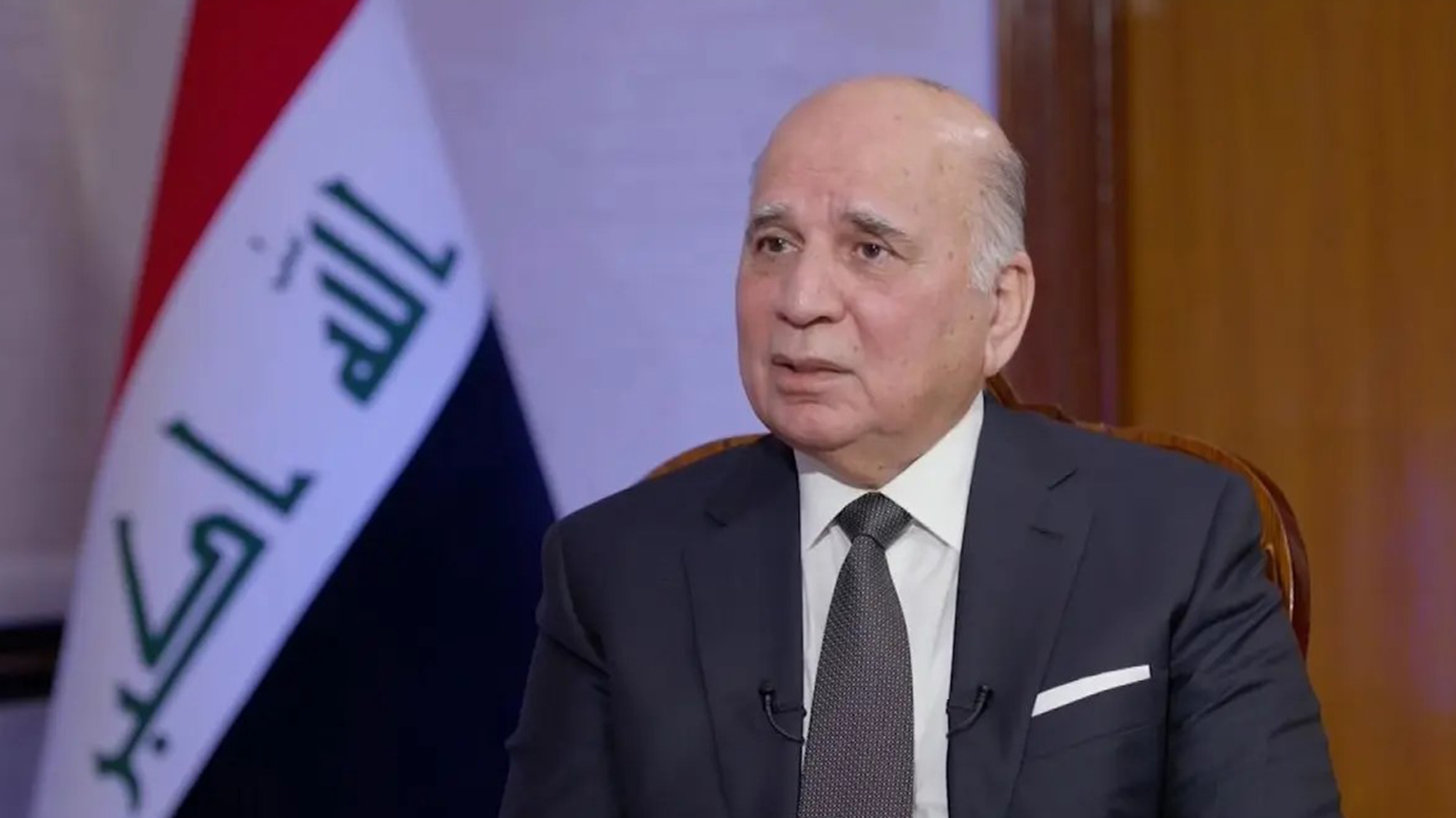
ERBIL (Kurdistan24) - Iraqi Foreign Minister Fuad Hussein said on Monday that Kuwait registered its maritime border maps and baselines with the United Nations in 2014 without consulting Iraq, describing the move as the root of the current border dispute between the two countries and calling for the issue to be resolved through legal dialogue and international standards.
According to official statements released on February 23, 2026, Hussein made the remarks during a telephone conversation with Omani Foreign Minister Badr Albusaidi. The Iraqi foreign minister stated that Kuwait deposited its maritime maps and baselines with the United Nations in 2014 without referring to Baghdad, while Iraq only recently submitted its own maritime maps to the international body.
Hussein said the current disagreement stems from that earlier Kuwaiti registration, emphasizing that Iraq’s recent submission of maritime information was intended to clarify the maps of its maritime zones. He stressed the necessity of resolving the file through legal dialogue based on international standards, in a manner that secures Iraq’s rights while simultaneously respecting international resolutions and bilateral agreements.
The statements come after Baghdad recently presented new maritime coordinates and related information to the United Nations. According to Iraqi officials, the submission aimed to clarify Iraq’s maritime zones. Kuwait subsequently lodged an official protest, asserting that the Iraqi maps interfere with its maritime sovereignty, particularly in areas identified as “Fasht al-Qaid” and “Fasht al-Aij.”
Kuwait’s Foreign Ministry announced that it summoned Iraq’s chargé d’affaires in Kuwait, Dr. Zaid Abbas Shanshul, to deliver an official protest memorandum regarding the maritime coordinates and map filed by Baghdad. Acting Deputy Foreign Minister Ambassador Aziz Rahim Al-Deihani conveyed Kuwait’s rejection of what it described as encroachments on its sovereign maritime territories and affiliated water elevations.
In its statement, Kuwait said Iraq had submitted a list of geographical coordinates and a map to the United Nations outlining what Baghdad described as Iraqi maritime domains. According to the Kuwaiti account, the submission contains claims that infringe upon Kuwait’s sovereignty over established maritime areas and fixed water elevations, including Fasht al-Qaid and Fasht al-Aij. Kuwait stated that these areas “have never been the subject of any dispute regarding the full sovereignty of the State of Kuwait,” and characterized Iraq’s move as a violation of settled understandings between the two neighboring countries.
Hussein, in his remarks, reaffirmed Baghdad’s commitment to resolving the matter through dialogue, respect for state sovereignty, and non-interference in internal affairs. He emphasized that Iraq seeks a legal solution grounded in international norms and in line with relevant United Nations resolutions and bilateral agreements.
The dispute has also drawn a response from Saudi Arabia. In a statement reported by Asharq Al-Awsat, the Saudi Ministry of Foreign Affairs said it was monitoring “with great interest and deep concern” the maritime coordinates and map submitted by Iraq to the United Nations. According to the report, Saudi Arabia expressed categorical rejection of any claims by other parties to rights in the divided submerged area it shares with Kuwait.
The Saudi statement said the Iraqi submission included large parts of the divided submerged area adjacent to the Saudi-Kuwaiti Divided Zone, where Saudi Arabia and Kuwait share ownership of natural resources under concluded and effective agreements between them. The ministry said those agreements are based on the provisions of the 1982 United Nations Convention on the Law of the Sea.
According to Asharq Al-Awsat, the Saudi Foreign Ministry stated that the submitted coordinates “violate the sovereignty of the brotherly State of Kuwait over its maritime areas and water elevations such as ‘Fasht al-Qaid’ and ‘Fasht al-Aij.’” The Kingdom reiterated its categorical rejection of any claims regarding the existence of rights for any other party in the divided submerged area within its defined borders between Saudi Arabia and Kuwait.
The Saudi statement further emphasized the importance of Iraq’s commitment to respecting Kuwait’s sovereignty and territorial integrity, as well as bilateral and international pledges and agreements. It specifically referenced United Nations Security Council Resolution 833 (1993), by which the land and maritime borders between Kuwait and Iraq were demarcated.
Saudi Arabia also called for prioritizing “the language of reason, wisdom, and dialogue” to resolve disputes and urged serious and responsible engagement in accordance with international law and principles of good neighborliness, according to the report.
The maritime disagreement revives longstanding sensitivities between Iraq and Kuwait regarding territorial and maritime boundaries. In 1993, the United Nations established the United Nations Iraq-Kuwait Boundary Demarcation Commission, which formally delineated the international land and maritime boundary between the two countries. The demarcation was endorsed by Security Council Resolution 833 (1993).
Kuwait accepted the demarcation, while successive Iraqi governments have periodically expressed reservations over aspects of the maritime boundary, particularly concerning access to the Gulf and navigation channels near the Khor Abdullah waterway.
In 2012, Iraq and Kuwait signed the Khor Abdullah agreement to regulate maritime navigation and cooperation in the shared waterway. The agreement was ratified by both parliaments. However, it has remained controversial within Iraq. In 2023, Iraq’s Federal Supreme Court invalidated the parliamentary ratification of the Khor Abdullah agreement, prompting renewed political debate and diplomatic sensitivity.
Despite periodic tensions, both governments have emphasized dialogue and cooperation in managing bilateral relations. Kuwait’s Foreign Ministry, in its recent statement, called on Iraq to take into account the historical trajectory of relations between the two countries and to engage responsibly in accordance with international law, particularly the 1982 United Nations Convention on the Law of the Sea. It also urged adherence to existing bilateral agreements and memoranda of understanding signed between the two states.
For his part, Hussein reiterated that Iraq’s objective is to secure its rights within a framework that respects international decisions and bilateral commitments. He underlined that resolving the dispute requires legal mechanisms and constructive dialogue, rather than unilateral measures.
The exchange of diplomatic communications follows Iraq’s recent filing with the United Nations and Kuwait’s formal protest, as well as Saudi Arabia’s expression of support for Kuwait’s position. Officials on all sides have called for adherence to international law and for disputes to be addressed through established legal and diplomatic channels.