White House Says Force ‘An Option’ as Trump Revives Bid for Greenland
“The president and his team are discussing a range of options to pursue this important foreign policy goal, and of course, utilizing the U.S. military is always an option at the commander in chief’s disposal,” Leavitt said in a statement.
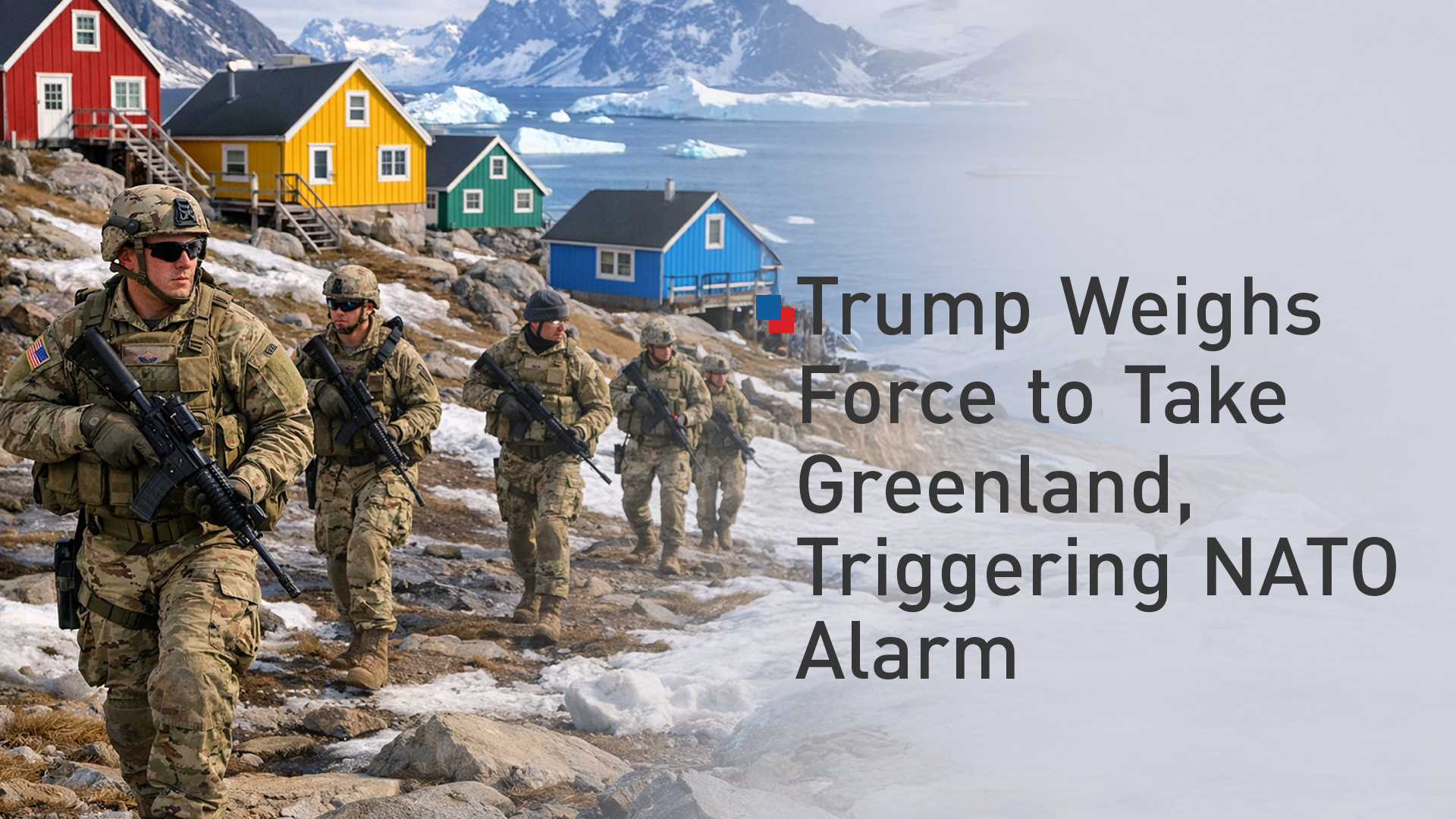
ERBIL (Kurdistan24) — U.S. President Donald Trump is weighing a range of options—including potential military action—to take control of Greenland, the White House confirmed on Tuesday, a move that has sharply escalated tensions with Denmark and raised fears of a historic rupture within NATO.
White House Press Secretary Karoline Leavitt said the Trump administration views the acquisition of the mineral-rich, self-governing Danish territory in the Arctic as a “national security priority,” citing concerns about growing Russian and Chinese influence in the region.
“The president and his team are discussing a range of options to pursue this important foreign policy goal, and of course, utilizing the U.S. military is always an option at the commander in chief’s disposal,” Leavitt said in a statement.
Trump has intensified his interest in Greenland in recent days, following a U.S. military operation last weekend that resulted in the capture of Venezuelan leader Nicolas Maduro. The renewed focus has revived a long-standing proposal first floated during Trump’s initial term in office.
According to The Wall Street Journal, Secretary of State Marco Rubio told U.S. lawmakers that Trump’s preferred course remains a negotiated purchase of Greenland from Denmark, stressing that the administration’s rhetoric does not signal an imminent invasion.
Denmark, however, has responded forcefully. Officials in Copenhagen warned that any attempt to seize Greenland by force would cause “everything to stop,” including NATO cooperation and nearly eight decades of close transatlantic security ties.
Any U.S. military action against Greenland would effectively collapse the alliance, as NATO’s Article Five obliges member states to defend one another against armed attack.
Greenland’s Foreign Minister Vivian Motzfeldt said on social media that her government had repeatedly sought a meeting with Rubio throughout 2025, but “it has so far not been possible.” Danish Foreign Minister Lars Løkke Rasmussen said such a meeting could help “clear up certain misunderstandings.”
Greenland’s Prime Minister Jens-Frederik Nielsen reiterated that the island is not for sale, insisting that only Greenland’s 57,000 residents have the right to determine its future.
European allies have rallied behind Denmark and Greenland while attempting to avoid a direct confrontation with Washington. Leaders from Britain, France, Germany, Italy, Poland, and Spain joined Denmark in a joint statement affirming the “universal principles” of sovereignty, territorial integrity, and the inviolability of borders.
French President Emmanuel Macron and British Prime Minister Keir Starmer sought to downplay the dispute while attending Ukraine peace talks in Paris alongside Trump’s envoy Steve Witkoff and his son-in-law Jared Kushner.
“I cannot imagine a scenario in which the United States of America would be placed in a position to violate Danish sovereignty,” Macron said.
The United States already maintains a limited military presence in Greenland, with around 150 personnel stationed at the Pituffik Space Base, a key strategic installation in the Arctic.
In Greenland, residents and business leaders have rejected Trump’s renewed threats. “This is not something we appreciate,” Christian Keldsen, director of the Greenland Business Association, told AFP in the capital Nuuk. “It is not acceptable in the civilized world.”
Denmark has increased its own security investment in the Arctic, allocating roughly 90 billion kroner ($14 billion) over the past year to bolster defense capabilities.
U.S. Vice President JD Vance defended the administration’s stance in a video posted on X, arguing that Denmark has failed to adequately invest in both Greenland’s people and its security infrastructure.
“Our message to Denmark is very simple,” Vance said. “You have not done a good job by the people of Greenland. You have underinvested in the people of Greenland, and you have underinvested in the security architecture of this incredible, beautiful landmass.”
While acknowledging Denmark’s sacrifices alongside the United States in the war on terror, Vance said past cooperation does not preclude present disagreements over future security arrangements.
As diplomatic tensions mount, the prospect of U.S. action toward Greenland has emerged as one of the most consequential challenges to the post–World War II transatlantic order, with allies warning that even the threat of force could have irreversible consequences for NATO unity.