SDF Commander: If our Deal with Damascus Collapses, we will Fight Until the End
SDF Commander Mazloum Abdi says Kurds will fight “until the very end” if their agreement with Damascus collapses, while warning that ISIS remains a threat and a U.S. withdrawal could destabilize Syria.
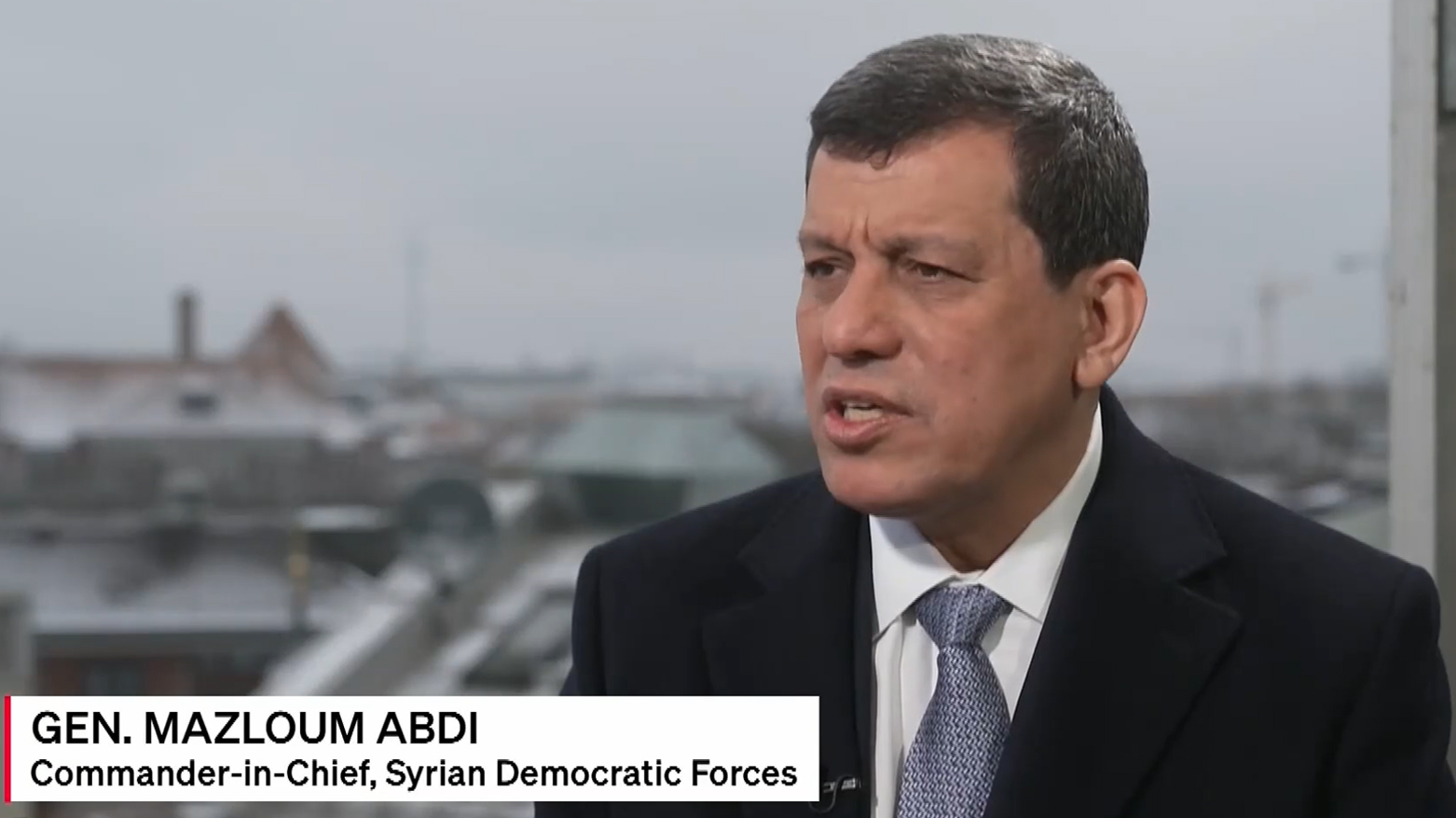
ERBIL (Kurdistan24) - As the Syrian government announced the closure of one of the largest camps that had housed ISIS fighters and their families, General Mazloum Abdi, Commander-in-Chief of the Syrian Democratic Forces (SDF), addressed the future of Syria’s Kurds, the ongoing ISIS threat, and the possibility of a U.S. withdrawal.
In an interview with PBS News Hour, Abdi described the late January agreement with Damascus as “the best possible outcome under the current circumstances,” emphasizing that while it was not necessarily the best deal for the Kurds, it secured a cease-fire and created space for dialogue.
The agreement followed military and economic setbacks for Kurdish forces, including withdrawal from large parts of northern Syria and the loss of oil and gas fields that had provided revenue. Under the deal, Kurdish forces are to integrate four brigades into the Syrian military, while border crossings are to be handed over to the central government. In return, Syrian forces withdrew from some Kurdish areas, and civil and educational rights in Kurdish regions were guaranteed.
Abdi said that empowered local governance is currently the realistic objective. “We want autonomy,” he stated, “but under the current circumstances, the condition for Damascus to accept us is local administration.”
He warned that if the agreement collapses, the SDF would not stand down. “I do not want or wish for that to happen, but if the deal collapses, we will persist in our fight until the very end. It is absolutely impossible for us to give up on the Kurdish regions,” he said.
Abdi cautioned that ISIS remains active and capable of carrying out attacks. He argued that without sustained pressure, the group could once again pose a broader threat.
He welcomed the recent transfer of 5,700 ISIS detainees to Iraq, saying the move would weaken the group’s influence and reduce the risk of those prisoners participating in future attacks.
However, he expressed concern about broader security challenges, particularly as the future of U.S. forces in Syria remains uncertain. The United States has recently closed two bases and consolidated troops, with officials indicating that further decisions would depend on conditions on the ground.
“Withdrawing American troops at this critical moment is not a good idea,” Abdi said, warning it would create challenges in the ongoing fight against terrorism.
Abdi also acknowledged disappointment among Kurdish communities over Washington’s response when Syrian government forces advanced into Kurdish-held areas.
“A major attack was launched against our regions. Many of our people were killed, and the U.S. stance was not strong enough to stop the attack,” he said, noting widespread frustration.
Despite the uncertainty, Abdi affirmed a dual identity as both Syrian and Kurdish. “I have two identities. One is being Syrian and the other is being Kurdish. I am essentially Kurdish. I am proud of both,” he said, expressing hope for a rebuilt Syria in which Kurdish regions develop and Kurds play a significant role within the country.
All sides, he noted, say they want the current transition to succeed and bring stability to a country that remains fragile after years of conflict.