Elham Ahmad Condemns ‘War of Extermination’ Against Kurds in Sheikh Maqsood, Ashrafiyeh
Elham Ahmad condemned the Syrian Defense Ministry's offensive on Aleppo's Kurdish neighborhoods as a "war of extermination," citing broken truces and refused dialogue amid civilian evacuation orders.
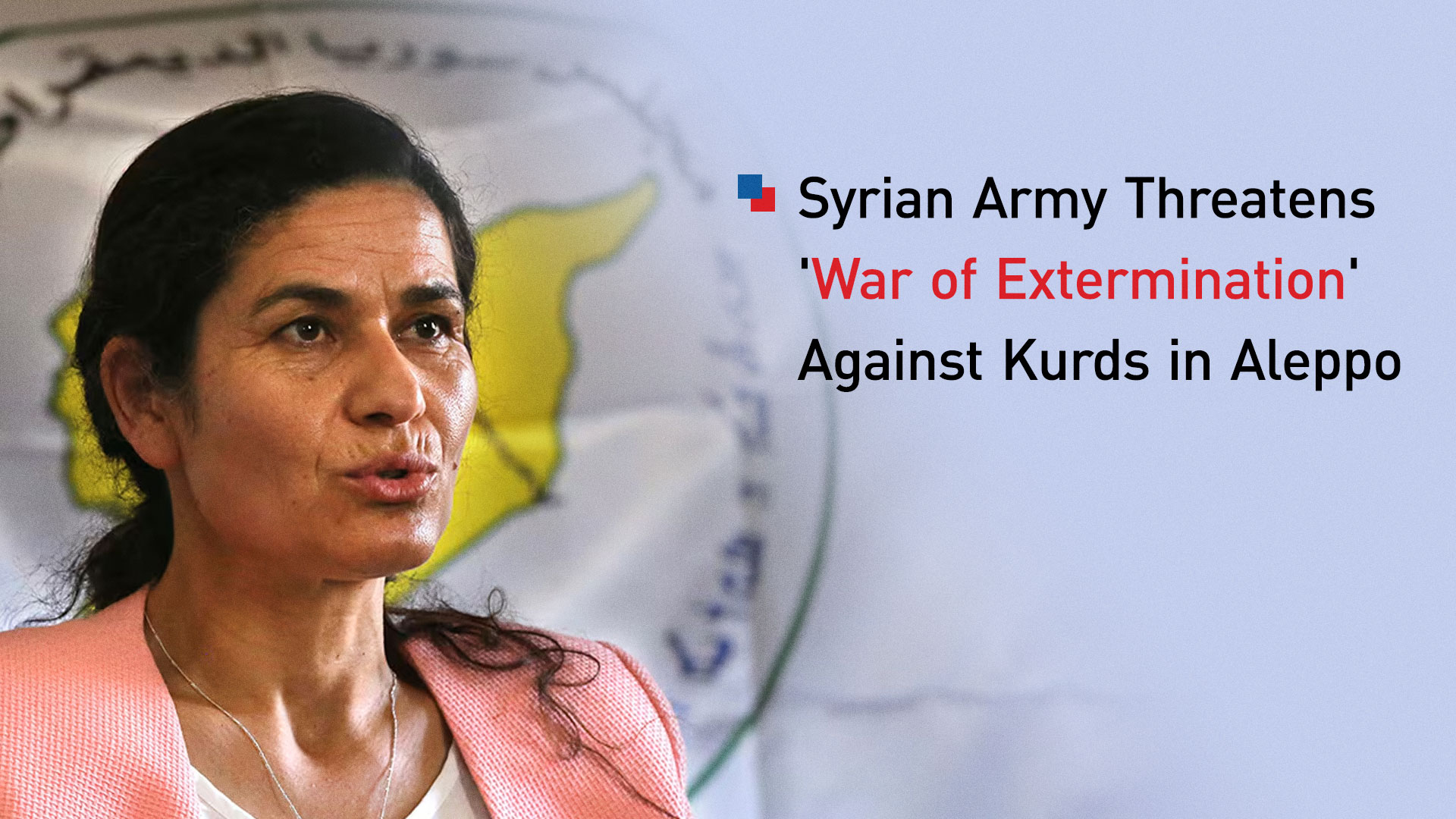
ERBIL (Kurdistan24) — Elham Ahmad, the Co-chair of the Department of Foreign Relations of the Democratic Autonomous Administration of the North and East Syria Region, issued a scathing condemnation on Wednesday regarding the escalating military offensive in Aleppo, characterizing the actions of the Ministry of Defense as a "war of extermination" targeting the Kurdish population.
In a statement posted to the social media platform X on Wednesday, January 7, 2026, Ahmad addressed the rapidly deteriorating security situation in the Sheikh Maqsood and Ashrafiyeh neighborhoods.
Her remarks came amid a violent intensification of hostilities, during which the Syrian Army declared positions held by the Syrian Democratic Forces (SDF) to be "legitimate military targets" and issued a strict deadline for civilian evacuations.
Ahmad explicitly accused the Ministry of Defense of the Syrian Interim Government of declaring war on districts that are densely populated with civilians.
"The Ministry of Defense of the Syrian Interim Government declares war on the Sheikh Maqsood and Ashrafiyeh neighborhoods, which are densely populated with civilians, declaring a war of extermination against the Kurds who suffered from the oppression of the previous regime," Ahmad wrote.
She highlighted the vulnerable demographic composition of these areas, noting that the "majority of the residents of the neighborhoods are forcibly displaced people from Afrin."
Allegations of Broken Agreements and Siege
A central component of Ahmad’s statement was the assertion that Kurdish forces have remained committed to established de-escalation protocols, specifically citing an agreement dating back to April 1st.
According to the Co-chair, "Despite the Kurds' adherence to the April 1st agreement, the other party has not adhered to it." She further described a diplomatic stalemate, stating that despite "unremitting contact to conduct talks," the Ministry of Defense has steadfastly refused to engage in dialogue.
Ahmad also drew attention to the pre-existing humanitarian conditions in the area, noting that Sheikh Maqsood and Ashrafiyeh were already "under a tight siege by divisions affiliated with the Ministry of Defense" prior to the current outbreak of violence.
This characterization aligns with reports from the Syrian Democratic Council (SDC), which has documented severe shortages of basic necessities.
Mohammad Amin, an official in the Relations Office of the SDC, recently confirmed that the entry of essential goods, including flour, yeast, and heating fuel, has been blocked by armed factions surrounding the districts. This blockade has reportedly forced the closure of many bakeries and left hospitals struggling with shortages of oxygen and emergency supplies.
The Ultimatum and Evacuation Orders
Ahmad’s comments were issued against the backdrop of a stark ultimatum delivered by the Operations Body of the Syrian Army earlier on Wednesday.
Citing what it termed a "major military operation" launched by the SDF toward government-held neighborhoods, the Syrian Army announced that all SDF positions in the area were now hostile targets. The military command instructed civilians to "immediately distance themselves from SDF headquarters and military points in order to protect their lives."
To facilitate an exodus of the population—estimated by local officials to number approximately 600,000—the Army announced the opening of two humanitarian corridors: the Awariz Crossing and Zuhoor Street.
However, the directive imposed a strict deadline, stating these passages would remain open only until 3:00 PM on Wednesday afternoon.
The logistical feasibility of evacuating hundreds of thousands of residents, including the elderly and children, within such a compressed timeframe has raised significant alarm, particularly given the reports of heavy shelling targeting the very infrastructure needed for transit.
Casualties and Infrastructure Damage
The urgency of Ahmad's appeal reflects the lethal reality on the ground.
According to reports from the Internal Security Forces (Asayish) and the SDF, the bombardment of Sheikh Maqsood, Ashrafiyeh, and Bani Zaid has intensified significantly over the preceding 24 hours. The shelling has utilized a wide array of heavy weaponry, including tanks, heavy artillery, Grad and Katyusha rocket launchers, mortars, and DShK machine guns.
This military escalation has already exacted a civilian toll. The shelling resulted in the deaths of four civilians, identified as Fatima Hamada, 41; Masoud Faiq Abdo, 30; George Khawam, 42; and a child.
Additionally, twenty-six other civilians sustained injuries.
The bombardment has caused widespread destruction to civilian infrastructure, with shells striking residential structures in areas such as Maghsalat al-Jazira, Farouj Ammar, al-Hassan Mosque, the Grand Sheikh Maqsoud Mosque, and the Youth Housing area.
Conflicting Narratives of Aggression
While Ahmad frames the conflict as a unilateral aggression by the Ministry of Defense against a besieged population, military accounts of the escalation remain polarized. The Syrian Army has justified its targeting of the neighborhoods as a response to SDF aggression.
Syrian state media outlets, citing the Ministry of Interior, reported that the SDF targeted army positions near Sheikh Maqsood with drones, killing one member of the Syrian Arab Army, and shelled the al-Midan neighborhood, killing three civilians.
Conversely, the Internal Security Forces maintained that they acted "within the framework of legitimate self-defense" to repel an assault launched by factions affiliated with the Damascus government.
The SDF specifically pointed to factions known as "al-Amshat," accusing them of shelling densely populated areas using "suicide drones" and heavy weapons in a "planned escalation" intended to destabilize the region.
Call for Reason and Dialogue
In her statement, Ahmad urged a de-escalation of the violence, calling on government officials to "bear their responsibilities regarding what is happening and to follow the path of reason and logic to resolve problems through dialogue and move away from the method of war and battles."
She emphasized that the Syrian population has suffered sufficiently from years of conflict. "The suffering Syrians have endured from wars is enough," she wrote. Concluding her statement, Ahmad appealed directly to the broader population, calling on "Syrians and Syrian youth to distance themselves from these paths, raise the voice of truth, and renounce war."
As the 3:00 PM deadline set by the Army approached, the situation remained volatile, with the political leadership of the Autonomous Administration signaling a desire for diplomatic resolution while facing what they describe as an existential military threat to the displaced communities of Aleppo.