Damascus Government Factions Declares Kurdish Districts of Aleppo a Military Zone as Fighting Intensifies
The Damascus government factions declared Sheikh Maqsood and Ashrafiyeh military zones, triggering heavy fighting, civilian casualties, mass displacement, and strong reactions from Kurdish leaders and rights groups.
ERBIL (Kurdistan24) — The Damascus government factions on Wednesday declared the Kurdish neighborhoods of Sheikh Maqsood and Ashrafiyeh in Aleppo a closed military zone, ordering the shutdown of all entry and exit routes and triggering renewed fighting, civilian displacement, and sharp reactions from Kurdish authorities and human rights monitors.
In a statement issued by the Operations Body of the Damascus government factions, authorities announced that as of 3:00 p.m. on Wednesday, all routes into and out of the two neighborhoods would be sealed. The army said that only two humanitarian corridors — Awariz Crossing and Zuhoor Street — would remain temporarily open to allow civilians to leave the area.
The declaration followed the launch of military operations in and around the densely populated Kurdish districts, which Syrian authorities said now constitute a military zone.
The Operations Body warned residents to distance themselves from positions held by the Syrian Democratic Forces (SDF), stating that all SDF sites inside Sheikh Maqsood and Ashrafiyeh would be considered legitimate military targets.
In response, the General Council of the Sheikh Maqsood and Ashrafiyeh neighborhoods accused Damascus government factions of initiating indiscriminate shelling of civilian areas using heavy weapons.
Speaking at a press conference, council representatives said the bombardment was aimed at intimidating residents and breaking the will of Kurdish civilians.
“The attack has begun with all kinds of heavy weapons,” the General Council said in a statement directed to public opinion and Kurdish communities across the region. Despite the escalation, the council said it would not abandon the defense of what it described as Kurdish land, rights, and survival.
The council called on residents of both neighborhoods to defend their homes alongside Asayish internal security forces and to repel attacks across all defensive positions.
Schools and public institutions in Sheikh Maqsood and Ashrafiyeh remained closed for a second consecutive day due to ongoing clashes between Syrian government-affiliated forces and SDF security units.
According to unofficial figures cited by local sources, at least nine people were killed over the past 24 hours, with dozens more injured, including civilians, women, and children. The figures could not be independently verified.
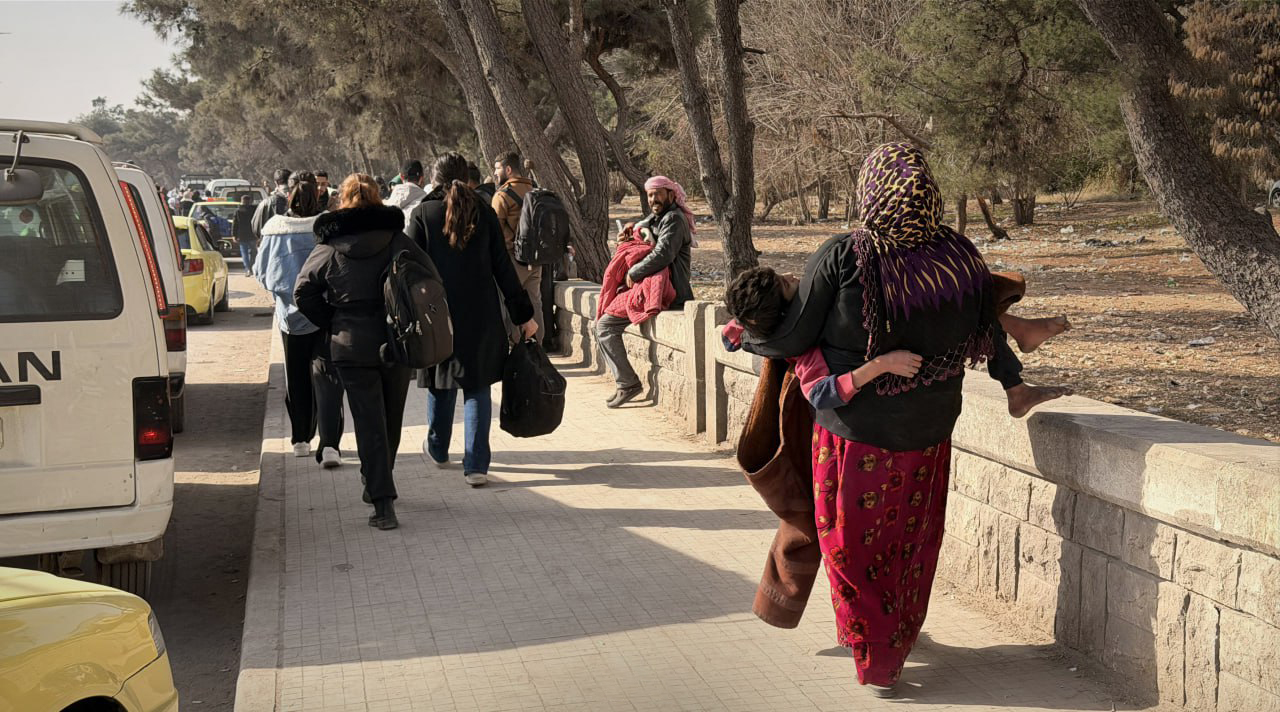
As fighting intensified, displacement accelerated. Kurdistan24 reported that the Syrian Civil Defense evacuated 850 civilians from the two neighborhoods by 12:30 p.m. on Wednesday.
The evacuations were carried out through assembly points in the Awariz area and along Zuhoor Street, coinciding with growing civilian departures from nearby districts affected by reciprocal shelling between Syrian factions affiliated with the Interim Government and the SDF.
The Damascus government factions framed its actions as a response to what it described as a major escalation by the SDF toward Aleppo neighborhoods and accused the group of committing “numerous massacres against civilians.”
The Operations Body reiterated its call for civilians to immediately distance themselves from SDF positions before the humanitarian corridors closed at the stated deadline.
The escalation prompted reactions from Kurdish political and military figures.
Sipan Hamo, a member of the General Command of the Syrian Democratic Forces, issued a message addressed to residents of Sheikh Maqsood and Ashrafiyeh, describing the day as one of “dignity” and portraying the neighborhoods as longstanding symbols of resistance.
Hamo said residents had endured more than 15 years of attacks, sieges, and assaults, and praised what he described as their unity and determination to defend their homes alongside fighters.
He said that resilience among residents had previously thwarted threats and would continue to do so, adding that the neighborhoods would remain “citadels of steadfastness” in the face of aggression.
Human rights organizations also weighed in. The Syrian Observatory for Human Rights (SOHR) issued a sharply worded statement on Wednesday accusing Syrian authorities of committing “sectarian crimes and ethnic cleansing” against various components of Syrian society.
The observatory alleged that government forces had previously targeted Alawite communities in coastal regions and Druze residents in Sahnaya and Sweida, and were now directing similar actions against Kurds.
According to SOHR, the current operations reflect what it described as the same “racist spirit” applied across different communities. The organization concluded its statement by asserting that Syria, with all its components, would remain strong.
The warning issued by the Syrian Army’s Operations Body later in the day reinforced fears of a wider offensive. The statement declared that all SDF positions in Sheikh Maqsood and Ashrafiyeh were legitimate military targets, a designation that further heightened concerns for civilians who remained inside the besieged districts.
Following the announcement, Ilham Ahmed, head of foreign relations for the Autonomous Administration of North and East Syria, said in a post on the X platform that the Syrian Ministry of Defense had declared war on neighborhoods filled with civilians.
She stated that the move amounted to a war of extermination against Kurds who had already suffered under previous forms of oppression, noting that many residents of the neighborhoods were forcibly displaced from Afrin.
As the humanitarian corridors remained open for only a limited period, residents faced urgent decisions amid continued shelling and uncertainty over whether further evacuations would be possible.
The closure of all other access points underscored the severity of the military posture adopted by Syrian authorities.
By Wednesday afternoon, Sheikh Maqsood and Ashrafiyeh stood at the center of a rapidly escalating confrontation, with civilians caught between evacuation orders, active fighting, and sharply diverging narratives from the warring sides.