Trump: ‘My Own Morality’ Is the Only Limit on My Power
Trump declared his power is limited only by his "own morality," dismissing international law. He asserted "ownership" over alliances and territories like Greenland, while defending coercive actions in Venezuela.
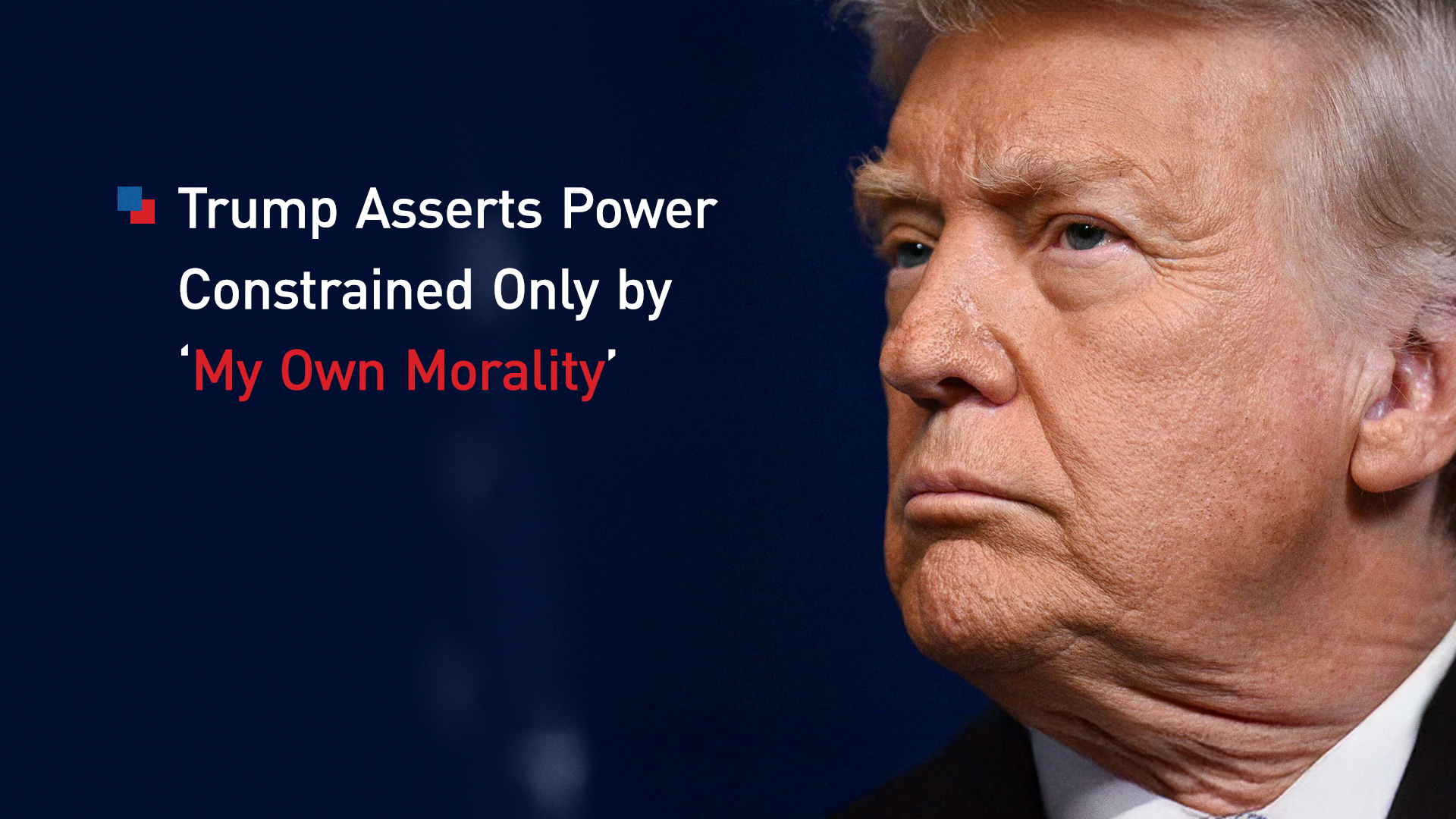
ERBIL (Kurdistan24) — In a wide-ranging interview with The New York Times, President Donald Trump declared on Wednesday evening that his authority as commander in chief is effectively limited only by his "own morality," dismissing the constraints of international law and treaties as he outlined a vision of American power based on strength and "ownership."
Asked directly if there were any limits on his ability to use military might to strike, invade, or coerce nations around the world, Mr. Trump responded: "Yeah, there is one thing. My own morality. My own mind. It’s the only thing that can stop me." He added, "I don’t need international law. I’m not looking to hurt people."
While he acknowledged needing to abide by international law when pressed further, he qualified his stance by stating, "It depends what your definition of international law is," making clear that he views himself as the arbiter of when such constraints apply to the United States.
A Worldview of Coercion and Ownership
The President’s remarks offered the blunt acknowledgment yet of a worldview where national strength supersedes conventions.
This philosophy was evident in his approach to Greenland. President Trump insisted that the Danish territory must become part of the United States, dismissing existing treaty rights to use bases there as insufficient.
"Ownership is very important," Trump said. "I think that ownership gives you a thing that you can’t do, whether you’re talking about a lease or a treaty."
He framed the acquisition as psychologically necessary for success, seemingly unconcerned with the implications for NATO unity.
When asked if obtaining Greenland or preserving the alliance was a higher priority, he acknowledged "it may be a choice," asserting that the trans-Atlantic alliance relies entirely on the U.S. core.
This approach extends to his recent actions in Venezuela, where U.S. Special Operations forces removed Nicolás Maduro.
President Trump cited the speed of the operation as a success and defended it against claims that it sets a dangerous precedent for adversaries like China or Russia. He argued that the threat posed by Venezuela—citing migration and drugs "pouring into" the U.S.—differentiated his actions from potential aggression against Taiwan or Ukraine.
"This was a real threat," Trump said. regarding China's potential moves on Taiwan, he expressed confidence that President Xi Jinping would not act during his tenure. "He may do it after we have a different president, but I don’t think he’s going to do it with me as president," he said.
Coercive Diplomacy in Action
The interview coincided with real-time examples of the administration's coercive diplomacy.
During his conversation with The Times, President Trump took a lengthy call from Colombian President Gustavo Petro, who expressed fears of a U.S. attack similar to the one in Venezuela. "Well, we are in danger," Petro told The Times prior to the call. "Because the threat is real. It was made by Trump."
The call came shortly after President Trump and Secretary of State Marco Rubio withdrew the United States from dozens of international organizations. Spurred by recent military actions, including a strike on Iran’s nuclear program—memorialized by a model B-2 bomber on his desk—President Trump appeared confident in his maximalist strategy.
Domestic Constraints and Executive Power
Domestically, President Trump acknowledged some checks on his power but signaled a willingness to bypass them.
He suggested that judicial restrictions on his agenda apply only "under certain circumstances" and floated workarounds for potential Supreme Court rulings against his tariffs, such as repackaging them as licensing fees.
He also reiterated his willingness to invoke the Insurrection Act to deploy the military inside the United States if necessary. "I haven’t really felt the need to do it," he said, though he has already deployed the National Guard to cities over local objections.
His comments regarding prolonged involvement in Venezuela prompted immediate legislative reaction.
On Thursday, the Senate agreed to debate a resolution aimed at curbing his war powers, a move Senator Rand Paul (R-Ky.) attributed directly to the President's assertion that the U.S. might remain in Venezuela for years.
Nuclear Policy and Global Stability
On the issue of arms control, President Trump appeared unconcerned about the imminent expiration of the last major nuclear agreement with Russia.
"If it expires, it expires," he said. "We’ll just do a better agreement." He insisted that any future deal must include China and possibly other players, despite the risk of an unconstrained nuclear arms race in the interim.
Throughout the interview, President Trump maintained that he has been "very loyal to Europe," claiming credit for increased NATO defense spending targets—which he noted do not fully take effect until 2035—and arguing that without his intervention, "Russia would have all of Ukraine right now."