DAANES Issues General Call to Arms in Syria
DAANES declared a state of emergency and a general call to arms Sunday, calling the Syrian government’s offensive an “existential war” after Syrian Arab Army expanded its offensive, urging citizens in Jazira and Kobani to prepare for popular defense.
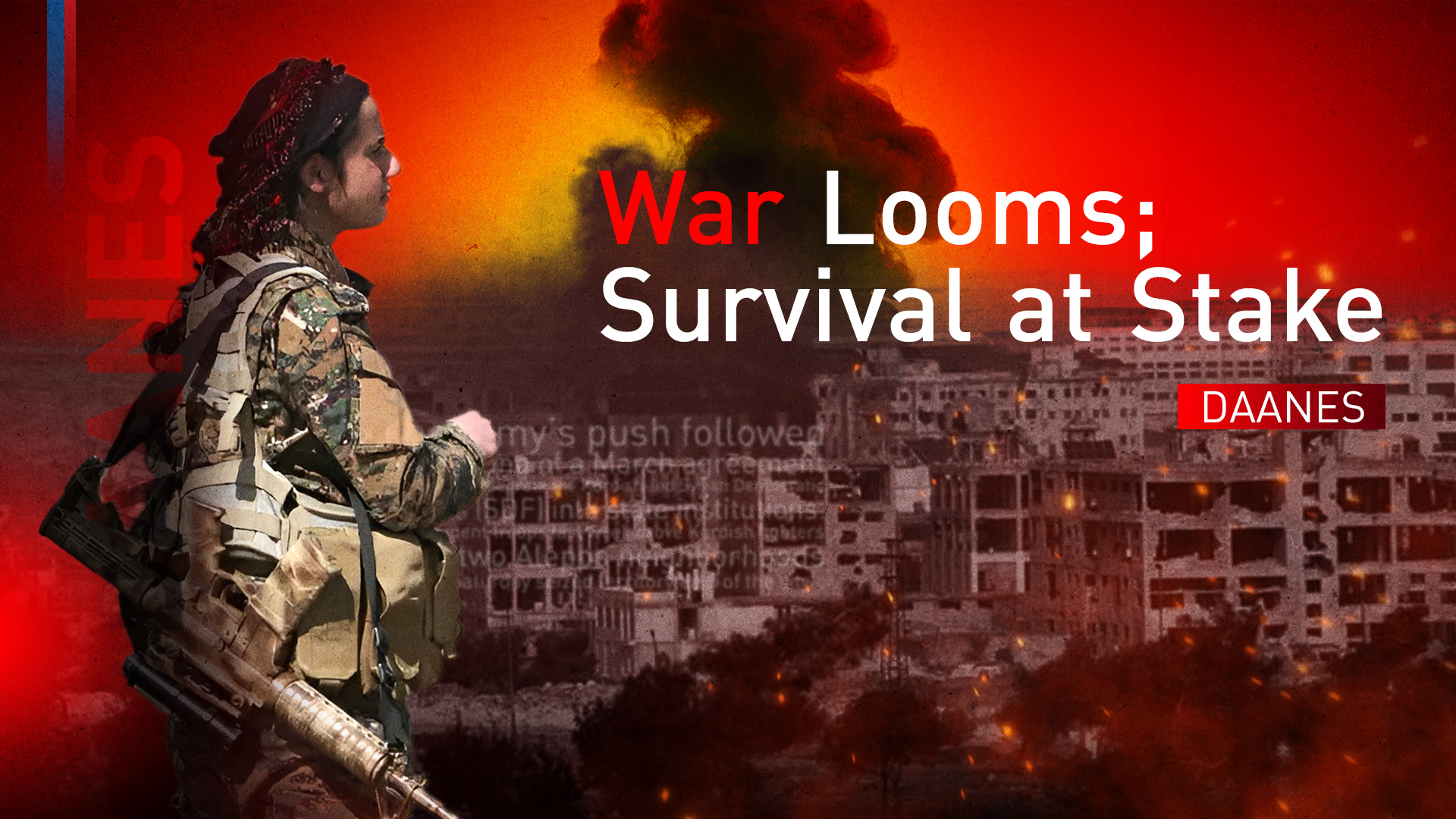
ERBIL (Kurdistan24) - The Democratic Autonomous Administration of North and East Syria (DAANES) declared a state of emergency and issued a general call to arms on Sunday, characterizing the intensifying military offensive by government forces as an "existential war."
The announcement came mere hours after Reuters reported that the Syrian Arab Army (SAA) had seized control of major energy infrastructure in the Deir ez-Zor region, including the strategic Omar oil field and the Conoco gas field, marking a significant shift in the balance of power in the country’s resource-rich northeast.
On Sunday, January 18, 2026, the Autonomous Administration released a statement citing imminent threats to its territory as the catalyst for the general mobilization.
The administration called upon citizens across the region, with a specific emphasis on the Jazira and Kobani areas, to prepare for a "popular defense" to confront potential incursions.
"We are facing an existential war; to protect our achievements and identity, the only option before us is popular defense," the statement read, underscoring the severity of the collapse in security arrangements that had maintained a relative, albeit fragile, stability in the region.
Government Forces Advance on Energy Hubs
The urgency of the Kurdish administration’s declaration coincides with rapid territorial gains by Damascus.
According to a report by the Reuters news agency on Sunday, the Syrian Arab Army has successfully extended its control over both the Omar oil field and the Conoco gas field in the eastern countryside of Deir ez-Zor Governorate.
These facilities represent some of the most critical economic assets in Syria, previously held by the Kurdish-led Syrian Democratic Forces (SDF) following the defeat of the Islamic State.
Local administrative responses reflected the deteriorating security environment.
The Governor of Deir ez-Zor announced the immediate suspension of official duties and issued a directive instructing citizens to remain in their homes, advising against travel unless for "very necessary business."
Syrian state media corroborated the Reuters report regarding the seizure of the energy fields and further indicated that army units had deployed in the villages of Ziban and the areas surrounding Deir ez-Zor city.
The fighting has also sparked a humanitarian crisis in the city of Raqqa. On Sunday, the Raqqa Media Directorate issued an official statement declaring that the city’s drinking water supply had been completely cut off.
The directorate attributed the outage to damage sustained by main water transmission pipelines, alleging that shelling by the SDF had put the infrastructure out of service.
The SDF categorically denied these allegations.
In a counter-statement, the Kurdish-led force described the accusation of blowing up water pipelines as "merely Damascus propaganda" with "no basis in truth."
This exchange of blame regarding essential services highlights the severe impact the renewed hostilities are having on the civilian population in former Islamic State strongholds.
Conflicting Narratives over Strategic Cities
The battlefield situation remains fluid and contested, with opposing sides offering contradictory accounts of territorial control.
The Operations Command of the Syrian Arab Army announced a "military victory" on Sunday, stating that its forces had established complete control over the strategic city of Tabqa, the Tabqa Military Airport, and the Euphrates Dam, effectively expelling Kurdish fighters from these key locations.
Furthermore, Damascus military sources claimed to have seized the Mansoura Dam and the towns of Ratla and Hamam, asserting that government troops were positioned only five kilometers from the western entrance of Raqqa city.
In contrast, the SDF denied that Tabqa and the dams had fallen to the Syrian Army.
The group’s leadership emphasized that their fighters had repelled the army's attacks and had not permitted any advance toward these strategic areas. The conflicting reports suggest a chaotic frontline as government forces attempt to reclaim territories held by the SDF for over a decade.
Breakdown of the Withdrawal Agreement
The escalation follows a failed attempt to implement a withdrawal agreement brokered to de-escalate tensions.
On Friday, January 16, Mazloum Abdi, the General Commander of the SDF, announced via social media that a "decisive decision" had been made to withdraw Kurdish forces toward the east of the Euphrates river.
General Abdi framed the move as a response to requests from "friendly and mediating countries" and an expression of goodwill regarding the implementation of the March 10 agreement.
The withdrawal process reportedly commenced at 7:00 a.m. on Saturday.
However, the SDF claims that the arrangement was immediately violated by government forces. The SDF Media Center stated that clashes erupted in the "Dabsi Afnan" area on Saturday, characterizing the engagement as an "unjust attack" by Damascus.
The SDF asserted that a 48-hour deadline had been set for their forces to withdraw from Deir Hafer and Maskana, but that the government moved military convoys and tanks into the area to launch an offensive before that deadline expired.
The SDF has publicly held the international parties monitoring the agreement responsible for the ensuing bloodshed and called for urgent intervention.
Diplomatic Efforts and Calls for Dialogue
As the military situation deteriorated, high-level diplomatic efforts to salvage stability continued in the Kurdistan Region.
President Masoud Barzani hosted a significant summit in Pirmam, Erbil, on Saturday, attended by U.S. President Donald Trump’s Special Envoy to Syria, Tom Barrack, and senior U.S. military officials including General Kevin Lambert.
Representing the Syrian Kurdish leadership were General Mazloum Abdi and Mohammed Ismail, President of the Kurdish National Council of Syria (KNCS).
During the meeting, President Barzani underscored the necessity of dialogue and coexistence as foundational elements for a "new Syria."
The participants discussed practical steps to prevent further escalation, with President Barzani emphasizing that the political and cultural rights of the Kurdish people must be a fundamental component of any future settlement.
The call for a return to dialogue was echoed by imprisoned Kurdish leader Abdullah Öcalan. In a meeting with a delegation from the DEM Party at Imrali prison on January 17, Öcalan warned that the escalation in Syria was an attempt to "sabotage the peace process."
According to the delegation, Öcalan stated that "all problems in Syria can only be, and must be, resolved through dialogue, negotiation, and wisdom," rejecting military solutions as unviable. He expressed readiness to play a role in de-escalating the conflict if parties acted "responsibly and conscientiously."
These diplomatic appeals, however, appear to be struggling to gain traction against the momentum of the Syrian Army’s advance.
The seizure of the Omar and Conoco fields, combined with the declaration of a state of emergency by the Autonomous Administration, suggests that the conflict has entered a volatile new phase, threatening to unravel the fragile security architecture of northeast Syria despite the recent decree by President Ahmed al-Sharaa formally recognizing Kurdish identity.
This article was updated on Sunday, Jan. 18, 2026, at 11:07am.