SDF Urges De-Escalation While Calling Kurds to Prepare for Defense
Mazloum Abdi urged urgent talks with Damascus and President Ahmed al-Sharaa as the SAA advances across northeast Syria, seizing energy sites. While seeking de-escalation, he warned of an “existential war” and called on Kurds to prepare for defense.
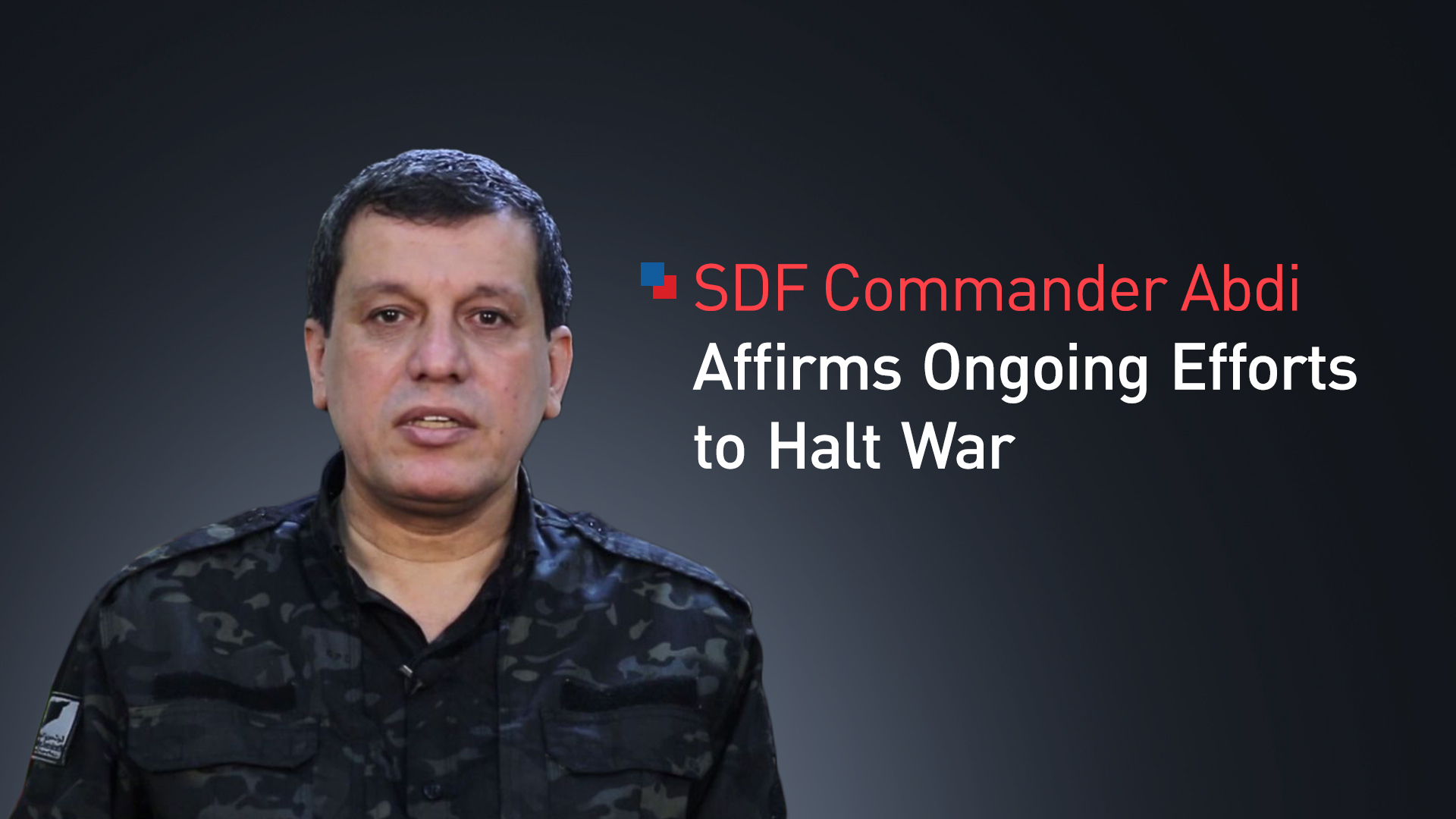
ERBIL (Kurdistan24) - Mazloum Abdi, the General Commander of the Syrian Democratic Forces (SDF), held a phone call on Sunday with authorities in Damascus, urging an urgent, high-level meeting with Syrian President Ahmed al-Sharaa. The call, confirmed by information obtained by a Kurdistan24 correspondent, reflects a critical effort to halt a rapidly escalating conflict that Kurdish authorities have described as an “existential war.”
The call represents a pivotal moment in the deteriorating security landscape of post-Assad Syria.
The SDF Commander, Mazloum Abdi, in his call with Ahmed al-Sharaa, emphasized, "Our efforts to stop the war are continuing".
The phone call comes as the Syrian Arab Army (SAA) presses a multi-front offensive that has compromised the territorial integrity of the semi-autonomous northeast, seizing key energy infrastructure and threatening urban centers held by the SDF for over a decade.
While engaging in this diplomatic track in Damascus, General Abdi simultaneously issued a public directive to the Kurdish population to prepare for defense.
According to the ANHA News Agency, the General Commander directed an appeal to the people of the region to "rally around their sons among our fighters and to possess the spirit of courage and faith."
He confirmed to the agency that while "efforts to work towards de-escalation and a ceasefire are continuing with the assistance of international parties," the reality on the ground remains volatile.
General Abdi provided a grim assessment of the military timeline to ANHA, noting that systematic attacks began on January 6, initially targeting Kurdish neighborhoods in Aleppo before expanding to North and East Syria, specifically the areas of Tabqa, the southern countryside of Raqqa, and Deir ez-Zor.
"Despite all our attempts and efforts to stop the escalation and work towards de-escalation, the attacks are still ongoing until now," Abdi stated.
The urgency of the talks in Damascus is underscored by the dramatic collapse of the security architecture in the resource-rich Deir ez-Zor province.
On Sunday, the Reuters news agency reported that government forces had successfully seized control of the Omar oil field and the Conoco gas field. These facilities represent the economic lifeblood of the autonomous region and were key assets secured by the SDF during the campaign against the Islamic State.
The seizure of these energy hubs has precipitated a collapse in local administration in the area.
The Governor of Deir ez-Zor announced the immediate suspension of official duties and issued a directive instructing citizens to remain in their homes, advising against travel unless for "very necessary business."
Syrian state media corroborated the reports regarding the energy fields and indicated that army units had deployed in the villages of Ziban and the areas surrounding Deir ez-Zor city.
Faced with these rapid territorial losses, the Democratic Autonomous Administration of North and East Syria (DAANES) declared a state of emergency and issued a general call to arms on Sunday.
The administration’s statement cited imminent threats to its territory as the catalyst for the mobilization, particularly in the Jazira and Kobani areas. "We are facing an existential war; to protect our achievements and identity, the only option before us is popular defense," the administration declared.
The diplomatic intervention by the United States, represented by Mr. Barrack’s presence in the Damascus meeting, follows a breakdown in previous de-escalation arrangements.
On Friday, General Abdi had announced a "decisive decision" to withdraw Kurdish forces toward the east of the Euphrates river as a gesture of goodwill to implement the March 10 agreement. However, the SDF claims that government forces violated this truce by launching offensives before the agreed-upon withdrawal deadline, specifically in the Dabsi Afnan area.
The conflict has also generated conflicting narratives regarding control of strategic infrastructure further west.
The Operations Command of the Syrian Arab Army announced a "military victory" on Sunday, claiming to have established complete control over the strategic city of Tabqa, the Tabqa Military Airport, and the Euphrates Dam.
Government sources asserted that their troops had also seized the Mansoura Dam and were positioned only five kilometers from the western entrance of Raqqa city.
In contrast, the SDF leadership has denied that Tabqa and the dams have fallen to the Syrian Army.
In statements released prior to the Damascus meeting, the group emphasized that their fighters had repelled the army's attacks and had not permitted any advance toward these strategic areas. However, the fighting has sparked a severe humanitarian crisis in Raqqa, where the local Media Directorate reported that the city’s drinking water supply had been completely cut off.
Authorities attributed the outage to damage sustained by main water transmission pipelines, alleging SDF shelling was responsible—a claim the SDF categorically denied as "Damascus propaganda."
The diplomatic groundwork for Sunday’s meeting in Damascus appears to have been laid in the Kurdistan Region the previous day.
On Saturday, President Masoud Barzani hosted a significant summit in Pirmam, Erbil, which brought together General Abdi, U.S. Envoy Tom Barrack, and senior U.S. military officials.
During that summit, President Barzani underscored the necessity of dialogue and coexistence as foundational elements for a "new Syria," emphasizing that the political and cultural rights of the Kurdish people must be a fundamental component of any future settlement.
The push for a negotiated settlement has also received support from Abdullah Öcalan, the imprisoned Kurdish leader. In a meeting with a delegation from the DEM Party on January 17, Öcalan warned that the recent violence was an attempt to "sabotage the peace process."
He urged all parties to resolve the conflict through "dialogue, negotiation, and wisdom," signaling a consensus among Kurdish leadership for a political off-ramp to the current hostilities.
As General Abdi and Mr. Barrack meet with President Sharaa, the focus remains on whether a new ceasefire agreement can be forged that halts the Syrian Army's momentum and addresses the SDF’s demand for the protection of their autonomous status, or if the "existential war" declared by the administration will continue to consume the northeast.
This article was updated on Sunday, Jan. 18, 2026, at 02:01pm.
This article was updated and corrected on Sunday, Jan. 18, 2026, at 02:37pm. SDF Commander held a phone call conversation and did not visit Syrian capital.