Mosque Sermons Backed by Syrian Ministry Call for ‘Conquest’ of SDF Regions
Syria's Ministry of Endowments ordered mosques to pray for an army "conquest" over the SDF. The government vowed to block a Jazira Region, while Kurdish leaders warned of humanitarian disaster and repelled attacks near Kobani.
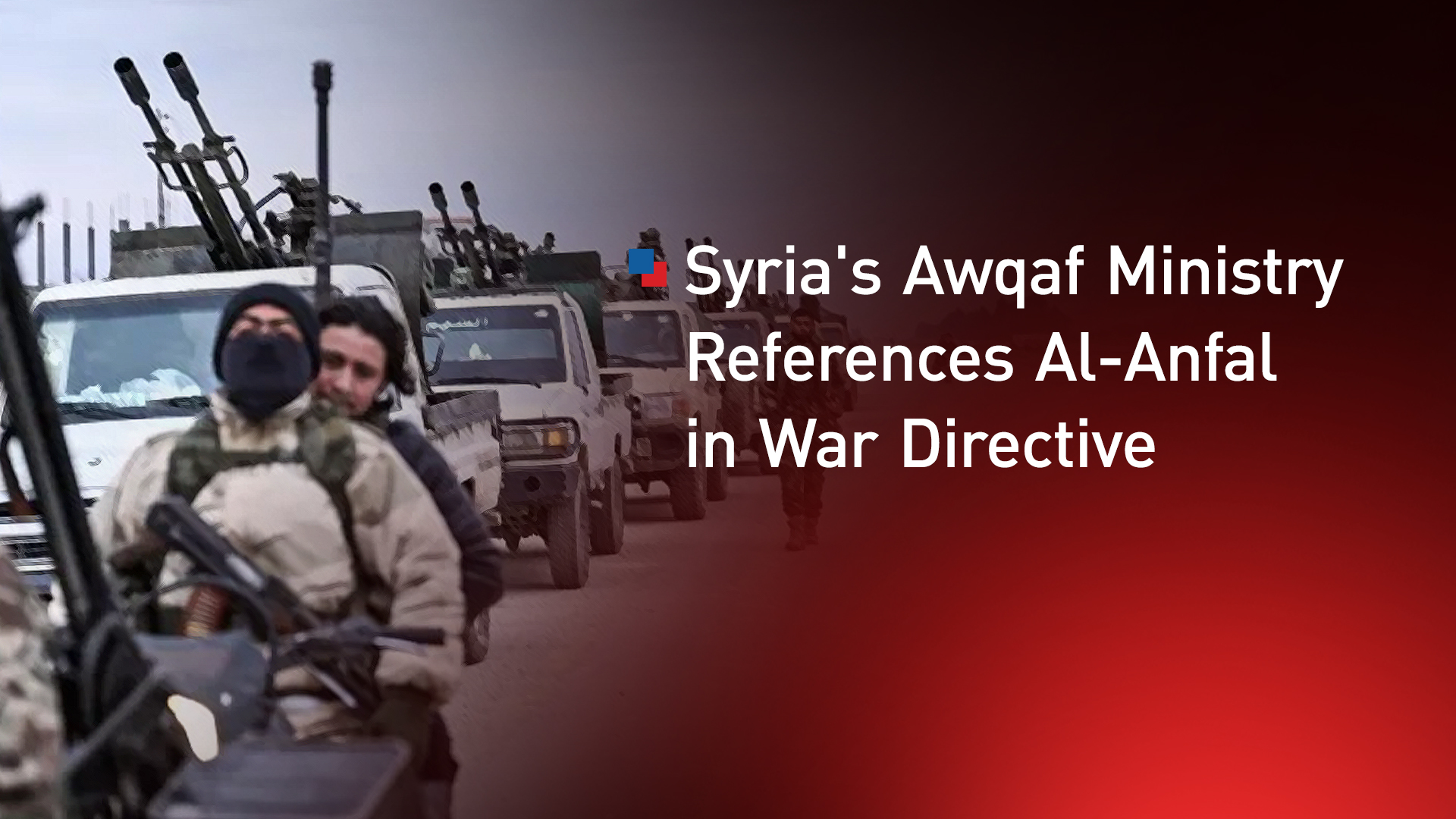
ERBIL (Kurdistan24) - The Syrian Ministry of Endowments (Awqaf), citing a verse from Surah Al-Anfal, issued a formal directive to mosques across the country on Tuesday instructing clerics to recite the Takbir and lead public prayers for the victory of the Syrian Arab Army.
The circular frames the government’s escalating military campaign against Kurdish-held territories in northeastern Syria—particularly areas controlled by the Syrian Democratic Forces (SDF)—in explicitly religious terms, marking a notable rhetorical escalation as Damascus seeks to mobilize public support for its operations in the Jazira region.
According to the directive distributed to mosques across the country, the Ministry of Awqaf requested that religious leaders incorporate specific prayers into the obligatory daily services.
The circular instructed imams to recite the Takbir—the phrase "Allahu Akbar"—specifically while Syrian security forces attack SDF positions and Kurdish-inhabited areas.
The ministry justified this directive by characterizing the current hostilities as a "difficult war" critical to the "unity and integrity" of the Syrian state, particularly in the country’s east.
In language that has raised alarm among monitoring groups and minority communities, the ministry’s statement explicitly compared the military offensive against the SDF to a "conquest."
This terminology, traditionally associated with religious expansion or the reclaiming of territory from non-believers, injects a volatile sectarian dimension into what has largely been a political and territorial conflict over autonomy and governance.
The directive encourages citizens to actively pray for the victory of the Syrian Arab Army, positioning the military campaign as a national and spiritual imperative.
The religious mobilization is being reinforced by stark political messaging from the central government. Hamza Mustafa, the Minister of Information for the Syrian Transitional Government, utilized the social media platform X to declare that Damascus will "not allow the creation of the Jazira Region in Syria."
Referencing historical precedent, Mustafa stated, "Our forefathers did not allow the creation of the Jazira Region in Syria, and we too will not allow the creation of such a region today."
He emphasized that the current struggle is for a "unified Syria," asserting that Jazira is sovereign Syrian land where no separate administrative region will be permitted.
"No matter how the situation turns out or how the years pass, there are some truths that remain as they are forever and do not undergo change," Mustafa added.
These developments coincide with urgent warnings from Kurdish political leadership regarding the deteriorating security situation.
Elham Ahmad, the Head of Foreign Relations for the Autonomous Administration of North and East Syria, issued a public appeal to international powers on Tuesday, urging decision-making countries to abandon their silence regarding the "pressures and attacks" targeting the Kurdish people.
Ahmad emphasized that the international community must take a "clear and practical stance" to prevent the dangers currently facing Kurdish citizens, warning that continued silence would lead to a further escalation of tensions and a potential humanitarian disaster.
Ahmad framed the protection of Kurdish rights as a moral obligation for global powers, citing the heavy price paid by the Kurdish people in the fight against terrorism over the past decade.
She argued that securing the legitimate rights of the Kurds is a prerequisite for any future peace in Syria, stating that the country "will not step towards peace without resolving the Kurdish cause and securing their rights."
Her comments come amid what she described as a new wave of threats aimed at cleansing and changing the demographics of the Kurdish regions.
Similar concerns were voiced by the Kurdish National Council in Syria (ENKS), which released an urgent statement on Tuesday expressing "deep concern" regarding the dangerous escalation of military activity near Hasakah and other Kurdish areas.
The Council warned that the current military movements threaten civilian security and risk plunging the region into a "new phase of war and destruction." The ENKS statement criticized attempts to impose a fait accompli through force of arms, arguing that such actions will only expand the circle of violence and jeopardize social peace.
The Council explicitly rejected a purely military solution to the conflict, asserting that "the logic of weapons cannot be a substitute for political solutions."
Instead, ENKS called for a future based on a clear political process that guarantees legitimate national rights within a democratic constitution.
The statement included an urgent plea to the United States, the United Nations, and the international community to intervene to lift the siege on the city of Kobani and restore essential services such as water and electricity to its residents.
On the ground, the security situation remains fluid and violent.
The Syrian Ministry of Interior announced on Tuesday that security forces have recaptured 81 Islamic State (ISIS) gunmen who had escaped from the Shaddadi prison in Hasakah governorate.
According to the ministry's statement, approximately 120 inmates fled the facility, prompting a high-alert status and a widespread manhunt. Interior Ministry forces are reportedly continuing sweep operations in the town of Shaddadi to locate the remaining fugitives.
While government forces grapple with the prison break in the south of Hasakah, the SDF reported significant military engagements in the north.
Early Tuesday morning, the SDF, supported by the Women's Protection Units (YPJ), claimed to have defeated a series of intense attacks by armed groups affiliated with Damascus near the town of Sarrin, south of Kobani.
The SDF Media Center released official statistics indicating that the clashes resulted in "extremely heavy losses" for the attackers.
According to the SDF report released on January 20, 2026, their fighters destroyed seven military vehicles and disabled four armored vehicles belonging to the attacking groups.
Additionally, SDF and YPJ units reportedly shot down four drones in the skies above the area.
The media center characterized these defensive actions as a "harsh response" to five consecutive attacks launched against the villages of Sarrin, signaling that the Kurdish-led forces retain significant combat capabilities despite the pressure from central government forces.
The convergence of religious decrees from Damascus, political intransigence regarding regional autonomy, and active combat operations across multiple fronts suggests a hardening of positions on both sides.
As the Ministry of Awqaf calls for divine support for a "conquest" in the east, and Kurdish leaders appeal for international intervention to prevent demographic change, the prospect of a negotiated settlement appears increasingly distant amidst the smoke of burning vehicles in Sarrin and the echoes of Takbir from the country's mosques.