Convoys from BCF and UN En Route to Besieged Kobani as Humanitarian Corridors Open
Aid convoys from the Barzani Charity Foundation and the UN entered Kobani on Sunday as Syria opened two humanitarian corridors, addressing a crisis that has left 150,000 civilians without essential supplies.
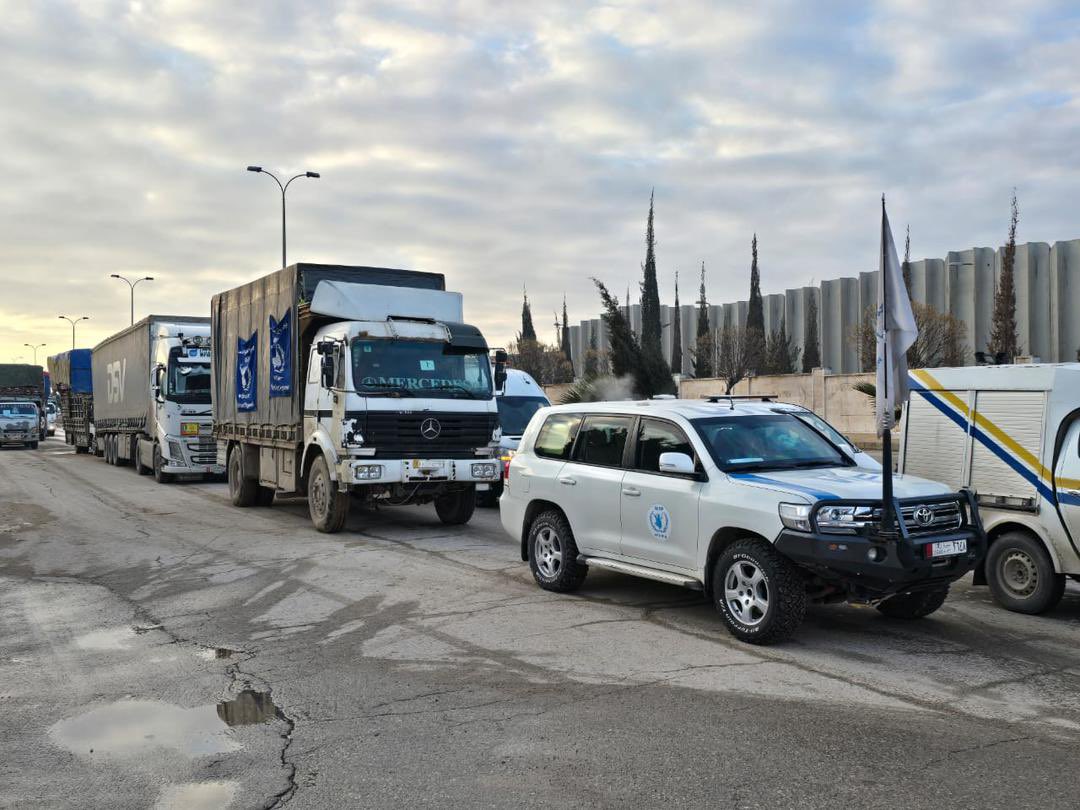
ERBIL (Kurdistan24) - Humanitarian relief began to reach the besieged city of Kobani on Sunday as the Barzani Charity Foundation and the United Nations dispatched separate convoys through newly negotiated corridors, offering a critical lifeline to approximately 150,000 civilians trapped by a military blockade and the region’s most severe winter storm in half a century.
The arrival of the supplies follows days of intense diplomatic maneuvering and marks the first successful entry of large-scale aid into the city since the Syrian Arab Army and affiliated armed groups established an encirclement that has resulted in several civilian fatalities.
Dilan Barzan, a correspondent for Kurdistan24 reporting from Western Kurdistan, confirmed on Sunday, Jan. 25, 2026, that more than 20 trucks of humanitarian aid from the Barzani Charity Foundation (BCF) and the United Nations have been sent to Kobani via two distinct transit routes.
The movement of the convoys coincided with an announcement from the Syrian Ministry of Defense regarding the formal preparation of humanitarian corridors in the governorates of Aleppo and Hasakah to facilitate the delivery of relief materials to civilians affected by the ongoing hostilities.
Gonzalo Vargas Llosa, the United Nations High Commissioner for Refugees (UNHCR) Representative in Syria, stated on the social media platform X that a large-scale international effort enabled the movement of goods from government-held areas toward the contested northeast.
Vargas Llosa noted that, through cooperation with the Syrian government at both the Aleppo and Damascus levels, a convoy of 24 trucks departed from Aleppo approximately one hour prior to his announcement. The shipment, organized by the UN Country Team in Syria and various non-governmental organizations, carries essential food, relief items, and diesel fuel intended for life-saving winter assistance.
The breakthrough in aid delivery arrives as Kobani contends with what local observers and human rights organizations have characterized as a "major humanitarian catastrophe." The city and its surrounding villages were placed under a tightening siege following the withdrawal of the Syrian Democratic Forces (SDF) from several outlying areas and a subsequent breakdown in negotiations with the central government.
The resulting blockade led to a total cutoff of electricity, water, internet, and communication lines. These conditions have been compounded by a historic wave of cold and snowfall that meteorologists say has not been witnessed in the region for at least 50 years.
Logistical Scale and Regional Mobilization
The entry of the BCF convoy into Kobani represents the culmination of an extensive relief campaign launched under the direction of President Masoud Barzani and the supervision of Masrour Barzani, the Prime Minister of the Kurdistan Region.
Musa Ahmad, the President of the Barzani Charity Foundation, detailed the foundation’s expanded operations during a press conference in Qamishlo on Sunday. Ahmad revealed that the scale of the foundation’s intervention in Rojava has now reached 114 trucks, with each vehicle transporting 12 tons of supplies.
"Fortunately, today our first convoy of aid reaches Kobani," Ahmad stated, characterizing the delivery as the result of continuous diplomatic efforts through the Barzani Headquarters to extend assistance to the isolated city. The BCF’s operation is supported by a workforce of more than 160 employees and a specialized medical team that has conducted examinations and provided treatment to 1,367 patients over the last 48 hours.
The foundation has prioritized the stabilization of essential infrastructure, specifically within the educational sector. Following a directive from Prime Minister Masrour Barzani, the BCF has provided diesel fuel to 81 schools to ensure heating for students and staff.
Additionally, 30 schools have received specialized health and food packages, each containing 22 different types of essential supplies. According to foundation statistics, 5,827 families—totaling 34,227 citizens—benefited from BCF aid on Saturday alone. The foundation is also managing the distribution of 3,500 hot meals daily and has secured 200 job opportunities for local youth to assist in the administration of the relief mission.
The humanitarian mission utilizes the Fishkhabour–Semalka border crossing as its primary logistical artery, which serves as the sole gateway for the Kurdistan Region to deliver sustained assistance to the residents of Rojava.
The BCF has historically played a central role in such efforts, particularly following the February 2023 earthquake, and officials in Erbil view the current mission as part of a broader national and humanitarian duty toward the inhabitants of the region.
Humanitarian Consequences of the Siege
The urgency of the aid convoys is underscored by the lethal toll the siege and weather have already taken on the city’s population. The Democratic Autonomous Administration of North and East Syria (DAANES) reported that at least one child died in a Kobani hospital on Saturday due to a critical lack of medical oxygen.
The health facility was reportedly struggling to function amid a sharp decline in medical supplies and fuel for emergency generators. Simultaneously, the Kurdish Red Crescent confirmed that five children, including an infant, died in the city due to extreme cold and the absence of heating fuel.
The humanitarian burden has been further strained by a massive wave of internal displacement. Official statistics indicate that more than 130,000 people have fled areas including Sheikh Maqsud, Ashrafiyeh, Raqqa, and Tabqa over the past several days.
Many of these displaced persons have headed toward the centers of Qamishlo and Hasakah, where they are being sheltered in mosques and schools under harsh conditions. Projections suggest the total number of displaced individuals could reach 150,000 in the coming days as tensions persist.
Farhan Haq, the Deputy Spokesperson for the UN Secretary-General, expressed grave concern on Friday regarding the closure of all access routes to Kobani.
Haq reported that while the UN had successfully reached Hasakah, Raqqa, and Deir ez-Zor, it had been forced to request specific "facilitation" from the relevant authorities to reach the population in Kobani. He noted that while some health centers remained operational, the scarcity of medicine and the poor quality of available water have created a situation that worsens day by day.
Security Volatility and Diplomatic Context
The delivery of aid occurs within a highly volatile security environment. Late Saturday, the SDF and the Syrian Ministry of Defense announced a 15-day extension of a standing ceasefire through international mediation. Damascus indicated that the truce is partially intended to support operations involving United States forces, specifically the transfer of approximately 7,000 ISIS detainees from SDF-run prisons to Iraqi territory.
On Wednesday, a convoy of 150 ISIS fighters, including prominent leaders and European nationals, was successfully moved to Iraq from a prison in Hasakah.
Despite the formal ceasefire extension, military and political tensions remain elevated. The SDF recently released a dossier alleging that the Syrian Arab Army and affiliated paramilitary units committed extensive war crimes during the first 17 days of their military campaign, including the targeting of medical facilities and the arbitrary detention of civilians.
Conversely, the SDF Media Center on Saturday announced the dismissal and prosecution of one of its own fighters who was photographed alongside the bodies of opposing gunmen, characterizing the incident as a violation of the force's ethical "red line."
Political leaders have warned that the current stability is fragile. Gulistan Kiliç, the head of the DEM Party parliamentary group, stated that the offensive against Kurdish districts represents an effort to complete extremist objectives and urged NATO members to pressure Damascus to permanently lift the blockades.
As the first BCF and UN trucks begin distributing food and medicine in Kobani, the opening of the promised corridors in Aleppo and Hasakah remains the decisive factor in whether the city can avert a broader catastrophe.
Musa Ahmad reiterated that the Barzani Charity Foundation is prepared to coordinate with any international party to serve the population, framing the mission as an essential intervention during what remains one of the region's most sensitive political and humanitarian phases.