Senator Graham Unveils ‘Save the Kurds Act,’ Vows Sanctions Against Those Targeting Kurdish Forces
US Senator Lindsey Graham warns abandoning the Kurds would be "a disaster for America’s national security interests," pledges bipartisan-backed legislation with “crippling” penalties.
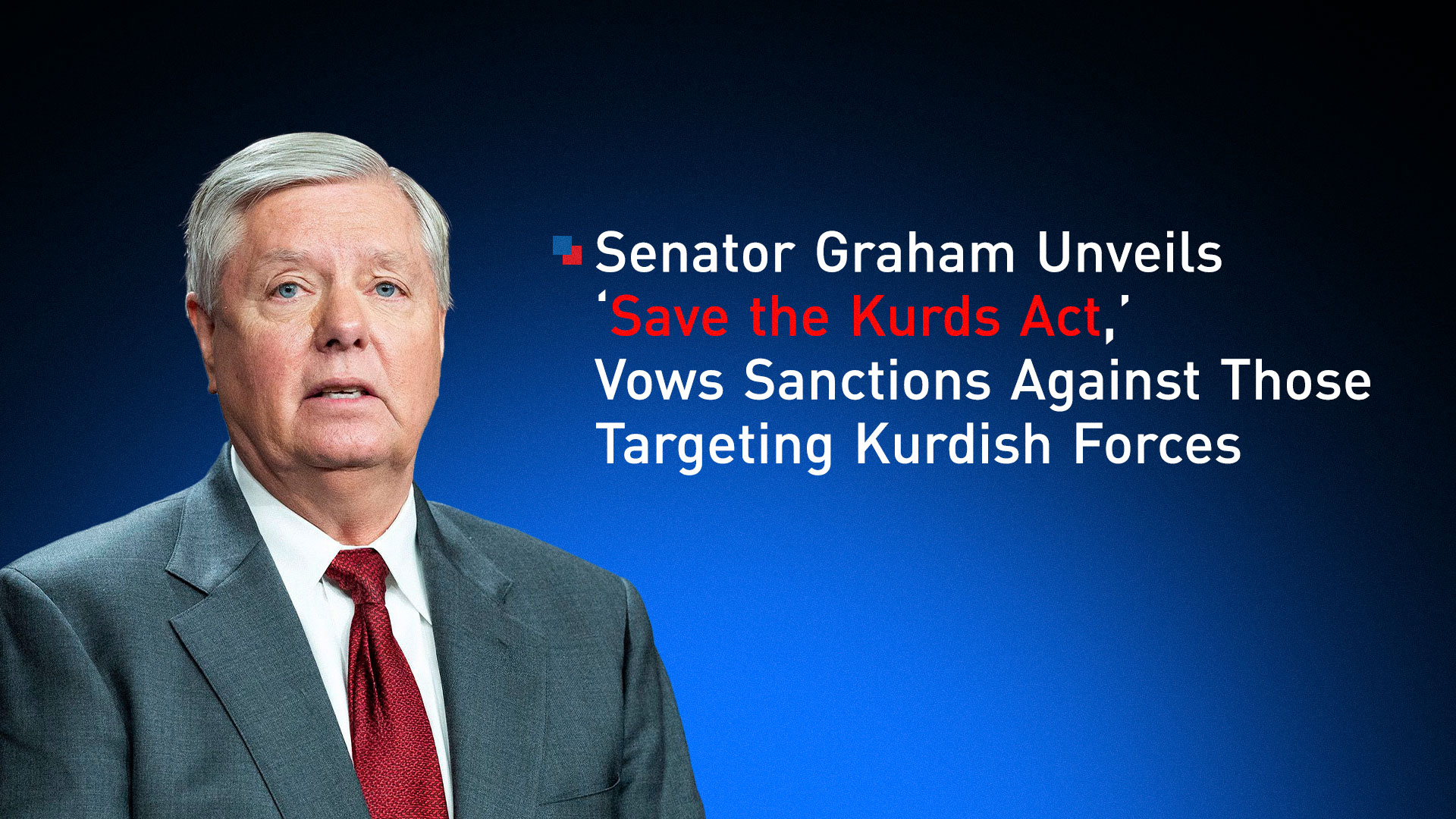
ERBIL (Kurdistan24) — US Senator Lindsey Graham announced on Tuesday that he will introduce new legislation aimed at imposing sweeping sanctions on any government or group involved in hostilities against the Kurds, warning that abandoning Washington’s longtime allies would damage both America’s credibility and national security interests.
In a statement posted on X, Graham said he was watching the “deteriorating situation in Syria with great concern,” arguing that Kurdish forces are facing growing threats from the country’s new authorities, whom he said are aligned with Turkey.
“The Kurds were the chief ally in destroying the ISIS caliphate,” Graham wrote. “It would be a disaster for America’s reputation and national security interests to abandon the Kurds.”
He said the proposed legislation, titled the Save the Kurds Act, is designed to carry “crippling sanctions” against any state or armed group that targets Kurdish forces, stressing that the bill must have “teeth” to be effective.
Graham expressed confidence that the legislation would attract strong bipartisan backing in Congress, signaling a rare cross-party consensus on the issue of Kurdish protection and US commitments in the region.
“Therefore, I will be introducing legislation this week,” he said, adding, “Stay tuned.”
The announcement comes amid heightened regional uncertainty following recent political and military shifts in Syria, where Kurdish-led forces have played a central role in the US-led campaign against the Islamic State group.
Analysts say Graham’s proposal reflects growing concern in Washington that Kurdish allies could be sidelined or exposed to new security threats as regional power dynamics evolve.
Syria has entered a new and volatile phase following the collapse of the Assad-era power structure and the advance of forces aligned with the country’s new authorities into areas previously controlled by the Kurdish-led Syrian Democratic Forces (SDF).
The shift has upended a decade-long security arrangement in which Kurdish forces, backed by the United States and an international coalition, governed large parts of northeastern Syria and spearheaded the fight against the Islamic State group.
The SDF, dominated by the Kurdish People’s Protection Units (YPG), was Washington’s most effective local partner in dismantling the ISIS “caliphate,” culminating in the group’s territorial defeat in 2019.
Since then, Kurdish authorities have overseen detention facilities holding thousands of suspected ISIS fighters and camps housing tens of thousands of their relatives, including the notorious al-Hol camp.
Recent months have seen mounting pressure on the Kurds as Damascus, supported diplomatically by Ankara, moved to reassert control over strategic areas in the north and east.
As Syrian government forces advanced, Kurdish units withdrew from several areas under negotiated arrangements, raising concerns about security vacuums, prisoner escapes, and the future of anti-ISIS operations.
Violence, unrest, and mass escapes have been reported in detention camps amid the transition, fueling fears that instability could allow ISIS remnants to regroup.
At the same time, Washington has signaled a reduced military footprint in Syria, describing its partnership with the SDF as largely mission-complete after the defeat of ISIS. This shift has heightened Kurdish fears of abandonment and triggered alarm among US lawmakers who argue that disengagement could undermine counterterrorism gains and embolden regional actors hostile to Kurdish autonomy.
Senator Graham’s proposed legislation reflects these concerns, coming as the balance of power in Syria is being redrawn and the long-term status of Kurdish forces remains uncertain.
The debate in Washington now centers on whether economic and diplomatic pressure—rather than military presence—can deter attacks on the Kurds and preserve US influence in a rapidly changing Syrian landscape.