‘No Syrian Army in Kurdish Cities’: SDF Commander Details Security Red Lines in New Agreement
Commander Mazloum Abdi stated the SDF's agreement with Syria prevents Kurdish marginalization, keeps security under exclusive SDF control in cities like Kobani, and limits the Syrian army's role to specific integration tasks in Hasakah and Qamishli.
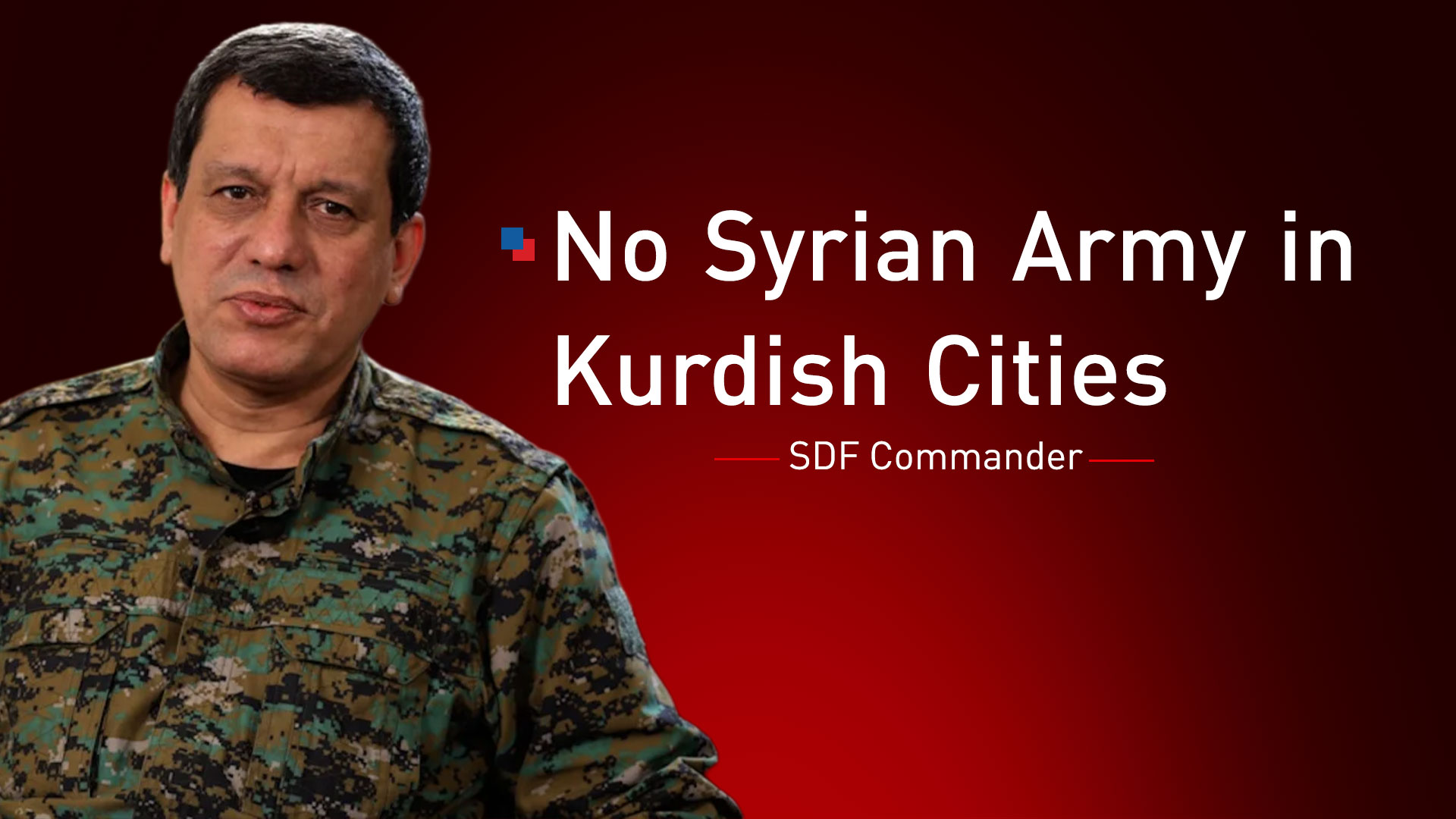
ERBIL (Kurdistan24) - As a new agreement between the Syrian Democratic Forces and Damascus enters its implementation phase, SDF Commander Mazloum Abdi has outlined firm security and administrative red lines, stressing that Syrian army forces will not be stationed in Kurdish cities and that governance will remain in the hands of local residents.
In a private briefing, Mazloum Abdi, commander of the Syrian Democratic Forces (SDF), revealed extensive details about the agreement reached with Syria’s new government. The deal was formally announced after a lengthy and intensive meeting with Syrian President Ahmed Sharaa in Damascus on Jan. 27, 2026.
Abdi said the agreement was strategically designed to neutralize plans aimed at marginalizing Kurdish communities and targeting their social cohesion. He explained that the SDF had exerted every effort to contain operations that could undermine Kurdish unity, adding that when it became clear that international actors were not fully prepared to stop hostile initiatives, the SDF chose to assume direct responsibility for safeguarding the agreement and preventing the implementation of anti-Kurdish plans.
Addressing security concerns, Abdi assured residents that Syrian forces would not be stationed in Kurdish areas. He said a joint committee would be formed between the two sides solely to reorganize civil and administrative institutions, including Hasakah province and Qamishli airport, and not for military purposes. He emphasized that the administration of Kurdish regions would remain in the hands of local residents and that existing institutions would continue operating as established.
On the military front, Abdi stressed that the Syrian army would not enter any Kurdish city or area, particularly Kobani and the Jazira region. He said defense and security in these areas would remain fully under SDF control. While coordination with the Syrian army may occur, he clarified that this does not signify Syrian authority over Kurdish territories but is limited to national-level strategic coordination.
Abdi confirmed that a limited number of Syrian army personnel were allowed to enter Al-Hasakah and Qamishli strictly to facilitate the integration process. He reiterated that these forces hold no authority to assume control and are confined to specific tasks outlined in the agreement, after which the areas remain under SDF jurisdiction.
He said a core element of the agreement is the protection of the distinct character of Kurdish areas across political, administrative, military, educational, and cultural dimensions. Abdi noted that many of the revolution’s achievements had been preserved, acknowledging that while the agreement does not fully meet the aspirations of the people, it represents a necessary and significant step under current conditions.
Under the agreement, SDF forces in Jazira, Qamishli, Hasakah, Derik, and Kobani will remain in place as the “Division of the Syrian Defense Forces,” continuing to carry out security responsibilities in their regions.
Regarding Kobani, Abdi said attacks on the city would come to an end and the siege would be lifted. He stated that the agreement was signed on the same day and would enter the implementation phase after three days. During this period, Syrian Arab Army forces are expected to withdraw from agreed areas, while some SDF units will redeploy from certain locations.
Abdi called on residents to support the process to ensure its successful implementation and the restoration of stability. He confirmed that the Kurdish regions of Afrin, Serekaniye, and Girê Spî would remain an integral part of the dialogue process, despite currently being under the control of other forces, noting that resolving their status would require time and further negotiations within the framework of a comprehensive agreement.
Administratively, Abdi announced that all current employees of the Autonomous Administration would become official state employees and be placed on the general payroll. He said the process would be carried out under direct international supervision and guarantees, with France and the United States, as participants in the talks, assuming responsibility for overseeing implementation. Abdi revealed that US President Donald Trump had discussed the matter directly with President Ahmed Sharaa, while French President Emmanuel Macron had personally provided political guarantees for the agreement.
Addressing his personal future, Abdi said several senior positions had been offered to him, but he declined them, believing others were more suitable. He stressed that he would remain among his people to continue the struggle ahead to secure rights that have yet to be achieved. He called for elevating the current unity of the Kurdish people to a higher level and working toward establishing a national reference for Kurds.
Abdi expressed pride in the national stance shown by Kurds across all four parts of Kurdistan in recent days, saying the support had given him significant strength. He offered special thanks to leaders and political parties in the Kurdistan Region for their material and moral support, describing the unified national position as impactful and historic.
Reflecting candidly on the agreement, Abdi said: “I know this agreement does not meet the level of our people’s hopes, nor even our own demands. I cannot say we achieved something great, but under these difficult circumstances, it was a necessary and unavoidable step.”
He concluded by announcing a shift toward political struggle, saying the SDF would pursue Kurdish rights and protect the people through political means. Abdi also called on all displaced persons to return to their homes and regions, emphasizing that the SDF would be responsible for safeguarding their lives and rights.
Updated on Jan. 31, 2025, at 12:26 pm