'A Significant Role': US Envoy Praises President Barzani's Efforts in Damascus-SDF's Dialogue
US envoy Tom Barrack thanked President Masoud Barzani for his role in facilitating dialogue and the Syria–SDF ceasefire, while discussions also addressed Iraq’s stability, constitutional implementation, and regional peace efforts.
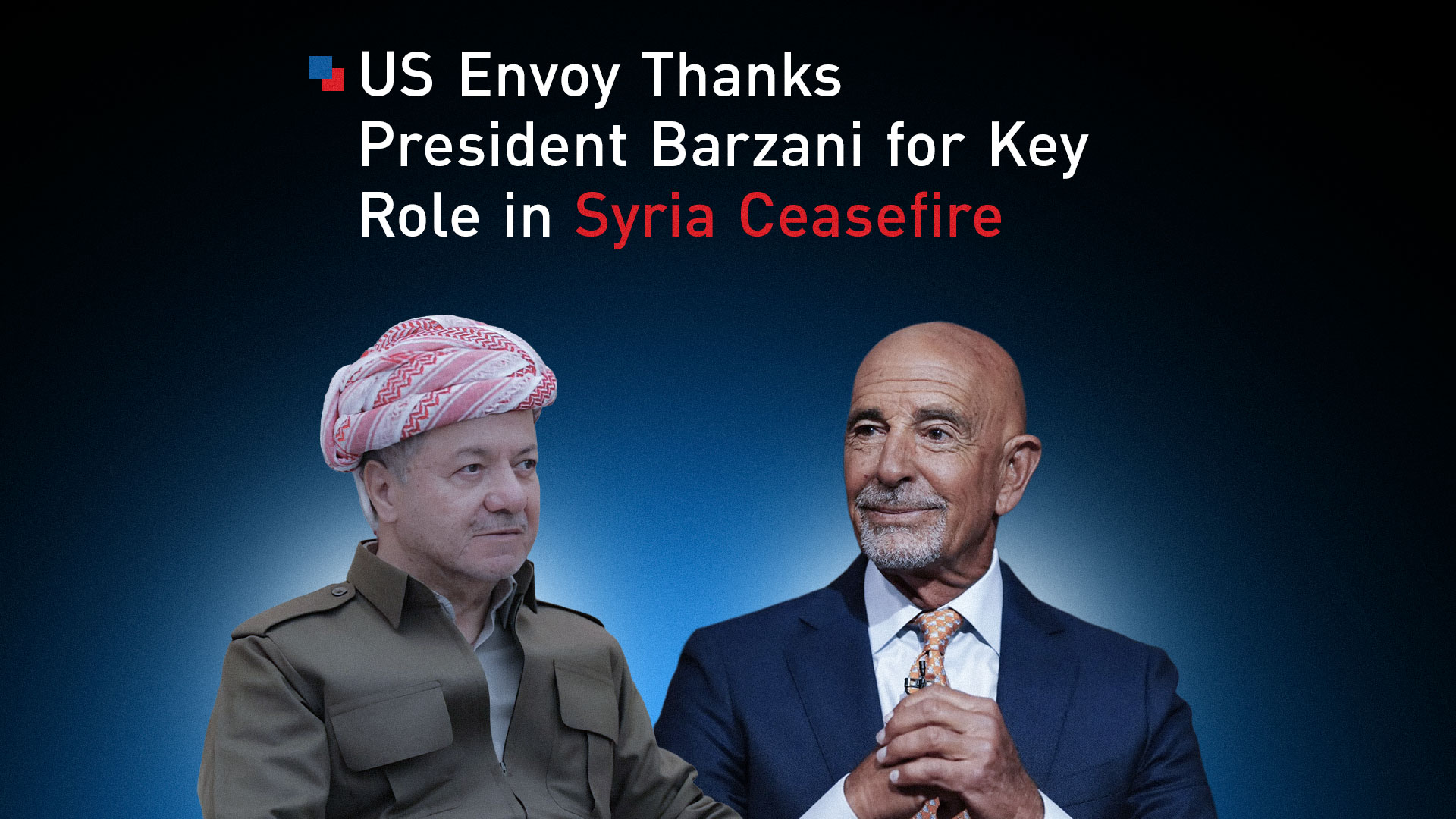
ERBIL (Kurdistan24) - A telephone conversation took place between President Masoud Barzani and Mr. Tom Barrack, the United States’s Special Envoy for Syrian Affairs, focusing on the ceasefire and political agreement reached between the Syrian government and the Syrian Democratic Forces.
According to an official statement published by Barzani Headquarters, during the call Mr. Tom Barrack, on his own behalf and on behalf of the President of the United States, expressed his special thanks and appreciation to President Barzani for his prominent role and positions in facilitating a ceasefire and supporting dialogue between the Syrian government and the Syrian Democratic Forces (SDF). He further highly commended President Barzani’s contribution to achieving the agreement reached between the Syrian government and the SDF.
In response, President Barzani expressed his gratitude to the US President and all individuals and parties who played a role in resolving the issues through dialogue. He reaffirmed his support for the agreement reached on Friday, Jan. 30, 2026, for the sake of consolidating peace. President Barzani also extended his appreciation to Mr. Tom Barrack for his effective role in reaching the agreement and fostering peace in the region in general, and in Syria in particular.
The conversation also addressed the situation in Iraq. According to the statement, Mr. Tom Barrack requested that President Barzani play a significant and prominent role in Iraq’s current political landscape. President Barzani emphasized that the fundamental requirements for stability and the resolution of issues remain the implementation of the Constitution and a commitment to allowing the various components of Iraq to determine the country’s fate while safeguarding Iraq’s sovereignty.
The call followed statements by US envoy Tom Barrack welcoming the comprehensive agreement reached between the Syrian government and the Syrian Democratic Forces, which he described as a historic milestone toward reconciliation and long-term stability in Syria. In a statement posted on X, Barrack said the agreement reflects a shared commitment to inclusion, mutual respect, and cooperation among Syria’s diverse communities, marking a significant step toward national unity after years of conflict.
According to details released by the SDF, the agreement includes a complete ceasefire and the withdrawal of military forces from current points of contact in northeastern Syria, also known as Western Kurdistan. Under the security arrangements, forces from Syria’s Interior Ministry are set to deploy to the centers of Hasakah and Qamishlo, while the internal security forces, known as Asayish, will be gradually integrated into the national security framework.
On the military level, the accord provides for the creation of a new division consisting of three SDF brigades, along with a special brigade formed from Kobani forces, to operate within Aleppo province’s military structure. Administratively, institutions affiliated with the Democratic Autonomous Administration of North and East Syria are to be placed under official Syrian state institutions, with civil servants continuing their duties under the new framework.
Barrack also highlighted measures addressing Kurdish rights, including the restoration of citizenship to individuals affected by past exclusions, recognition of Kurdish alongside Arabic in relevant areas, and protections against discrimination. The agreement further includes provisions facilitating the return of internally displaced persons and aims to create conditions conducive to reconstruction and investment.
As international engagement intensifies around the SDF–Damascus agreement, the phone call underscored President Barzani’s acknowledged role in dialogue-driven solutions and placed renewed emphasis on constitutional stability and sovereignty in both Syria and Iraq.