Ceremony in Kirkuk Honors Kurdish Fighter Who Fell in Western Kurdistan
A Kurdish fighter from Kirkuk killed in Rojava was buried in a ceremony attended by hundreds, as his death coincided with widespread Kurdish demonstrations and advocacy in support of Western Kurdistan.
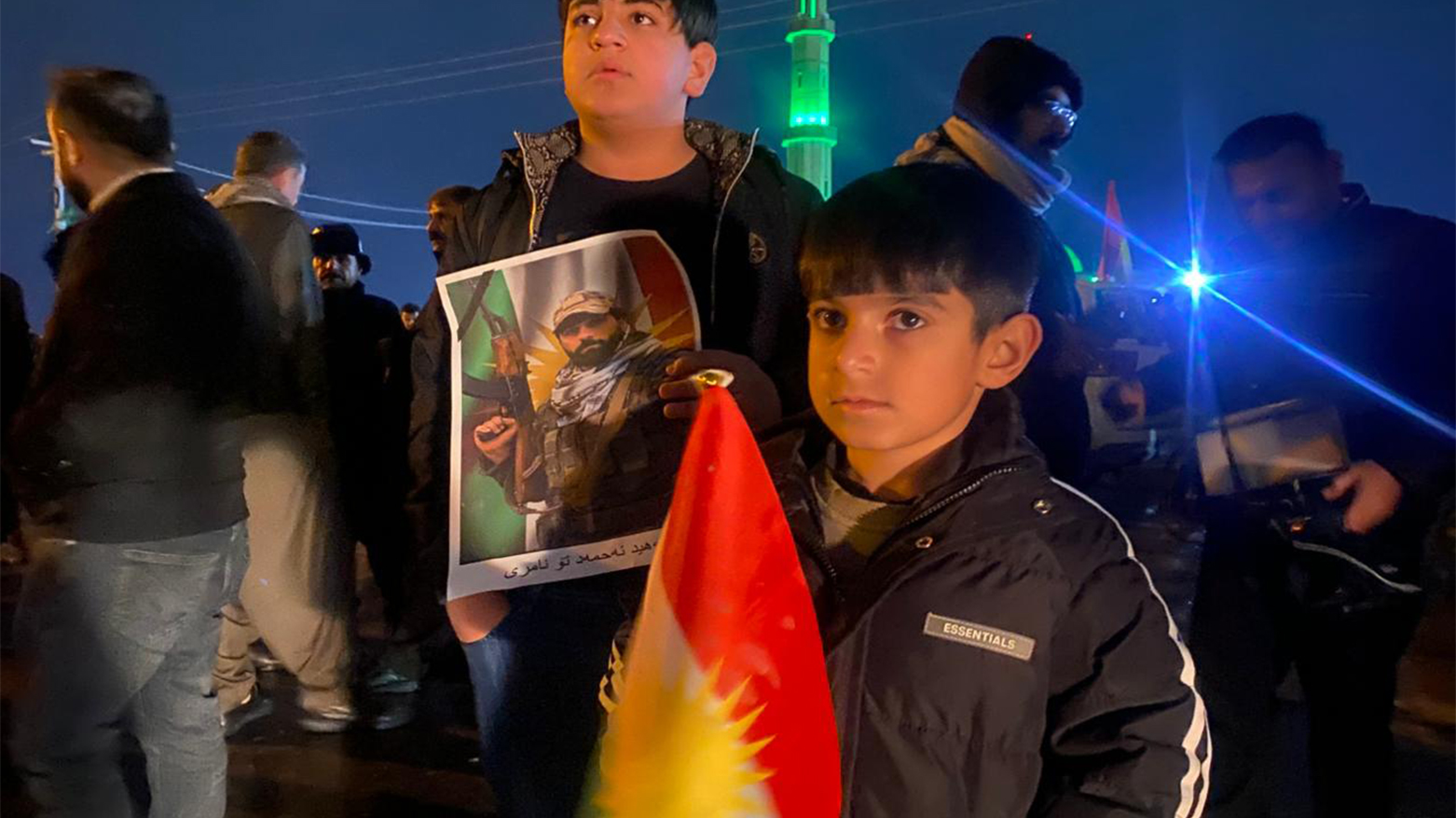
ERBIL (Kurdistan24) - The body of a Kurdish fighter from Kirkuk who was killed while fighting in Western Kurdistan was laid to rest on Saturday following a funeral ceremony that drew hundreds of mourners, according to a report by Kurdistan24 correspondent Hemn Delo. The burial of Ahmad Hemn, who was killed in Hasakah while fighting against the Syrian Arab Army, became a focal point for public expressions of grief and unity amid continued fighting in Rojava and growing demonstrations of solidarity across Kurdistan and the Kurdish diaspora.
According to the report by Hemn Delo, Ahmad Hemn, a Kurdish individual from Kirkuk, was killed on Tuesday, Jan. 27, 2026, while fighting in Hasakah, Western Kurdistan. His death was widely felt across Kurdistan, with Kurdistan24 reporting that news of his killing reverberated deeply among Kurds in different regions.
Following confirmation of his death, arrangements were made to transfer his body back to his birthplace in Kirkuk for burial.
The funeral ceremony took place on Saturday, Jan. 31, 2026, in Kirkuk, where hundreds of people gathered to participate in the procession and burial. Kurdistan24’s correspondent reported that the ceremony reflected both mourning and collective recognition of Ahmad Hemn’s decision to join fighting in Western Kurdistan.
During the funeral, Ahmad’s uncle addressed those present, saying, “He is not dead, as we gained many sons here today,” a statement that was heard by attendees and reported by Kurdistan24.
The report described Ahmad Hemn’s participation in the fighting in Western Kurdistan as an act that crossed imposed borders between different parts of Kurdistan.
His death, while described as deeply tragic, was also portrayed in the report as a moment that underscored a sense of unity among Kurds across geographic divisions. Kurdistan24 noted that Ahmad’s sacrifice was framed by those present as part of a broader shared struggle involving Kurds from multiple regions.
In connection with his death, Kurdish authorities in Western Kurdistan issued a certificate of martyrdom in Ahmad Hemn’s name. The certificate, the text of which was included in the Kurdistan24 report, formally documented his personal details and framed his death within the language and principles used by the issuing authorities.
The certificate identified him as “Ahmed Omer Hemn,” stating that he was born in Kirkuk on Nov. 1, 2003, and that he was killed in Hasakah on Jan. 27, 2026.
It described martyrs as central to the continuation of a collective cause, stating that “a free life is the product of the martyrs' will” and emphasizing that their rights should not be neglected. The certificate further characterized martyrs as individuals who understood what it described as the truth of their cause and sacrificed themselves for its realization.
The document stated that no human could harm a cause that grows through the blood of martyrs and credited martyrs with enabling life to rise against death.
It concluded with a declaration from the Movement for a Democratic Society (TEV-DEM), stating that the organization follows the path of its martyrs and pledging to continue what it described as their struggle until the establishment of a Democratic Syria and a free Kurdistan.
Ahmad Hemn is among a number of Kurdish fighters killed in fighting in Western Kurdistan. The report stated that the official number of Kurdish fighters killed had been reported as 27.
Ahmad Hemn’s burial took place against the backdrop of widespread demonstrations of sympathy and unity among Kurds.
Kurdistan24 reported that his death came amid large social and popular demonstrations in support of Western Kurdistan, both within the Kurdistan Region and among Kurdish communities abroad. These demonstrations have been organized in response to continued fighting and reports of civilian and fighter casualties in Rojava.
One such report by Kurdistan24 stated that mass demonstrations were planned across the Kurdistan Region and internationally in support of Western Kurdistan. Organizers said up to one million people were expected to gather in Erbil at 3 p.m., with parallel rallies planned in Sulaimani and other cities.
According to the report, demonstrations were also scheduled abroad, including what organizers described as the largest Kurdish diaspora demonstration to date in Bonn, Germany, with more than 20,000 participants expected.
These demonstrations were reported to be aimed at protesting attacks by the Syrian Arab Army and expressing solidarity with Kurds in Western Kurdistan.
Kurdistan24 reported that aid collection campaigns were also launched across cities in the Kurdistan Region to support civilians affected by the fighting. Kurdish diaspora communities in Europe, the United States, and the United Kingdom were likewise reported to have organized protests and advocacy efforts.
International political developments were also cited in Kurdistan24’s background reporting. According to those reports, U.S. Senators Lindsey Graham and Richard Blumenthal introduced legislation titled the Save the Kurds Act, which they said was aimed at protecting Kurdish forces in Syria.
In a statement cited by Kurdistan24, Senator Graham said there was bipartisan support in Congress for safeguarding Kurdish forces, particularly the Syrian Democratic Forces, which he described as a key ally in the fight against the Islamic State.
In parallel with demonstrations, Kurdistan24 also reported on increased diaspora activism in support of Western Kurdistan. A separate report detailed a global petition organized by the Kurdistani Diaspora Confederation in support of the Save the Kurds Act.
According to that report, the petition had surpassed 151,450 signatures, with organizers stating that the campaign was intended to apply diplomatic pressure on U.S. lawmakers.
Jihan Brifki, an advisor to the Kurdistani Diaspora Confederation, told Kurdistan24 that the petition was launched in response to a call by Senator Graham and aimed to mobilize public support for Kurdish protection in Syria.
She described the campaign as bipartisan in nature and said it was intended to keep Kurdish concerns in international political discourse.
Within the Kurdistan Region itself, Kurdistan24 has reported on a range of social and cultural responses connected to developments in Western Kurdistan. One such report described the expulsion of a Kurdish student in Kirkuk after he drew the Kurdistan flag during an art exam.
The incident drew attention after the Kurdistan Region’s education minister pledged to cover the student’s education costs and ensure that he would not lose his right to schooling.
Kurdistan24 has also reported on cultural initiatives linked to expressions of Kurdish identity and resistance. In Sulaimani, Governor Haval Abubakr announced plans to construct the “Kezi” (Braid) Monument, a project described as a tribute to Kurdish dignity, resistance, and unity. The initiative followed widespread reaction to reports and imagery related to the treatment of Kurdish female fighters in Rojava.
The braid has emerged as a recurring symbol in recent Kurdistan24 reporting, particularly following the circulation of a video that prompted outrage across Kurdish society.
In response, Kurdish women launched a hair-braiding campaign, which Kurdistan24 described as a form of protest and cultural resistance. Demonstrations involving hair braiding were reported in Erbil and other cities, with participants framing the act as an assertion of identity and dignity.
Artistic responses have also featured prominently in Kurdistan24’s coverage. The outlet reported that Kurdish artist Lukman Ahmad, originally from Rojava, planned to open an exhibition titled “Braids of Rojava” in Berlin, pledging to donate all proceeds to humanitarian relief efforts in northern Syria.
Ahmad told Kurdistan24 that his work aimed to depict the suffering of Kurds in Rojava and to contribute materially to relief efforts.
These cultural, political, and humanitarian initiatives have unfolded alongside reports of worsening conditions in parts of Western Kurdistan. Kurdistan24 has reported extensively on protests in European cities, including Paris, where thousands demonstrated against the siege of Kobani. Those reports cited concerns over humanitarian shortages, civilian suffering, and continued military pressure.
Against this broader backdrop, the burial of Ahmad Hemn in Kirkuk was reported as both a personal loss and a moment reflecting wider Kurdish sentiment.
Kurdistan24’s account emphasized that his funeral drew participants from across the community and that his death was framed by those present as part of an ongoing collective experience shaped by events in Western Kurdistan.
The report concluded by situating Ahmad Hemn’s death among a series of developments that have intensified public engagement with the situation in Rojava.
His burial, the issuance of a martyrdom certificate, and the reactions surrounding his death were presented as interconnected with ongoing demonstrations, advocacy campaigns, and expressions of unity among Kurds in the Kurdistan Region and beyond.
This article was updated on Saturday, Jan. 31, 2026, at 01:56pm; adding an update of Kurdish fighters killed from 14 to 27.