German Official Backs International Protection for Rojava as 40,000 Gather for Historic Bonn Rally
The Mayor of Cologne joined 40,000 protesters in Bonn to demand international protection and independence for Rojava, warning that a failure to act risks a resurgence of extremist groups in Syria.
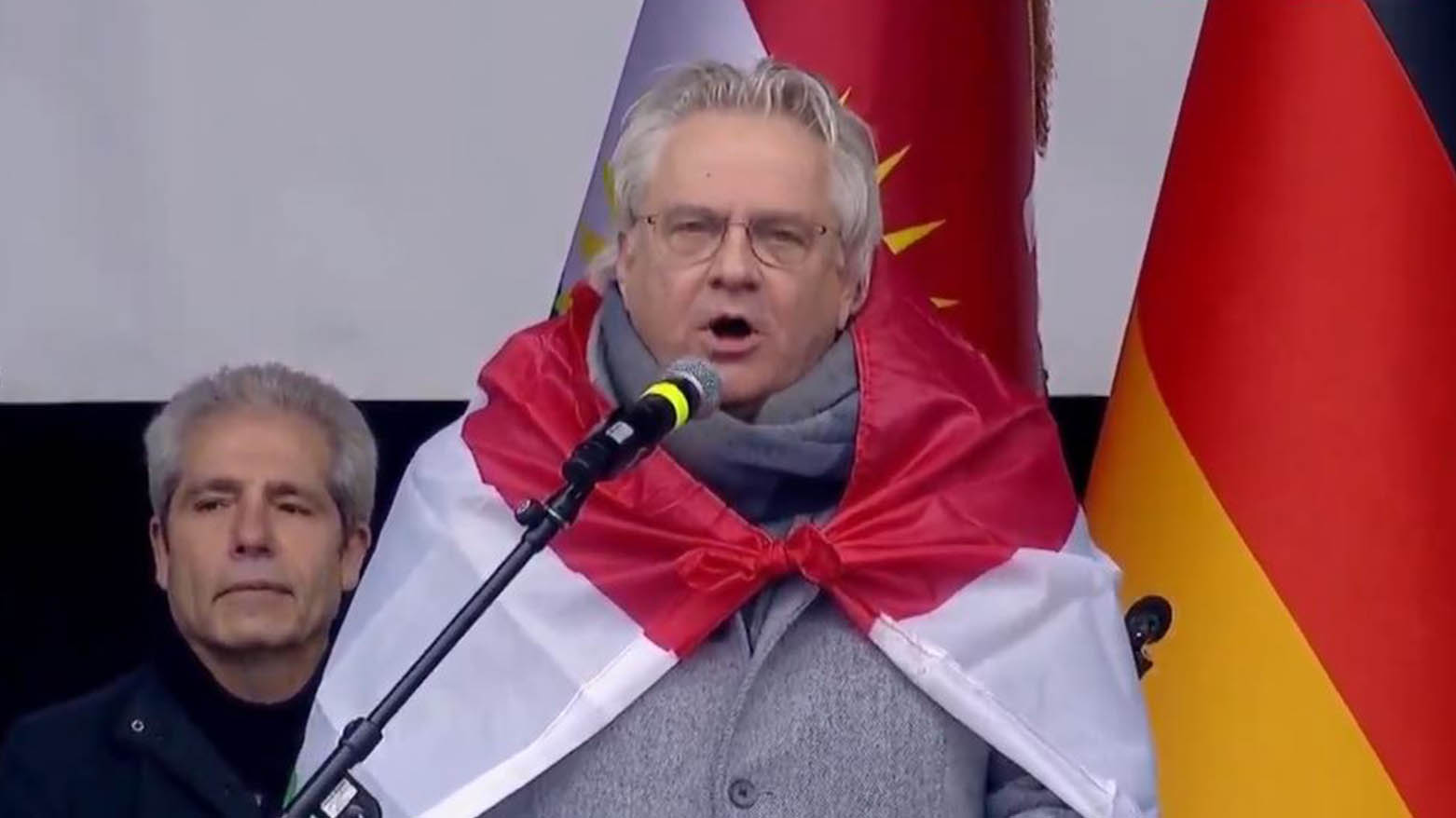
ERBIL (Kurdistan24) - The mayor of Cologne on Saturday called for the provision of international protection and political independence for the Kurdish region of northeastern Syria, known as Rojava, joining more than 40,000 demonstrators in a massive show of solidarity against a backdrop of escalating regional instability.
The remarks by the mayor of Cologne Dr. Ralph Elster mark a significant escalation in political advocacy for the Kurdish cause within the European Union’s most populous nation.
Addressing a crowd that organizers described as the largest diplomatic and public demonstration in the history of the Kurdish diaspora, Dr. Elster stated that, as an official party in Germany, his administration demands the establishment of lasting peace and a sovereign status for the autonomous region.
He emphasized that the international community must break its silence regarding the current threats facing the territory, characterizing the protection of its various ethnic and religious components as a non-negotiable humanitarian and moral obligation.
The demonstration, organized by the Kurdistani Diaspora Confederation, drew participants from across Germany, including the cities of Bonn and Cologne, to highlight what officials described as a "dangerous and unfortunate" situation unfolding in northern Syria.
Dr. Elster noted that while the community had gathered in previous years to celebrate cultural milestones such as Newroz, the current assembly was driven by acute distress over the humanitarian landscape.
"Today we have not gathered for celebration or festivity," Dr. Elster told the assembled crowd, citing deep concern over the reports of violence and the activities of irregular militias.
The mayor issued a specific warning regarding the resurgence of extremist elements, noting that armed groups currently operating in the region allegedly include individuals previously affiliated with the Islamic State (ISIS) who have recently been released from detention.
Dr. Elster expressed a visceral fear that the "oppression and misery" previously visited upon other regional minorities, specifically the Druze and Alawite communities, could soon be repeated against the Kurds, Yezidis, and other groups within Rojava.
He argued that the world has a duty to ensure these populations can live with dignity and security, protected from the encroachment of terrorist organizations.
The event featured a high-level diplomatic message from President Masoud Barzani, which was read to the crowd by Shifa Barzani, the Director General of the Kurdistani Diaspora Confederation. In the statement, President Barzani praised the national stance of the Kurds living abroad, describing their unified voice as a source of national pride.
He reflected on the "grave injustice" of the 20th-century division of Kurdistan, asserting that decades of repression had failed to break the collective will of the Kurdish people to secure their legitimate rights.
President Barzani’s message paid tribute to the historical role of Kurdish forces in the territorial defeat of ISIS, reminding the international community that the "blood of Kurdish youth formed a defensive shield not only for Kurdistan but for humanity as a whole."
He warned that Rojava has entered a new and complex phase of vulnerability and called upon Western countries to act responsibly to prevent the repetition of previous humanitarian catastrophes.
Shifa Barzani, speaking on behalf of the Confederation, emphasized that the movement currently taking shape across Europe transcends specific political parties or ideologies.
He characterized the Bonn gathering as a critical moment for uniting diaspora efforts into a form of tangible political advocacy that can influence international parliaments, including those in the United States, Norway, Sweden, and the broader European Union.
The ultimate objective of this initiative, according to the Director General, is to secure international guarantees for the constitutional, political, and civil rights of Kurds across all regions.
The significance of the Bonn rally is amplified by Germany’s role as the primary hub for the Kurdish diaspora in Europe.
According to regional analysts, the public sympathy expressed by local officials like Dr. Elster serves as a form of political pressure on the German federal government and the European Union to adopt a more interventionist role in protecting the stability of Rojava.
This support is viewed not only as a humanitarian response but as a strategic necessity, given that the resurgence of extremist groups in the Middle East has a direct and measurable impact on European internal security.
During his address, the Mayor of Cologne praised the organizers for the "democratic, calm, and peaceful manner" in which the massive demonstration was conducted. He specifically cited the full coordination between the protesters and the German police as an example of the diaspora's commitment to the rule of law.
The rally concluded with a reiterated demand from the Kurdistani Diaspora Confederation for an immediate end to hostilities and the lifting of sieges currently affecting Kurdish urban centers.
Organizers and speakers alike framed the event as a turning point in Kurdish-American and Kurdish-European relations, seeking to transform cultural solidarity into formal diplomatic influence during a period of shifting global alliances.