Kurdistan24 Exclusive: Iraqi Kurdish Presidential Candidate on US Friction, ISIS, and a Major Political Trade
KDP presidential candidate Fuad Hussein has offered to trade four major ministerial posts to the PUK for the presidency. He also addressed US opposition to Nouri al-Maliki and confirmed Iraq's plan to repatriate thousands of ISIS militants from Syria with international financial support.
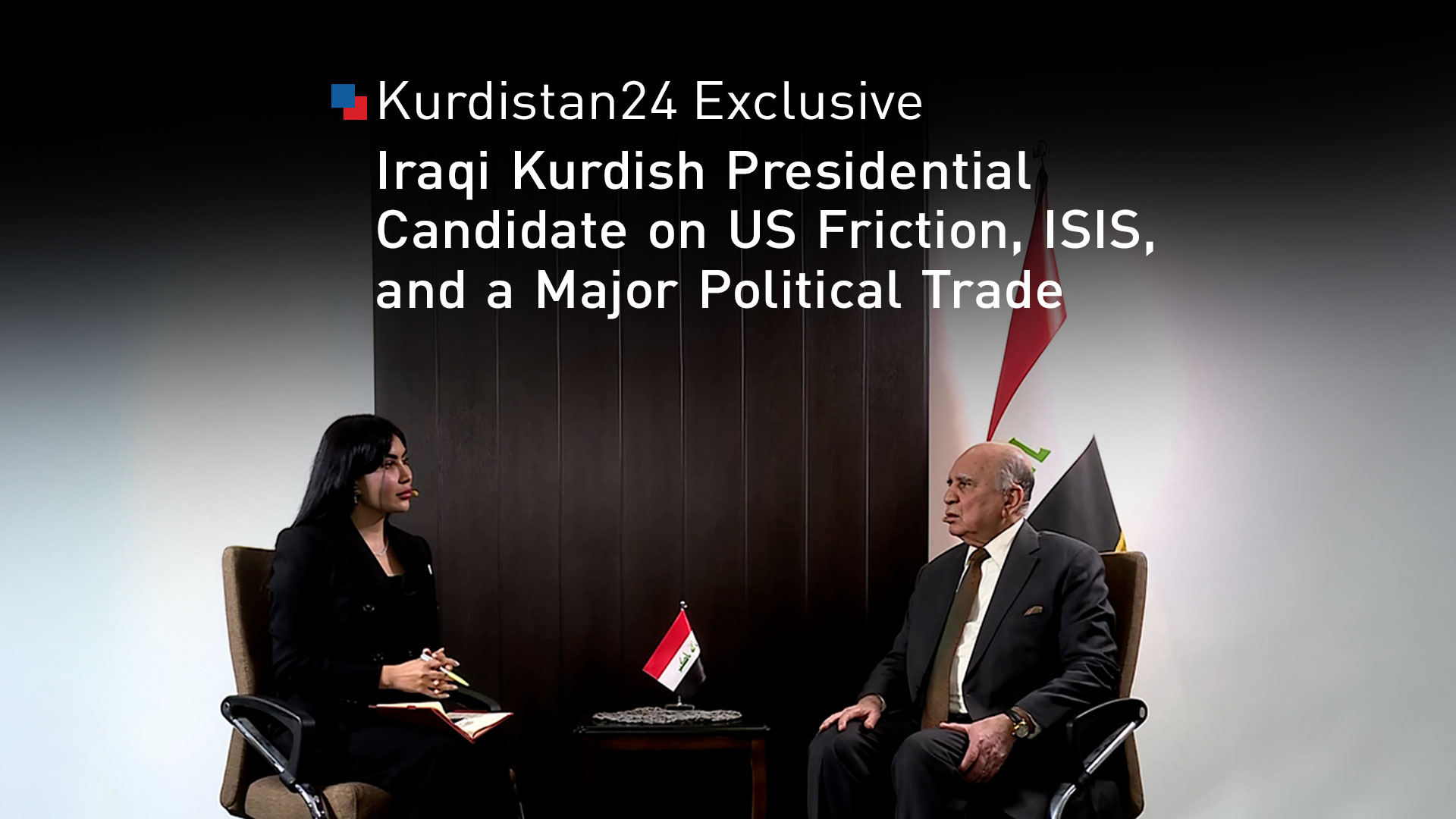
ERBIL (Kurdistan24) - In the heart of Baghdad, amidst a climate of intense political deliberation and shifting regional alliances, Dr. Fuad Hussein, the Kurdistan Democratic Party (KDP) candidate for the Iraqi presidency, sat down for an exclusive interview with Kurdistan24. As Iraq stands at a critical juncture in its government formation process, Hussein provided a comprehensive roadmap of the negotiations between Erbil and Baghdad, the security challenges posed by the remnants of ISIS, and the delicate diplomatic balancing act involving Washington and regional powers.
The interview opened with the imminent arrival of a high-level delegation from the Coordination Framework in Erbil. Hussein confirmed that Prime Minister Mohammed Shia al-Sudani, alongside Hadi al-Amiri and Mohsen al-Mandalawi, is scheduled to meet with President Masoud Barzani on Monday. The primary objective of the visit is to resolve the deadlock surrounding the establishment of the new Iraqi government, specifically addressing the positions of the President of the Republic and the Prime Minister.
Dr. Fuad Hussein, the Kurdistan Democratic Party’s candidate for the Presidency of Iraq, has detailed a high-stakes proposal to resolve the executive deadlock, revealing that the KDP is prepared to trade key ministerial portfolios for the nation’s highest office. As the Iraqi capital awaits the formation of a new government, Hussein emphasized that the KDP is leveraging its significant electoral weight to navigate both internal Kurdish disagreements and the broader international friction surrounding the nomination of Nouri al-Maliki for the premiership.
The political landscape is set to shift on Jan. 31, 2026, as a high-level delegation from the Coordination Framework, comprised of Prime Minister Mohammed Shia al-Sudani, Hadi al-Amiri, and Mohsen al-Mandalawi, travels to Erbil to meet with President Masoud Barzani. The discussions are expected to center on the establishment of the new Iraqi government, specifically the selection of the President and the Prime Minister. While rumors suggested the delegation is seeking Erbil’s mediation between Baghdad and Washington regarding US dissatisfaction with Nouri al-Maliki, Hussein noted that while the US stance will be discussed, the primary focus remains on securing a unified Kurdish position.
Addressing the friction between Washington and the Coordination Framework, Hussein acknowledged that US President Donald Trump and several US senators have signaled opposition to Maliki. He revealed that while the Framework reaffirmed Maliki as their candidate during a recent meeting, the international dimension remains complex. Hussein noted that Marc Savaya is no longer in his post and that Tom Barrack, U.S. Ambassador to the Republic of Türkiye and Special Envoy for Syria and representative in Lebanon, is now active regarding Iraqi affairs. Hussein suggested that Iraqi officials should travel to Washington to determine if the US opposition is a permanent or temporary stance against a specific individual or a political direction.
In an effort to break the stalemate with the Patriotic Union of Kurdistan (PUK), Hussein detailed a significant offer made during his discussions with Qubad Talabani. The KDP has proposed to relinquish its currently held positions in Baghdad—including the Deputy Prime Minister, the Foreign Minister, the Minister of Construction, and the Deputy Speaker of Parliament—to the PUK in exchange for the presidency. Hussein grounded this demand in the KDP’s status as the majority Kurdish force, noting the party holds 32 seats with 1,130,000 votes, compared to the PUK’s 18 seats and approximately 400,000 votes.
“This is not a personal matter,” Hussein stated. “I see that the President of the Republic is designated for the Kurdish component, and the Kurdish component has the right to choose. The KDP, as the majority, has the right to nominate someone, and the rest remains for the parliamentarians to decide who will become president.” If no bilateral agreement is reached within the next five or six days before the parliamentary session, the matter will be decided through a competitive vote in the legislature.
Beyond domestic politics, Hussein addressed the security crisis involving ISIS militants held in Hasakah, Syria. He confirmed that the Iraqi federal government has accepted, in principle, the repatriation of these individuals to prevent potential escapes. Out of approximately 8,000 militants discussed, between 2,000 and 3,000 are Iraqi nationals, many of whom are high-ranking and dangerous leaders. Hussein stipulated that repatriation is contingent upon international assistance from the West, both in terms of security and funding, to manage the long-term incarceration costs. He further noted that the courts used by the Syrian Democratic Forces (SDF) lack international recognition, requiring these criminals to be tried under Iraqi jurisdiction.
Regarding the situation in Western Kurdistan, Hussein expressed support for the ceasefire and the agreement between the SDF and the Syrian government in Damascus, highlighting the importance of security along the Iraqi border. He lauded the historic and sensitive role of President Masoud Barzani in mediating between Damascus and the SDF leadership, noting that both sides have historically listened to his counsel. Regarding regional tensions involving Iran, Hussein advocated for "sulh" or peace, asserting that Iraq remains committed to dialogue to prevent the adverse effects of war in the region.
The full interview:
Presenter: Greetings to all Kurdistan 24 viewers. From Baghdad, the capital of Iraq, we have a very important guest. We have many questions for him at this sensitive time regarding developments, past events, and their impact on the future. Dr. Fuad Hussein, the Kurdistan Democratic Party (KDP) candidate for the post of President of the Republic of Iraq—welcome, sir.
Dr. Fuad Hussein: Thank you.
Presenter: An important question: let's start with the components of the Shiite Coordination Framework who are scheduled to meet with President [Masoud] Barzani tomorrow. Who does that delegation consist of, and what will they discuss with President Barzani?
Dr. Fuad Hussein: From what I understand, the delegation consists of Mr. [Mohammed Shia’] al-Sudani, Mr. Hadi al-Amiri, and Mr. Mohsen al-Mandalawi. They are scheduled to go to Erbil tomorrow to meet with the President. Naturally, the discussion relates to the formation of the new Iraqi government, whether it concerns the President of the Republic or the Prime Minister.
Presenter: It has been said that this delegation is going to Erbil so that Erbil can mediate between Baghdad and Washington, as there is American dissatisfaction regarding Nouri al-Maliki’s candidacy for the post of Prime Minister. Is this true?
Dr. Fuad Hussein: I don’t believe that is the primary reason for the visit. However, the nature of Washington’s stance regarding Mr. Nouri al-Maliki will certainly be part of the discussion. The core purpose of the delegation’s visit relates to the issue of the Presidency—whether the PUK and KDP can reach a unified position and a single candidate—and it also relates to the Prime Minister’s post in Iraq. These issues are interconnected, but the American position will definitely be discussed.
Presenter: Is it true that the election of the President of Iraq is tied to the candidate for Prime Minister? Are these two issues or agreements linked?
Dr. Fuad Hussein: Generally speaking, from a legal perspective, they are not linked. However, without a President, there can be no Prime Minister, because the President is the one who tasks the Prime Minister [with forming a government]. The problem is the structural nature of the government in Baghdad; the reality is that a President must be elected so that a Prime Minister can be designated. In reality, the "Coordination Framework" had made their decision and chosen Mr. Maliki, but this American stance caused debate within the Framework itself. Last night, not all parties in the Framework were present, but those who were reaffirmed that Maliki is their candidate. Now, we will see how they handle it.
Presenter: Is there any possibility that the Coordination Framework will change Nouri al-Maliki?
Dr. Fuad Hussein: I don't know; I cannot give an opinion on that. That decision lies with the Shiite leaders. As of this moment, I see that Maliki is still the candidate.
Presenter: Regardless of whether Nouri al-Maliki is changed or not, what changes will occur in the political, security, and economic process in Iraq? We see Washington saying that if Maliki becomes Prime Minister, they will cut all financial aid, and Senators are making threats. Where is Iraq headed?
Dr. Fuad Hussein: What you are saying is true; it was mentioned in Trump’s tweet and by one or two Senators. Naturally, Iraq has not yet attempted to clarify in Washington whether this perspective is temporary or permanent; there has been no formal discussion with the Americans yet. We have discussed it with them here [in Baghdad] and spoken over the phone, but because we are busy with these elections, we haven't been able to dedicate ourselves to it. The best course of action would be to go to Washington to discuss whether this is a permanent or temporary stance. Is it a stance against a person or a policy direction? If it is against a direction, let’s discuss what that direction is and how to solve it. If it is against a person, why and how? Because Maliki was proposed for Prime Minister until five or six days ago and there were no objections—neither to his person nor his direction—but after the tweet, the situation changed.
Presenter: They say there is an internal Iraqi hand behind this issue or behind Trump’s statement. Is this true?
Dr. Fuad Hussein: I won’t comment on that; it hasn't been investigated, but they certainly received information from various sides.
Presenter: Is Marc Sievers still there or not? If not, who is his deputy?
Dr. Fuad Hussein: From what I have read, and I believe this to be true, he is no longer there. Is there a deputy? I don’t think so. From what I know, Tom Barrack—who was the US Ambassador to Turkey and Trump’s representative for Lebanon and Syria—is now also involved with Iraq.
Presenter: Moving to today: the Iraqi Parliamentary session to elect the President was postponed. What was discussed in the last meeting between the KDP and PUK? Was an agreement reached?
Dr. Fuad Hussein: The last meeting was between Mr. Qubad [Talabani] and myself. We had a long discussion about the status of political forces, the situation in Kurdistan, and the regional government. Aside from that, we discussed the Presidency. I told him that we, as the KDP, are ready to hand over the positions we currently hold in Baghdad—such as Deputy Prime Minister, Foreign Minister, Minister of Construction, and Deputy Speaker of Parliament—to the PUK in exchange for the post of President of the Republic.
Presenter: So, the KDP is willing to give up the post of Second Deputy Speaker of Parliament to the PUK in exchange for the Presidency?
Dr. Fuad Hussein: Yes, we discussed this. Whether they want it or not, or how they discuss it within their leadership, I don’t know, but we have made this proposal.
Presenter: Are you personally determined to become the President of Iraq?
Dr. Fuad Hussein: This is not a personal matter. I see that the Presidency is designated for the Kurdish component, and the Kurdish component has the right to choose someone. The KDP, as the majority, has the right to nominate someone, and the rest is up to the Members of Parliament to decide who becomes President.
Presenter: Do you plan to have another meeting between the KDP and PUK? If so, when and between whom?
Dr. Fuad Hussein: I imagine one of the tasks of the Framework delegation is to bring the KDP and PUK closer together and find a solution for the Presidency. They are going to Erbil and then later to Sulaymaniyah.
Presenter: Is it truly because of the KDP-PUK disagreement that a President isn't being elected, or are there other reasons?
Dr. Fuad Hussein: The election mechanism is such that we either agree on one person, or if we don't, an election is held in Parliament. The KDP suggested that Kurdish MPs in Baghdad sit together and elect one person to be the Kurdish candidate, or that the political forces use the same mechanism used for the Sunnis, or simply use the parliamentary mechanism.
Presenter: If the Coordination Framework delegation asks President Barzani tomorrow for the KDP to withdraw its candidate, would you be willing?
Dr. Fuad Hussein: Personally, I will implement whatever decision the party makes. However, I don’t believe President Barzani would make that decision. In exchange for what? The KDP is a large party with 31 seats, while the PUK has 18. Based on the number of voters, the KDP has 1,130,000 votes, while the PUK has about 400,000. Therefore, the KDP has the right [to the post].
Presenter: Can we say the political equations in Iraq are changing?
Dr. Fuad Hussein: We need to change the equation in Baghdad because the domestic, regional, and global situations require it. The KDP, as a major force, can play an important role both in Iraq and at the regional level.
Presenter: Will the post of President be settled this week?
Dr. Fuad Hussein: Parliament has set a time; there are five or six days left for discussion and reaching an agreement. If an agreement isn't reached, it will become a competition within Parliament.
Presenter: Moving to the issue of Syria and the ISIS prisoners being returned to Iraq—how many have been returned so far?
Dr. Fuad Hussein: There are a large number in the Hasakah prison. We, as the federal government, have accepted in principle to bring them back because we fear they might escape or be released. Most of them are ISIS leaders and are dangerous. About 2,000 to 3,000 of them are Iraqis; we have discussed 8,000 people in total. The issue of their trial is also important because the courts under the SDF (QSD) are not internationally recognized. They have committed crimes and must be sentenced.
Presenter: What are your conditions for bringing them back?
Dr. Fuad Hussein: The condition is that the outside world, especially the West, must help both in terms of security and finances, because these people will need to be in prison for many years, and managing them is costly. If they are free, they are a threat; therefore, they must be controlled in prison.
Presenter: As the Iraqi government, how do you view the agreement between the SDF and Damascus?
Dr. Fuad Hussein: We would be very pleased to see a ceasefire and security in Syria, especially on the Iraqi border, and for there to be no threat to the Kurds in those areas. The borders are well-controlled now; Iraq today is not like 2014. We have a lot of information on ISIS movements, and we must remain prepared.
Presenter: How do you see President Masoud Barzani’s role in calming the tensions in Rojava (Western Kurdistan)?
Dr. Fuad Hussein: President Barzani’s role is well-known. He had contact with both Damascus and the SDF leadership, and both sides listened to him. It was a very sensitive and important role during the war.
Presenter: Regarding Iran and the tensions in the region, what is Iraq's role?
Dr. Fuad Hussein: As a government, we are not in favor of war in the region because it would have a negative impact. We hope a solution is found and we believe this issue can be resolved through dialogue. We have played a role before, and if we are asked, we will be at their service. I believe the possibility of "peace" is the better path.