President Barzani, Iraqi PM Sudani Hold Talks on Government Formation and Regional Developments
Coordination Framework delegation participates in discussions on the presidency, government formation, and Iraq’s stalled constitutional steps.
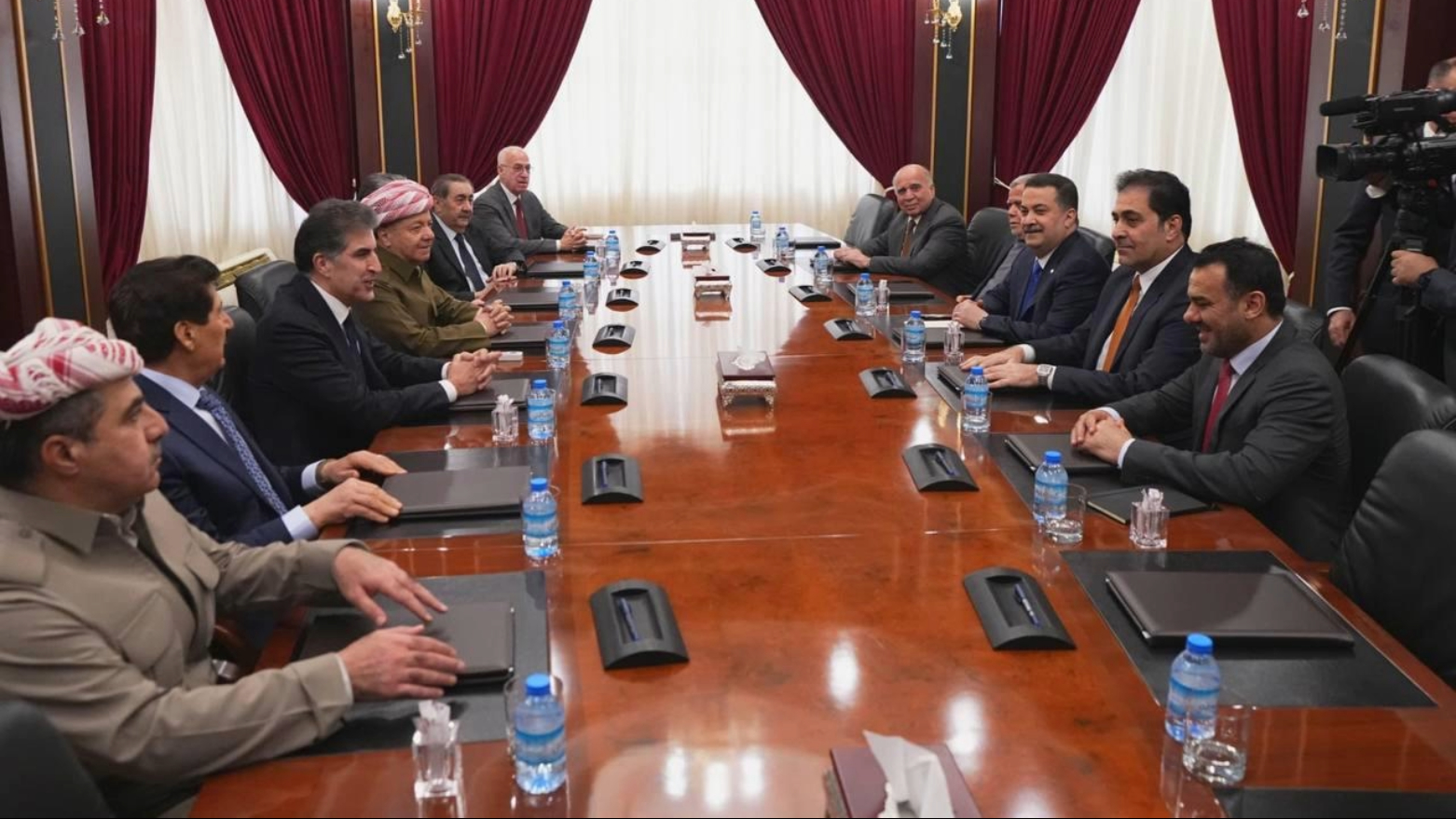
ERBIL (Kurdistan24) — Iraqi Prime Minister Mohammed Shia al-Sudani met on Monday with President Masoud Barzani, leader of the Kurdistan Democratic Party (KDP), in Pirmam, near Erbil, to discuss upcoming constitutional obligations, foremost among them the election of Iraq’s president, as efforts continue to complete the formation of a new federal government, reads a statement by Sudani's media office.
According to a statement from the federal prime minister’s media office, the meeting was attended by a senior delegation from the Shiite-led Coordination Framework, including Badr Organization Secretary-General Hadi al-Amiri, head of the Asas Coalition Mohsen al-Mandalawi, and Coordination Framework Secretary-General Abbas Radhi.
The talks focused on Iraq’s next constitutional steps, particularly the presidential election, which is seen as key to moving forward with government formation in line with the results of the parliamentary elections.
Iraq’s political process has been stalled amid repeated delays in parliament due to a lack of quorum and unresolved political disputes.
The meeting also addressed current regional developments, with a particular focus on the situation in Syria.
The meeting's discussions also addressed the importance of unifying Iraq’s national political discourse in response to regional changes and crises, in a way that strengthens Iraq’s position and safeguards its supreme national interests, reads the statement published by Sudani's media office.
The discussions come amid intensified political activity aimed at breaking the prolonged deadlock over Iraq’s top leadership positions, as well as growing regional uncertainty that has placed additional pressure on Baghdad to present a unified and coherent political stance.
The talks also took place against the backdrop of growing international pressure over the choice of Iraq’s next prime minister. U.S. President Donald Trump has publicly rejected the nomination of former prime minister Nouri al-Maliki for a return to the premiership, warning that Washington would end its support for Iraq if Maliki were selected.
The stance has deepened divisions within the Shiite political camp, with some leaders reportedly concerned about the risk of U.S. sanctions and the broader impact on Iraq’s fragile economy and international relations.
Meanwhile, Erbil has increasingly emerged as a hub of intense political activity, hosting a steady flow of senior Iraqi political leaders, top government officials, foreign diplomats, and envoys from international partners.
The surge in high-level visits reflects the urgency of discussions underway on Iraq’s political deadlock, regional developments—particularly in Syria—and broader strategic challenges facing the country.
As Baghdad struggles to move forward on key constitutional milestones, Erbil has become a focal point for dialogue aimed at easing tensions and shaping the next phase of Iraq’s political process.