Iraqi PM Orders Termination of Over 100 Advisory Contracts Amid Cost-Cutting Drive
Sudani's Decision Comes as Truck Drivers Protest Fees in Kirkuk and Traders React to Higher Customs Tariffs
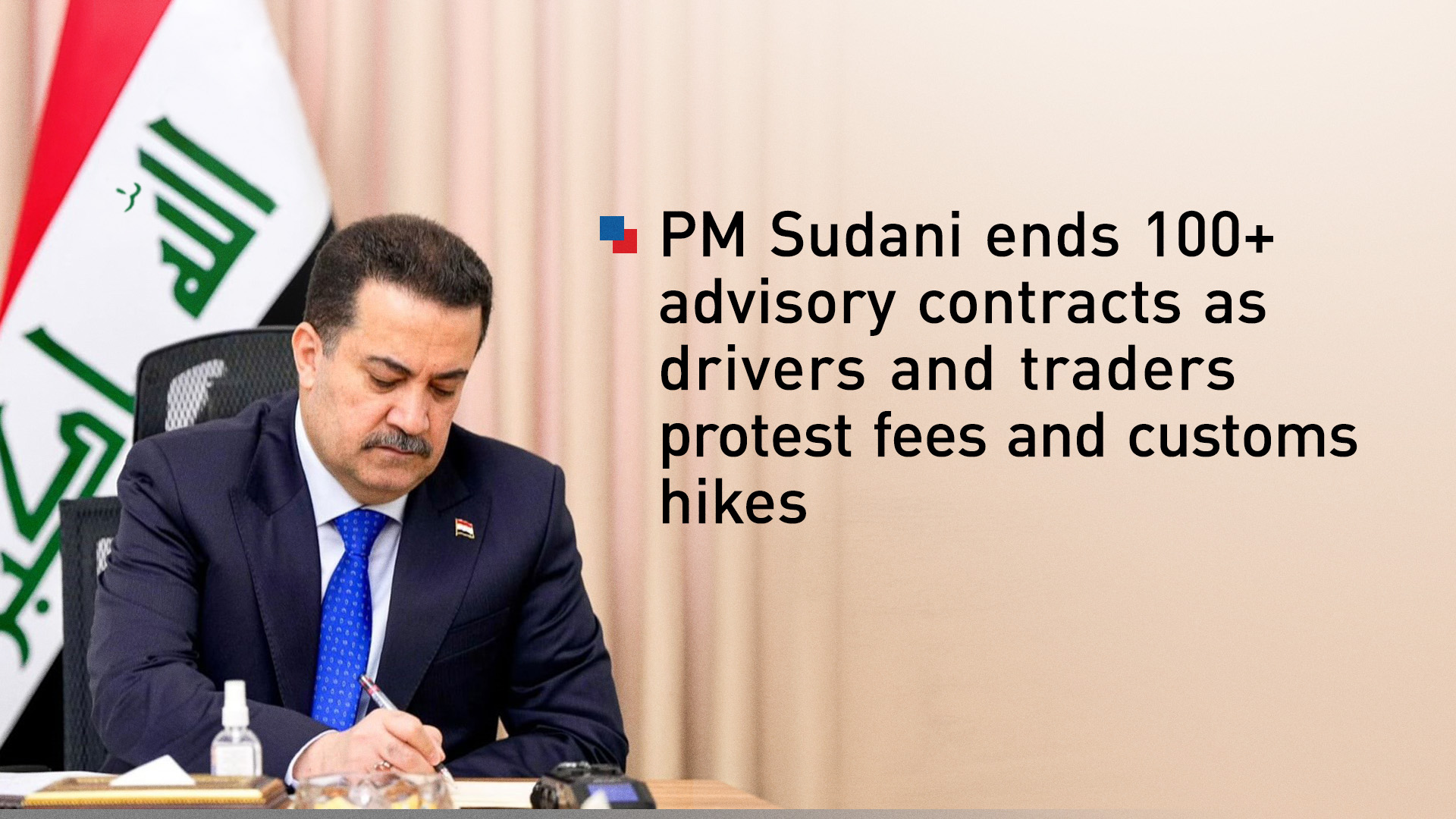
ERBIL (Kurdistan24) — Iraqi Prime Minister Mohammed Shia al-Sudani has ordered the termination of more than 100 contracts for advisers and experts working within the Prime Minister’s Office, according to a statement released Monday by his media office.
The decision, per the statement, is part of broader government efforts to streamline administrative structures and reduce public spending. The statement noted that the move aligns with directives issued by Prime Minister Sudani to reorganize and rationalize the internal framework of his office, with the dual objective of cutting expenditures and enhancing operational efficiency.
Several of the terminated advisers had been tasked with overseeing and managing sensitive and strategic government files, particularly in the implementation of federal programs. The statement stressed that overall completion rates of those programs have reached 88 percent, suggesting that many projects are nearing their final stages.
According to information obtained by Kurdistan24’s correspondent in Baghdad, the contract termination process began approximately two weeks ago. The affected advisers, who possess diverse areas of expertise, had reportedly been working in the Prime Minister’s Office for nearly four years.
The decision comes amid mounting fiscal pressures and forms part of a broader package of measures introduced by Sudani’s government aimed at increasing state revenues and reducing public expenditures.
These steps have included terminating advisory contracts, imposing higher customs tariffs on traders, and cutting certain financial allowances for low-income government employees, as Baghdad seeks to address budgetary constraints and narrow the fiscal deficit.
Truck Drivers Protest Alleged “Illegal Fees” in Kirkuk
In a related development, tensions flared again in southern Kirkuk, where truck drivers staged a protest at the Maktab Khalid checkpoint. Drivers transporting goods from Hawija, Rashad, and surrounding areas halted their vehicles, causing traffic disruptions along the main route.
Protesters accused authorities at the checkpoint of imposing excessive and illegal fees under the pretext of taxes and weighbridge charges. One driver told Kurdistan24 that while officials initially stated that only 5,000 Iraqi dinars would be collected for weighing services, additional payments are now being demanded.
“This is not just a tax; it is extortion,” the driver alleged, claiming that vehicles are sometimes allowed to pass without inspection if payments are made or connections are used, while others are delayed.
Another driver said he passes through the checkpoint three to four times daily and must pay each time, adding that weighbridges are often non-functional and “exist only to collect money.”
Drivers stated they had previously appealed to Kirkuk local authorities, but any improvements were temporary, with the fee system resuming shortly afterward. They called on local and security authorities to establish a transparent and lawful taxation mechanism that does not threaten their livelihoods.
Customs Hike Reshapes Trade Flows Toward Turkey
Meanwhile, recent changes to Iraq’s customs policy have begun reshaping regional trade patterns. Traders report that the government’s decision to increase customs valuations on imported goods—particularly from China—has significantly raised costs.
Previously, customs duties on certain Chinese goods ranged between $100 and $150 per cubic meter. Traders say those rates have now increased to between $300 and $400, prompting many Kurdish and Iraqi merchants to shift sourcing to Turkey.
As a result, Istanbul’s Mertera textile market has seen a notable uptick in activity, fueled by Iraqi and Kurdish buyers. Merchants cite faster shipping times—three to four days from Turkey compared to much longer transit periods from China—as an additional incentive.
According to traders, thousands of Iraqi containers remain held at the port of Umm Qasr, resulting in significant financial losses. While Mertera had previously suffered from Turkey’s domestic economic downturn, Iraqi demand has injected new momentum into the district.
Over recent weeks, thousands of traders across Iraqi cities—including Mosul, Basra, Baghdad, and Kirkuk—have closed their shops and staged protests against increased taxes and customs measures. Large demonstrations have also been held by federal government employees and teachers opposing salary cuts and reductions in financial entitlements.
Protesters argue that instead of raising taxes on citizens and small businesses, the government should prioritize tackling corruption and improving fiscal management.
Taken together, the developments reflect the delicate balancing act facing Sudani’s administration: implementing fiscal consolidation measures while navigating growing public discontent over economic strain and governance challenges.