Journalists and Media Activists in Syria's Afrin Region Call for Press Freedom and Kurdish Language Recognition
Journalists and media activists from Afrin issued a statement urging the local administration to strengthen press freedom, allow the safe return of displaced journalists, and recognize Kurdish alongside Arabic in official communications.
ERBIL (Kurdistan24) - A group of journalists and media activists from the Afrin region in Western Kurdistan (Northwest Syria), issued a statement addressed to the local administration, calling for stronger guarantees for press freedom and improved conditions for media work in the area in line with international principles of freedom of expression.
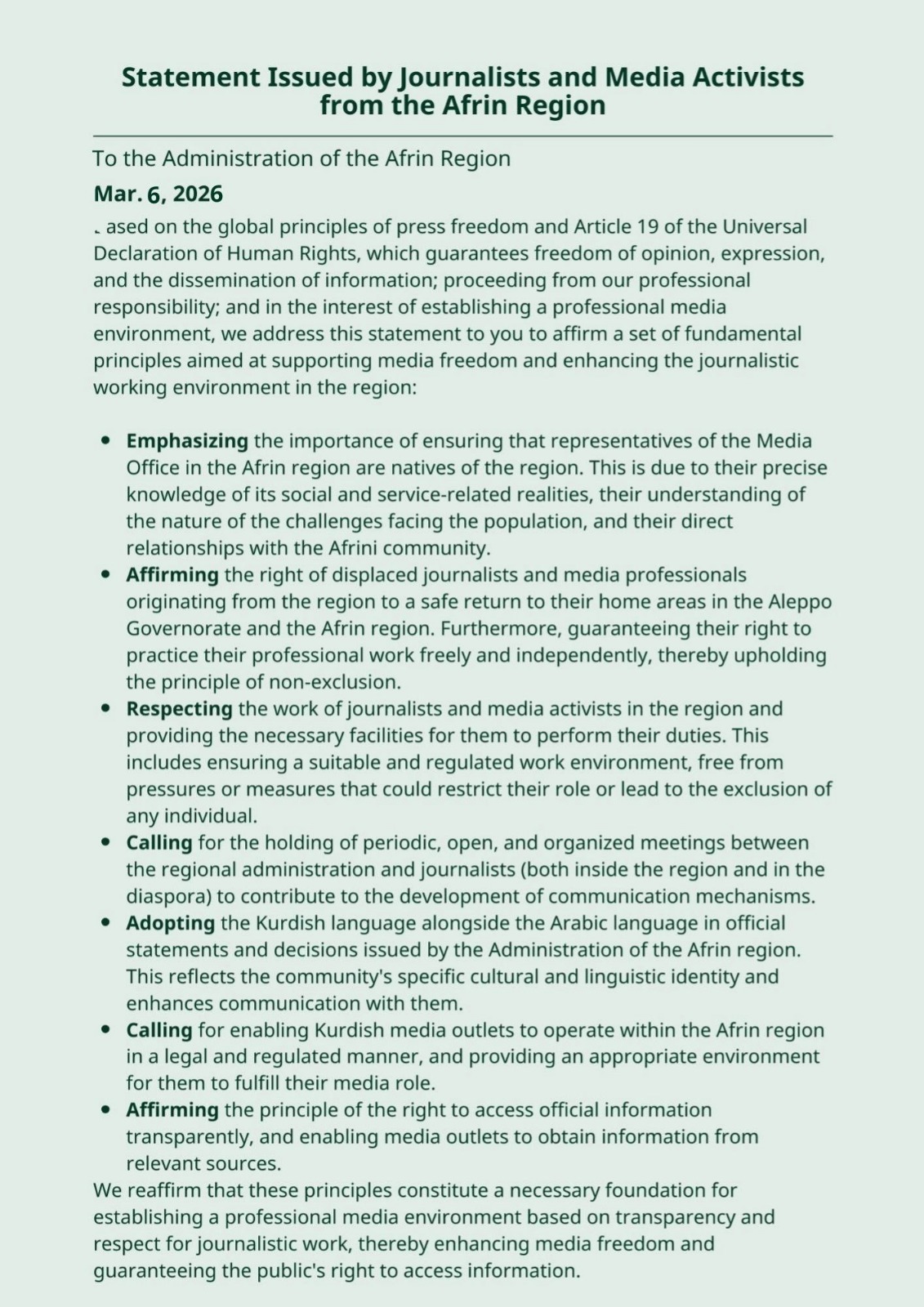
In the statement, the signatories said their demands are based on global principles of press freedom and on Article 19 of the Universal Declaration of Human Rights, which guarantees the right to freedom of opinion, expression, and the exchange of information.
They stressed their commitment to establishing a professional media environment built on transparency and cooperation in the region.
The journalists also emphasized the importance of appointing representatives of the media office in Afrin from among the region’s residents, arguing that local journalists are more familiar with the area’s social and service realities, the challenges faced by residents, and maintain direct connections with the community.
The statement further called for ensuring the right of displaced journalists and media workers from the region to safely return to their original areas in Aleppo province and the Afrin region, allowing them to practice their profession freely and independently without exclusion.
Signatories also urged authorities to respect the work of journalists and media activists and to provide the necessary facilitation for them to perform their duties, ensuring a suitable working environment free from pressure or procedures that may restrict their role or marginalize any of them.
They proposed holding a regular, open, and organized meeting between the region’s administration and journalists and media workers both inside the region and in the diaspora to improve communication mechanisms and strengthen cooperation.
In addition, the statement called for adopting the Kurdish language alongside Arabic in official statements and decisions issued by the Afrin regional administration, reflecting the cultural and linguistic characteristics of the local community and improving communication with residents.
The journalists also stressed the need to enable Kurdish media outlets to operate in the region legally and in an organized manner, while ensuring an environment that allows them to perform their journalistic role.
In the conclusion of the statement, the signatories said these principles are essential to establishing a professional media environment based on transparency and respect for journalistic work, strengthening media freedom and ensuring society’s right to access information.
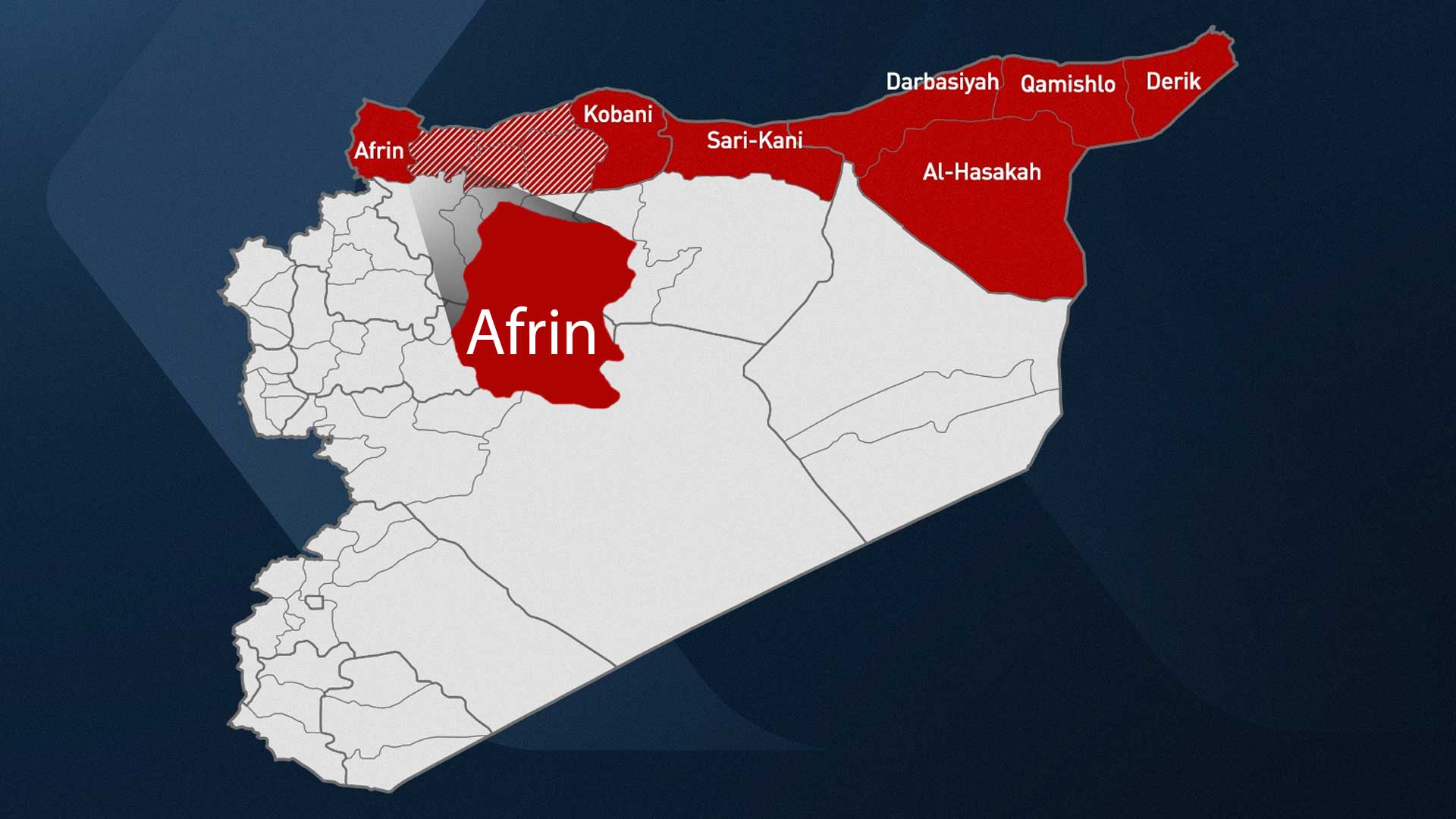
Afrin, a historically Kurdish-majority region in Western Kurdistan (Northwest Syria), has witnessed significant political and security upheaval since the 2018 'Olive Branch' operation, which displaced large numbers of its Kurdish residents.
Debates over the protection of Kurdish rights in the region have continued. Syrian President Ahmed al-Sharaa stated in a televised interview on Jan. 14, 2026, that Kurdish rights are guaranteed under Syria’s constitutional framework, emphasizing that Kurdish citizens are entitled to full citizenship rights, participation in state institutions, and representation in the army, security forces, and parliament.
However, a report published on Jan. 27, 2026, by the organization Syrians for Truth and Justice documented what it described as widespread violations affecting Kurdish residents in Afrin, particularly regarding housing, land, and property rights.
The report, based on 39 testimonies collected between May 2024 and July 2025, detailed alleged cases of property seizure, looting, arbitrary arrests, and intimidation targeting Kurdish property owners displaced from the region since 2018.
According to the organization, the violations involved elements and leaders linked to several factions of the Syrian National Army, including the Sultan Suleiman Shah Brigade, Sultan Murad Division, Hamza Division, Ahrar al-Sharqiya, and Ahrar al-Sham.
Testimonies cited in the report described confiscation of homes for military or residential use, settlement of fighters’ families in Kurdish properties, destruction of agricultural land—including uprooting hundreds of olive trees—and financial extortion in exchange for returning property.
The organization stated that such practices contradict Syria’s 2025 constitutional declaration, which affirms the protection of private property and prohibits confiscation without legal basis and fair compensation.
It also noted that arbitrary detention, threats, and torture described in the testimonies violate Syrian law and international human rights standards, including the Universal Declaration of Human Rights and the Geneva Conventions.
The report concluded that despite official assurances that Kurdish rights are constitutionally protected, the documented testimonies suggest ongoing challenges in Afrin related to displacement, property rights, and accountability.
Against this backdrop, the journalists’ statement highlights growing calls from local media workers for stronger protections for press freedom and a more inclusive and transparent media environment in Afrin.