Trump Dismisses Threats From Iranian Security Chief as War With Iran Intensifies
Trump dismissed threats from Iranian security official Ali Larijani in comments to CBS News while reaffirming that U.S. military operations against Iran would continue.
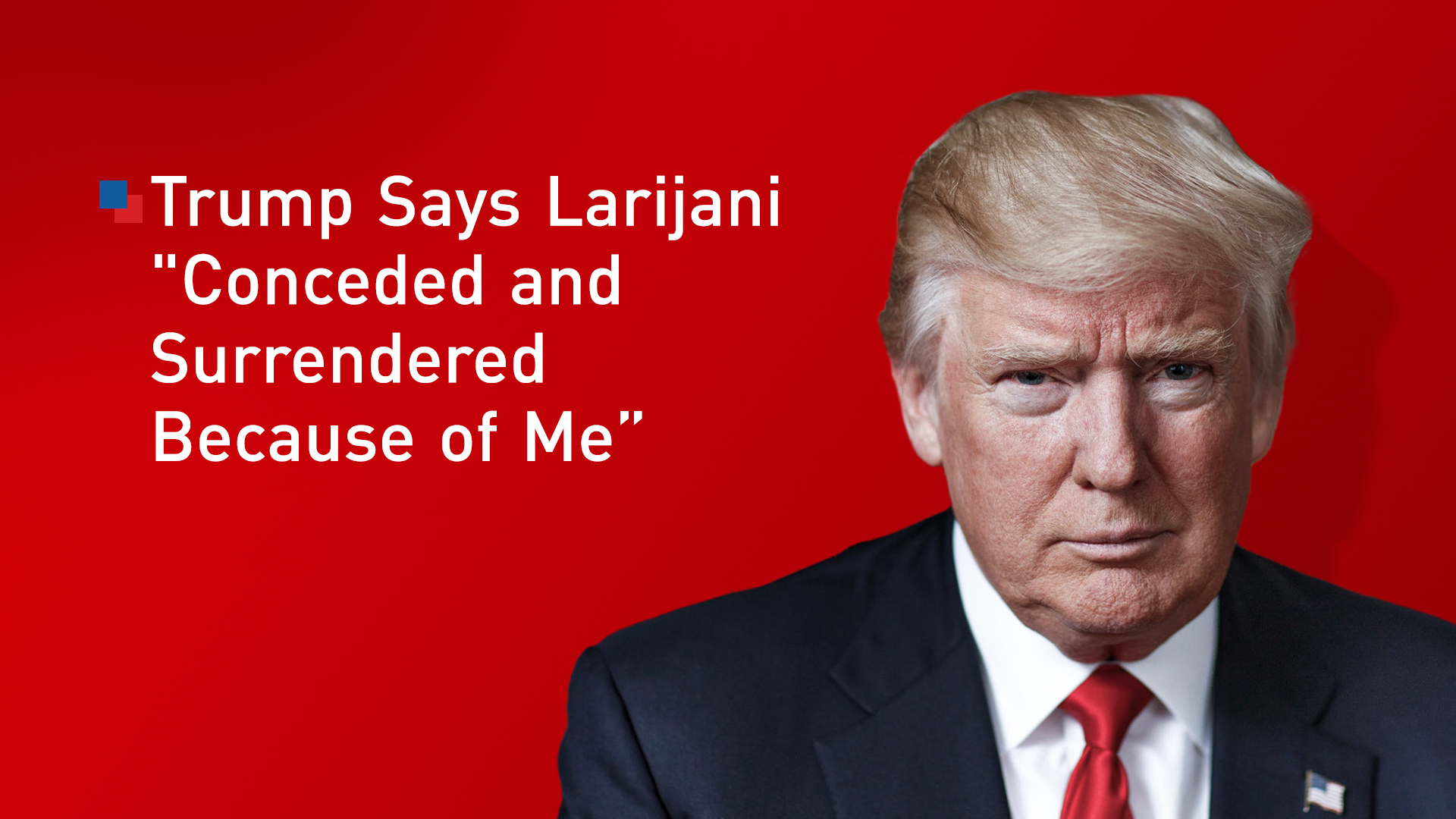
ERBIL (Kurdistan24) - U.S. President Donald Trump dismissed threats issued by Iranian security official Ali Larijani during a phone interview with CBS News on Saturday evening, saying he “couldn’t care less” about the warnings amid the ongoing U.S.-Israeli military campaign against Iran.
According to CBS News, Trump responded to statements posted earlier Saturday on social media by Larijani, who serves as secretary of Iran’s Supreme National Security Council. Larijani said the U.S. president must “pay the price” for strikes carried out by the United States and Israel against Iranian targets.
“I have no idea what he's talking about, who he is. I couldn't care less,” Trump told CBS News during the phone interview, according to reporting by the network. Trump added that Larijani had “already been defeated.”
Larijani has emerged as one of the most prominent Iranian political figures in the aftermath of the killing of Iran’s supreme leader during the first day of the current conflict on Feb. 28, according to CBS News. The development has reshaped the country’s leadership dynamics while military exchanges between Iran and its adversaries have intensified.
Trump used the interview to reject the warnings from Larijani and other Iranian officials, describing their statements as weak and arguing that Iran’s influence in the region had diminished. According to CBS News, Trump reiterated that U.S. military operations would continue as he demands what he described as an “unconditional surrender” from Iran.
“He intended to take over the Middle East and he's conceded and surrendered to all of those countries because of me,” Trump told CBS News when asked about Larijani. “He's already surrendered to all of the Middle Eastern countries because he was trying to take over the entire Middle East.”
Trump also claimed that Iranian missile systems had been previously directed at neighboring countries, suggesting those weapons had been part of earlier plans for regional expansion. According to CBS News, the president said those plans had existed “long before this started.”
The exchange between Trump and Iranian officials reflects an increasingly direct rhetorical confrontation between Washington and Tehran as military operations continue across multiple theaters in the region.
Earlier in the day, Iranian President Masoud Pezeshkian released a video message addressing neighboring countries, according to CBS News. In the video, Pezeshkian apologized to Iran’s regional neighbors for retaliatory strikes carried out against Israel and U.S. bases in the Middle East.
However, CBS News reported that Pezeshkian later modified his remarks in a follow-up social media statement.
“We have not attacked our friendly and neighboring countries. Rather, we have targeted U.S. military bases, facilities, and installations in the region,” Pezeshkian wrote in the post, which did not include the earlier apology referenced in the video message.
The shifting tone in the Iranian president’s statements came as Iranian officials continue to respond publicly to the ongoing military campaign launched by the United States and Israel.
CBS News reported that the continuing verbal exchanges between the Trump administration and Iranian leaders underscore uncertainty about who the United States may engage with diplomatically in the coming weeks as Iran’s leadership structure evolves during the conflict.
While Larijani has become a prominent public voice, CBS News reported that Iran is currently governed by an interim three-person council that includes Pezeshkian. The council is playing a central role in managing state affairs while the country’s leadership transitions following the death of its previous supreme leader.
The interview with CBS News also included extensive comments from Trump regarding the progress of U.S. military operations in Iran.
Trump expressed strong confidence in the effectiveness of the campaign, saying the United States had inflicted severe damage on Iranian military capabilities since the start of the conflict.
“It’s been incredible, the job we’ve done,” Trump said during the interview. “The missiles are blow to smithereens.”
According to CBS News, Trump continued by asserting that Iran’s drone capabilities and weapons production facilities had also been targeted.
“They're down to very few. The drones are blown. The factories are being blown up as we speak,” Trump said.
Trump further claimed that Iran’s naval forces had been heavily damaged during the operations.
“The navy is gone, it's at the bottom of the sea. Forty-two ships, 42, in six days, 42 ships. The navy is gone,” he said, according to CBS News.
He also asserted that Iran’s air force and other military structures had been neutralized during the campaign.
“The air force is gone. Every single element of their military is gone. Their leadership is gone. There's not a thing that's not gone,” Trump told CBS News.
Separate information released by the U.S. Central Command provided additional details about the scope of the military operations.
According to U.S. Central Command, at least 43 Iranian ships have been damaged or destroyed in U.S. strikes since the start of the war. The command also said more than 3,000 targets have been struck during the campaign.
The data cited by CBS News indicates the scale of the military activity since the conflict began.
Trump also used the interview to express confidence in the broader strategy behind the military campaign.
“We're winning at levels never seen before and quickly,” he told CBS News.
The president’s remarks addressed not only the battlefield situation but also the response of U.S. allies and international partners to the conflict.
When asked whether he would like allied countries to take additional actions in support of the military campaign, Trump said he was primarily focused on the United States’ own operations.
“I couldn't care less,” Trump said when asked about allied contributions. “They can do whatever they want. The loyal ones are already in.”
His comments came hours after he referenced developments involving the United Kingdom on his social media platform Truth Social.
Trump wrote that the United Kingdom had prepared two aircraft carriers for possible deployment to the Middle East, according to CBS News.
However, during the interview with CBS News, Trump indicated that such a deployment would not be necessary.
“It’s a little bit late to be sending ships, right? A little bit late,” he said.
The president’s remarks were also directed at British Prime Minister Keir Starmer, whom Trump has criticized for what he described as delays in granting permission for U.S. forces to use British military bases in the Middle East during the initial phase of the strikes.
CBS News reported that Trump characterized the possible dispatch of aircraft carriers as a late gesture.
The continuing war has also prompted reactions from Iranian officials regarding Washington’s military strategy.
In remarks reported earlier, Larijani said the United States had misread the political and social dynamics of the region, according to statements cited by Kurdistan24.
Larijani said U.S. policymakers attempted to replicate in Iran a strategy similar to one previously pursued in Venezuela.
“The biggest problem for the Americans is that they do not understand the intellectual structure of West Asia, especially Iran,” Larijani said.
He argued that Washington had attempted to reshape the situation in Iran through military attacks designed to create shock and internal disruption.
According to Larijani, the strategy involved targeting senior leadership figures and military commanders to destabilize the country’s governing system.
He said the United States believed such actions could quickly end the conflict through intense strikes over a short period.
However, Larijani said Washington underestimated the reaction of the Iranian population.
“They did not consider that Iranians would not give up,” he said.
Larijani acknowledged that political differences exist within Iran but said the country’s population tends to unite when facing external threats.
“Our people may have disagreements, but when the nation is in danger they stand together and will not allow America’s plans to succeed,” he said.
He also suggested that countries in the region have begun to question Washington’s ability to provide stability in the Middle East.
Larijani added that Trump should acknowledge that the United States had made a mistake and had been misled by Israel in its approach toward Iran.
The competing narratives from Washington and Tehran highlight the continuing escalation in rhetoric alongside the ongoing military confrontation.
The conflict has produced a combination of military strikes, political statements, and diplomatic uncertainty as regional actors respond to rapidly changing developments.
The United States says its operations are intended to prevent Iran from acquiring nuclear weapons, while Iranian officials say the country is defending itself against what they describe as aggression by the United States and Israel.