Iranian and French Presidents Discuss Regional Developments in Phone Call
Iranian President Masoud Pezeshkian and French President Emmanuel Macron discussed the latest regional developments in a phone call, as Iran’s foreign minister reiterated that Tehran has not requested a ceasefire and will continue defending itself.
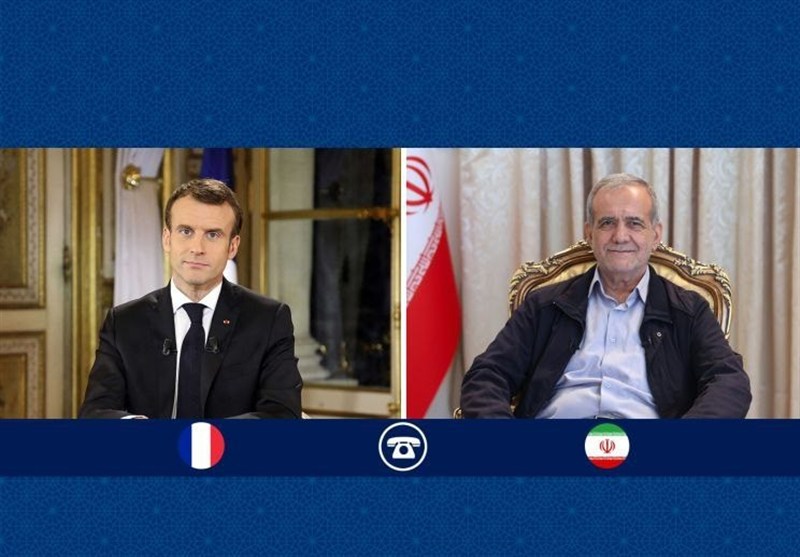
ERBIL (Kurdistan24) - A phone conversation between the presidents of Iran and France unfolded against the backdrop of intensifying regional tensions, as the two leaders reviewed the latest developments shaping the Middle East.
On Sunday, Iranian news agency Tasnim reported that Iranian President Masoud Pezeshkian and French President Emmanuel Macron held a telephone conversation during which they discussed the most recent developments and the current situation in the region.
According to the agency, the two leaders examined the latest changes and unfolding events across the region during the call, amid growing regional tensions linked to the ongoing conflict.
The conversation comes as Iran continues to respond to developments following the outbreak of war involving the United States and Israel.
Since the conflict began, Iran has repeatedly targeted US bases and installations belonging to Washington and its allies in the region using drones and missiles.
On Feb. 28, 2026, the United States and Israel launched airstrikes on Iran, which resulted in the deaths of several senior figures in the country.
Iran quickly responded to those strikes by launching several missiles toward Israel and targeting multiple US military bases and facilities across the region.
Separately, Iranian Foreign Minister Abbas Araghchi said Tehran has not requested a ceasefire and has no plans to return to negotiations with the United States, stressing that Iran is prepared to continue defending itself for as long as necessary.
During an interview with CBS, Araghchi addressed Iran’s stance on the ongoing conflict and negotiations with Washington.
Responding to a question about whether Iran had asked for a ceasefire, he said: “No, we never asked for a ceasefire, and we have never asked even for negotiation.”
He added: “We are ready to defend ourselves as long as it takes, and this is what we have done so far and we continue to do that until President Trump comes to the point that this is an illegal war with no victory.”
Araghchi also criticized what he described as statements from US officials, saying the conflict was initiated by Washington.
“This is a war of choice by President Trump and the United States, and we are going to continue our self-defense,” he said.
When asked whether the conflict was a war of survival for the Iranian government, Araghchi rejected the characterization.
“No, it’s not a war of survival. We are stable and strong enough. We are only defending our people from this act of aggression,” he said.
He also said Tehran sees no reason to resume talks with Washington.
“We don't see any reason why we should talk with Americans, because we were talking with them when they decided to attack us, and that was for the second time. There is no good experience talking with Americans,” he said.
Addressing accusations that Iran had targeted civilian areas in neighboring countries, Araghchi said: “No, no, this is not the fact. We are only targeting American assets, American installations, American military bases, everything belonging to Americans.”
He argued that American forces were operating from the territory of neighboring countries.
“These are the countries who have given their soil to American forces to attack us,” he said.
Araghchi also discussed the situation in the Strait of Hormuz, stating that the waterway remains open but that ships have been hesitant to pass due to security concerns.
“We're open to countries who want to talk to us about the safe passage of their vessels,” he said, adding that vessels belonging to several countries had already been allowed to pass safely.
The Iranian foreign minister also addressed Iran’s enriched nuclear material, saying the country’s nuclear facilities had been attacked.
“They are under the rubble. Our nuclear facilities were attacked and everything is under the rubble,” he said, noting that retrieval could occur under the supervision of the international agency if Tehran decides to do so.
Araghchi also referred to earlier negotiations with US officials, saying Iran had offered to dilute its 60 percent enriched uranium during talks.
“That was one of the elements of a deal that we were negotiating with our American interlocutors,” he said. “But for the time being, nothing is on the table.”
He also commented on American citizens detained in Iran, saying: “Well, if the US and Israel do not attack our prisons, I guess they are safe.”
Addressing internet restrictions inside Iran, Araghchi said access had been limited due to security concerns during the conflict.
“Internet is closed because of the security reasons, because we are under attack, we are under aggression, and we have to do everything to protect our people,” he said.
Araghchi concluded that Iran would continue defending itself and that any future negotiations would depend on developments in the ongoing conflict.
The call between Pezeshkian and Macron highlights continued diplomatic engagement as regional tensions intensify amid the widening conflict.