Iraq’s Kataeb Hezbollah Announces Conditional Pause on Attacks Against U.S. Embassy
Five-day halt tied to Israeli actions in Lebanon as regional tensions continue to escalate
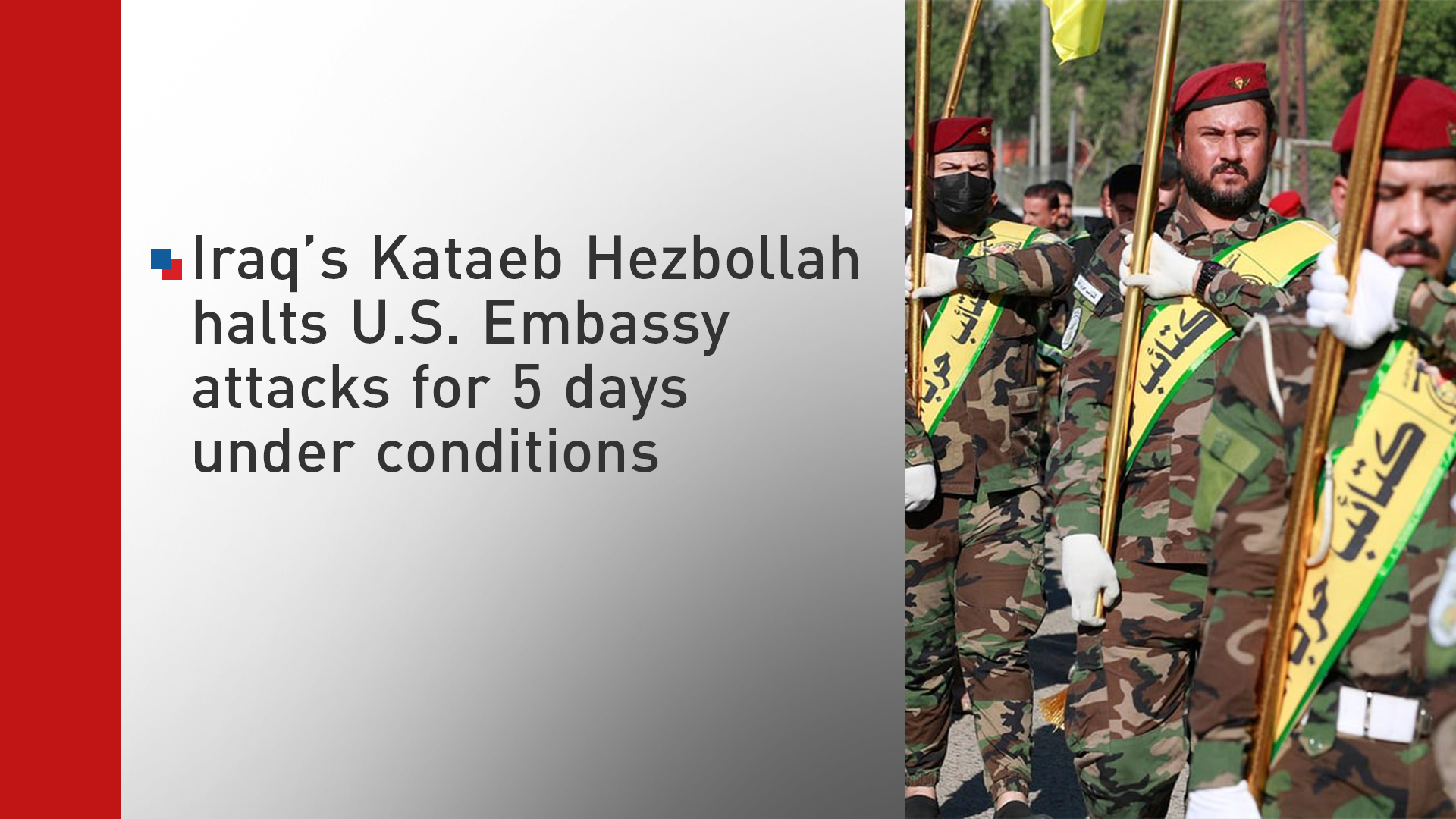
ERBIL (Kurdistan24) — The Iran-backed Iraqi armed group Kataeb Hezbollah announced on Thursday a temporary suspension of attacks on the U.S. Embassy in Baghdad, offering a five-day pause contingent on specific conditions tied to the broader regional conflict.
The group said its secretary-general had ordered a halt to operations targeting the embassy, following a recent wave of drone and rocket attacks. However, the pause is conditional, including a demand that Israel cease its strikes on Beirut’s southern suburbs—an area considered a stronghold of the Iran-backed Lebanese group Hezbollah.
Kataeb Hezbollah also called for a halt to airstrikes on residential areas in Baghdad and other Iraqi provinces, warning that any violation of the proposed truce would trigger an “immediate” response. The group further signaled that attacks could resume after the five-day period.
Despite the announcement, tensions remained high. Hours later, two fighters from the Popular Mobilization Forces (PMF) were killed in separate strikes targeting their positions in northern Iraq. The PMF said sites in the Nineveh region and Salah al-Din Governorate were hit, blaming the United States and Israel for the attacks.
The pause follows several days of intensified attacks on U.S. diplomatic and military-linked sites in Iraq. The heavily fortified U.S. Embassy compound in Baghdad’s Green Zone has been repeatedly targeted with rockets and drones, most of which were intercepted by air defense systems.
A U.S. logistics and diplomatic facility at Baghdad International Airport—where American military personnel are stationed—has also come under frequent fire.
The developments come amid a rapidly widening regional conflict triggered by U.S. and Israeli strikes on Iran on February 28. Since then, Iran-backed groups across Iraq and the wider Middle East have escalated attacks on U.S. interests, framing them as retaliation.
In Iraq, the PMF—an umbrella network of mostly Shiite militias formally integrated into the state’s security apparatus—plays a central role in this dynamic. While nominally under government command, several factions within the PMF, including Kataeb Hezbollah, maintain close ties to Tehran and often operate with a degree of autonomy.
These groups have long opposed the U.S. military presence in Iraq, which continues under a security cooperation framework focused on counterterrorism operations against remnants of the Islamic State.
Periodic escalations between U.S. forces and Iran-aligned militias have occurred for years, but the current cycle marks one of the most intense in recent memory.
Kataeb Hezbollah’s conditions highlight the interconnected nature of the conflict, linking developments in Iraq to the war between Israel and Hezbollah in Lebanon. Israel has intensified strikes on Beirut’s southern suburbs, targeting Hezbollah infrastructure as part of ongoing hostilities.
By tying its actions to events in Lebanon, the Iraqi group signaled alignment with a broader Iran-backed regional axis, often referred to as the “Axis of Resistance,” which includes Hezbollah and other allied factions.
The fragile pause announced Thursday underscores both the volatility of the situation and the potential for rapid escalation. While the absence of attacks on the U.S. Embassy since late Wednesday may indicate a temporary de-escalation, the continued strikes on PMF positions and the conditional nature of the truce suggest that tensions remain far from resolved.
With multiple fronts active—from Iraq to Lebanon and the Gulf—the risk of further escalation involving state and non-state actors continues to loom over the region.