Rubio Stresses U.S. Military Actions Serve Global Interests at G7 Meeting
G7 foreign ministers met near Paris, pressing U.S. Secretary of State Marco Rubio on Iran operations and Strait of Hormuz security. Talks underscored transatlantic divisions over U.S. military action while reaffirming support for Ukraine and regional stability.
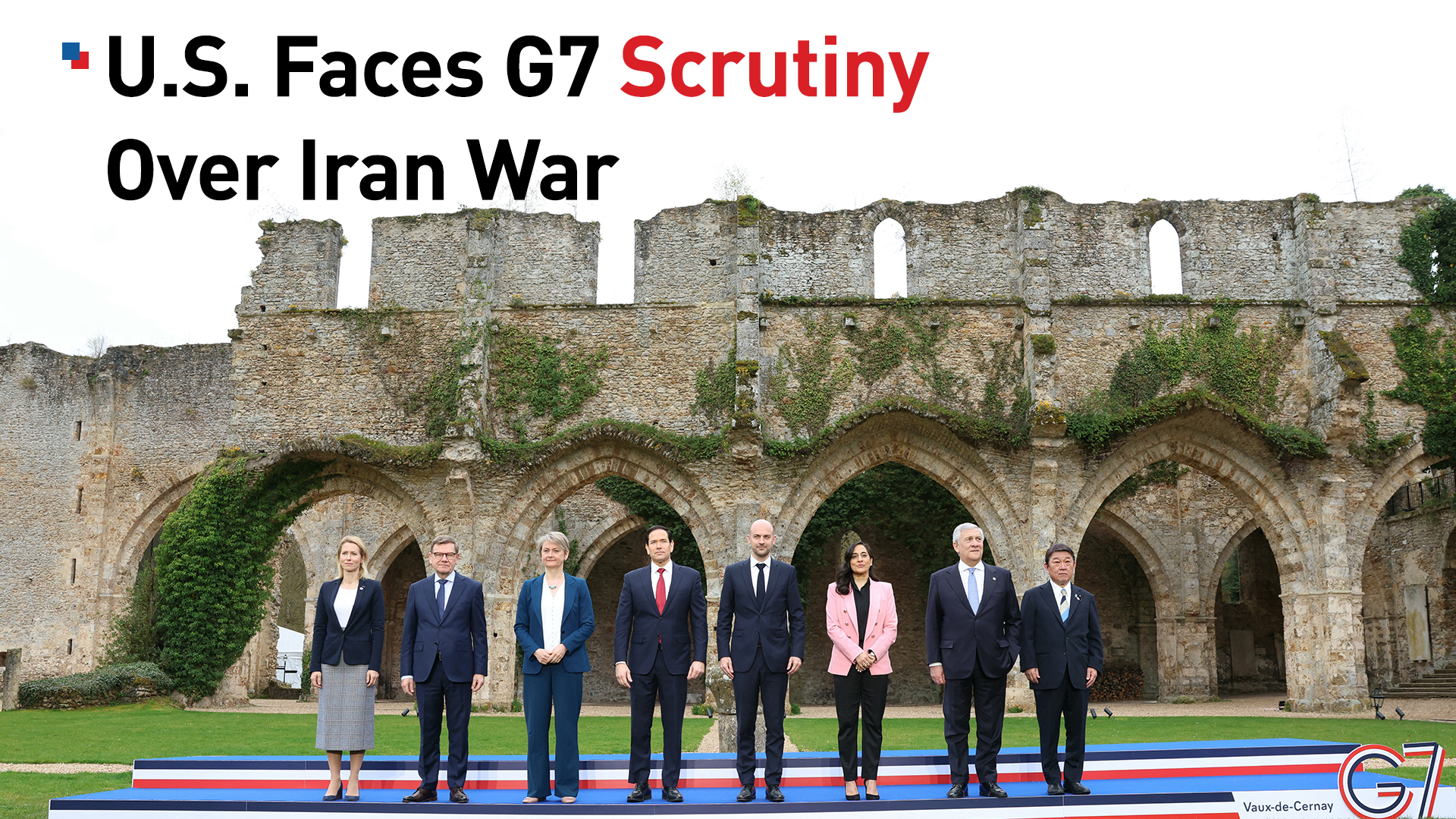
ERBIL (Kurdistan24) - G7 foreign ministers met on Friday at the Vaux-de-Cernay Abbey near Paris to discuss developments in the Middle East and reaffirm commitments related to the Russia-Ukraine conflict, as U.S. Secretary of State Marco Rubio faced intensive questioning from allies over Washington’s military operations in Iran and the closure of the Strait of Hormuz, according to Agence France-Presse (AFP) and The Associated Press (AP) reports.
Rubio arrived for the second day of talks after skipping the first day of the meeting at the historic 12th-century abbey, a former monastery turned hotel complex outside Paris. The U.S. secretary’s attendance followed President Donald Trump’s criticism of NATO members and other allies for what he described as a lack of support for U.S. and Israeli actions in Iran, including retaliatory attacks and the strategic blockade of the Strait of Hormuz.
German Foreign Minister Johann Wadephul said the international community now faced the challenge of coordinating on two simultaneous conflicts: Russia’s ongoing war in Ukraine and the hostilities involving Iran. “We need to strengthen our unity. Given that Iran and Russia are working together in the closest way, we must stand even closer together,” Wadephul told reporters. He added in an interview with German radio that allies needed clarification on “how the U.S. will proceed” in Iran, noting that Rubio “perhaps [would] explain this more precisely.”
The unusual absence of a joint communique at the conclusion of the meeting further highlighted tensions among the G7, AFP reported, citing a diplomatic source. Instead, France, holding the G7 presidency this year, will issue a formal statement, the source added.
British Foreign Secretary Yvette Cooper emphasized the need for a diplomatic resolution to restore stability in the region. She pointed to Iran’s de facto blockade of the Strait of Hormuz, which has contributed to rising global oil prices and created congestion for maritime traffic. “Frankly, Iran cannot be able to just hold the global economy hostage as a result of a Strait which is about international shipping routes and the freedom of navigation,” Cooper said, according to AFP.
Rubio defended U.S. actions prior to departing for France, stating that reopening the Strait of Hormuz served “the interest of all G7 nations” and that U.S. President Trump’s military strategy was “not just doing a favour to the United States and to our people. This is for the world,” AFP reported.
European ministers attending the talks also underscored the ongoing importance of supporting Ukraine, four years after Russia launched its full-scale invasion. Wadephul warned that any neglect of Ukraine’s defense efforts would “play into Putin’s hands,” cautioning against a diversion of attention from Eastern Europe due to the Middle East escalation.
Rubio also communicated on social media platform X that he had reiterated Trump’s commitment to achieving a ceasefire and negotiated settlement in the Russia-Ukraine war. The secretary’s remarks came in the context of broader diplomatic engagement at the G7 meeting, which included participation from Ukraine’s Foreign Minister Andrii Sybiha.
French officials voiced skepticism about the U.S.-led Iran operations. Minister of the Armed Forces Catherine Vautrin said the conflict “is not ours” and emphasized that France’s objective was a “truly diplomatic approach” to guarantee a return to peace, speaking to Europe 1 and CNews. Gen. Fabien Mandon, chief of the French defense staff, noted earlier in the week that U.S. allies had not been informed in advance of the air strikes. “They have just decided to intervene in the Near and Middle East without notifying us,” Mandon said, adding that the U.S. “is less and less predictable and doesn’t even bother to inform us when it decides to engage in military operations.”
Nevertheless, France convened military talks involving 35 countries on reopening the Strait of Hormuz “once the intensity of hostilities has sufficiently decreased,” the French Defense Ministry said.
British officials acknowledged differences with the United States over military operations while affirming support for defensive measures. Cooper said, “We have taken the approach of supporting defensive action, but also we’ve taken a different approach on the offensive action that has taken place as part of this conflict,” according to AP.
Germany, for its part, highlighted the dual challenge of maintaining support for Ukraine while addressing economic and security concerns stemming from the Iran conflict. Wadephul noted, “We must avoid further destabilization, secure our economic freedom and develop perspectives for an end of and the time after the hostilities. Our joint support for Ukraine … must not crumble now. That would be a strategic mistake with a view to Euro-Atlantic security.”
U.S. officials sought to present their actions as necessary to enforce international law and protect global commerce. Rubio said countries with an interest in international law “should step up and deal with it,” AFP reported. The secretary’s visit also came amid criticism from Trump, who stated that NATO had done “absolutely nothing” to assist in the Iran conflict.
Trump has repeatedly cited the lack of allied support as justification for unilateral U.S. action, with comments ahead of the G7 meeting criticizing European reliance on American military capabilities. Rubio, speaking to reporters prior to departure, said he was “not there to make them happy” but to represent the interests of U.S. citizens. He added, “I get along with all of them on a personal level, and we work with those governments very carefully, but the people I’m interested in making happy are the people of the United States. That’s who I work for. I don’t work for France or Germany or Japan.”
The G7 session at Vaux-de-Cernay also reflected the broader diplomatic reach of France’s current presidency. Foreign ministers from emerging economies Brazil and India, as well as Saudi Arabia and South Korea, were invited to participate ahead of the planned G7 summit in Evian, in the French Alps, to be chaired by President Emmanuel Macron in June.
French Foreign Minister Jean-Noel Barrot addressed allegations regarding South Africa’s disinvitation from the summit. Barrot clarified that Kenya, not South Africa, had been invited, stating, “We did not give in to any pressure,” AFP reported.
The Iran conflict, triggered by U.S. and Israeli military action, entered its fourth week on Friday. AP reported that the war has included targeted strikes on Iranian facilities and the killing of supreme leader Ali Khamenei, and has contributed to disruption of international oil shipments through the Strait of Hormuz. Iran has consistently denied pursuing nuclear weapons and has accused the United States and Israel of attacking its “peaceful safeguarded nuclear facilities,” the AP report noted, citing Reza Najafi, Iran’s ambassador to the International Atomic Energy Agency.
Rubio’s efforts to maintain allied engagement are complicated by previous U.S. criticisms and by European concerns about unilateral military interventions. France, Germany, and other European countries have expressed reservations about the lack of prior notification regarding U.S. actions in the Middle East and about the broader implications for regional stability.
The combination of ongoing hostilities, allied skepticism, and regional economic impacts underscores the diplomatic challenge facing the United States as it seeks to coordinate with the G7 on the Iran conflict. Despite these divisions, officials reported that discussions focused on diplomatic measures, defense cooperation, and ensuring continued support for Ukraine, with formal statements from the G7 to be issued by the French presidency rather than through a joint communique.
As the day of talks concluded, European and U.S. officials continued to emphasize the importance of maintaining coordinated approaches to regional security, safeguarding global energy markets, and supporting Ukraine, according to both AFP and AP reports. The discussions at Vaux-de-Cernay highlighted the complexity of sustaining international alignment amid concurrent conflicts and strategic disagreements among the world’s leading industrialized nations.
Friday’s G7 meeting ended without a formal joint statement, but diplomatic sources confirmed that the French presidency will issue an official communiqué summarizing the outcomes and reaffirming the group’s stated objectives regarding regional stability, the Iran crisis, and coordination on Ukraine.