Kurdistan President Says 'No Military Solution' to Iran Crisis, Urges Consolidation of Truce
In his interview with the Italian newspaper Corriere della Sera, Kurdistan Region President Nechirvan Barzani endorsed the U.S.–Iran ceasefire, asserting that diplomatic negotiation remains the only viable mechanism to resolve the regional conflict.
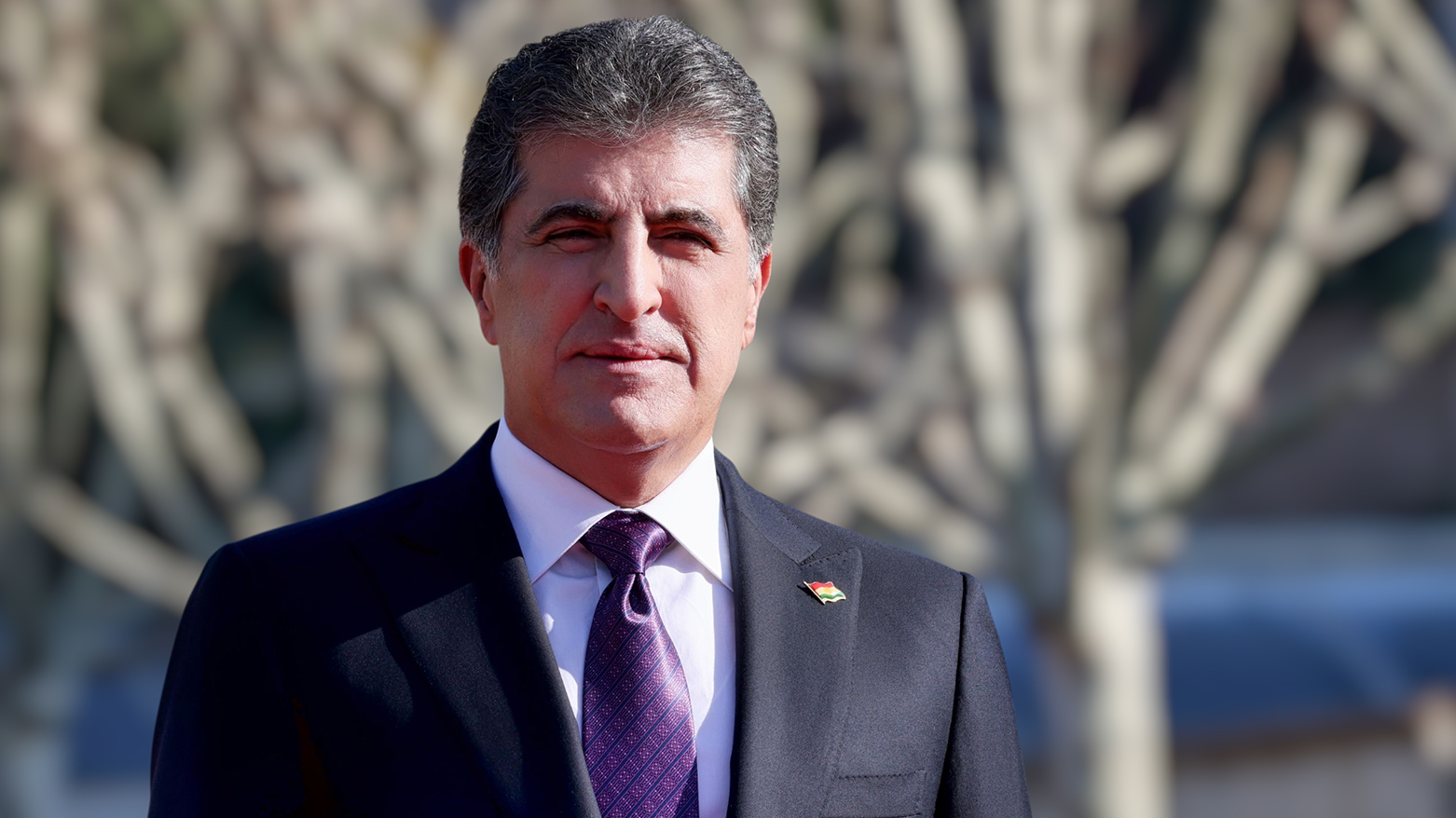
ERBIL (Kurdistan24) - Kurdistan Region President Nechirvan Barzani has formally endorsed the newly enacted truce between the United States and Iran, stating that "there is no military solution to the Iranian crisis" and emphasizing that "everything must be done to consolidate the ceasefire."
In an interview with the Italian newspaper Corriere della Sera published on Thursday, the regional president addressed the fragile cessation of hostilities, the ongoing Israeli military operations in Lebanon, and the broader geopolitical stability of the Middle East, while ruling out Kurdish military intervention in neighboring territories.
Barzani acknowledged the fragility of the current truce but stressed the necessity of transitioning from armed conflict to diplomatic engagement.
“We are welcoming the ceasefire between America and Iran,” Barzani stated during the interview, expressing hope that the pause in fighting will "give a room for a real dialogue between two sides and solve all the issues through a negotiation."
He noted that consolidating the truce requires patience, observing a contrast in negotiating postures where Iranian diplomats focus heavily on detail while American officials seek rapid resolutions.
Addressing concurrent military operations in the region, Kurdistan Region's President warned that continued Israeli strikes on Hezbollah targets threaten the broader de-escalation framework.
He characterized the bombardments in Lebanon as an error. “It is a mistake,” he said. “They should stop immediately to guarantee the stability of the ceasefire, not least because the Israelis are not only attacking Hezbollah but are also damaging the country's infrastructure.”
Outlining the Kurdistan Region’s operational posture during the conflict, Nechirvan Barzani clarified the nature of communications with Washington. He stated that American officials maintained a focus on containing specific military capabilities rather than pursuing the overthrow of the government in Tehran.
"The Americans never mentioned regime change in Tehran to us; rather, they insisted on the necessity of blocking the Iranian nuclear project and missile programs," the Region's President noted. He firmly rejected any potential use of Kurdish territory for cross-border offensives.
"No one ever asked us Kurds to intervene militarily in Iran; regardless, we are opposed to using our territory as a base against our neighbors," he said. "We do not want to be part of this war."
Drawing on his educational background in Iran and fluency in Farsi, Kurdistan Region President Nechirvan Barzani assessed the internal stability of the Iranian state following the recent military exchanges. He argued that the armed conflict has inadvertently consolidated the government's domestic position.
"The Iranian system is a unique combination of religion and nationalism: the war has united them," Barzani explained. He noted that the leadership in Tehran had absorbed tactical lessons from earlier phases of the conflict in June and adapted accordingly.
"Even the killings of leaders serve little purpose, because replacements are found immediately," he said, reiterating that the state structure cannot be dismantled strictly through aerial bombardments.
Evaluating the domestic opposition within Iran, the regional president estimated that a significant core of the population remains aligned with the state apparatus.
"At least 25 to 30 percent of the population clearly supports the regime, which still possesses very strong institutions," he stated.
The Region's President contrasted this institutional strength with the current state of opposition factions, which he described as lacking political structure and local leadership. He also pointed out that despite the economic grievances driving earlier domestic protests, daily civil administration remains functional, observing that "there are no queues at gas stations, shops are open as usual, and the regime remains in control."
The interview also addressed the severe economic disruptions stemming from the closure of the Strait of Hormuz. Nechirvan Barzani emphasized that securing the critical maritime chokepoint requires diplomatic rather than strictly military solutions.
“You cannot just control it by a military presence there, no matter how many troops do you have,” he stated. He underscored that the waterway "has to be open for everybody" due to its impact on the global economy, adding that reopening and securing the passage for international shipping must ultimately be the result of negotiation.
In response to the broader energy crisis precipitated by the conflict, Kurdistan President Barzani offered regional energy infrastructure as a partial mitigation measure, indicating readiness to expand export capacities through neighboring Türkiye.
"We are ready to upgrade our pipelines that go to Türkiye," he said, noting that current regional exports of approximately 300,000 barrels per day could be scaled up to 700,000 barrels per day.
Domestically, the president expressed sharp frustration with the federal government in Baghdad over its failure to secure the Kurdistan Region against persistent attacks by armed groups aligned with Tehran.
Detailing the scale of the domestic security challenge since the regional war began, he reported that Kurdish areas have been subjected to over 600 strikes.
“We are not satisfied; they are not doing enough,” Nechirvan Barzani said of the federal authorities. He warned that "Iraq will never be stable if it does not control the militias," calling the continued bombardments unacceptable.
Shifting to bilateral and international relations, Kurdistan President addressed the recent evacuation of Italian military personnel from the Kurdistan Region.
While expressing understanding for the tactical withdrawal, he emphasized a desire for their return to resume military training operations. “Since 2003, they have contributed to stabilizing our region, and later they also secured the Mosul Dam from ISIS attacks," he said. “Today, I believe their mission is not finished."
The president concluded the interview by detailing his forthcoming diplomatic mission to Europe, scheduled for May 18 to 20. The itinerary includes a visit to the Vatican to meet the new Pontiff, a continuation of historical relations bolstered by the Kurdistan Region's role as a refuge for persecuted communities.
After the emergence of the Islamic State in 2014, the region hosted over two million displaced persons, predominantly Christians, Yezidis, and Sunnis.
Additionally, Kurdistan Region President plans to meet with Italian government officials in Rome to transition the bilateral relationship toward commercial investment, specifically seeking "to encourage the Italian company to come and to invest in Iraq and Kurdistan."