KDP Rejects Withdrawal Claim, Says Talks With PUK Continue Over Presidency
“Our problem is neither with Nizar Amedi nor with anyone else, we do not even have a problem with the PUK as a political party. Our problem is based on a political principle that has been established in Iraq since 2003,” KDP's Ali Hussein said.
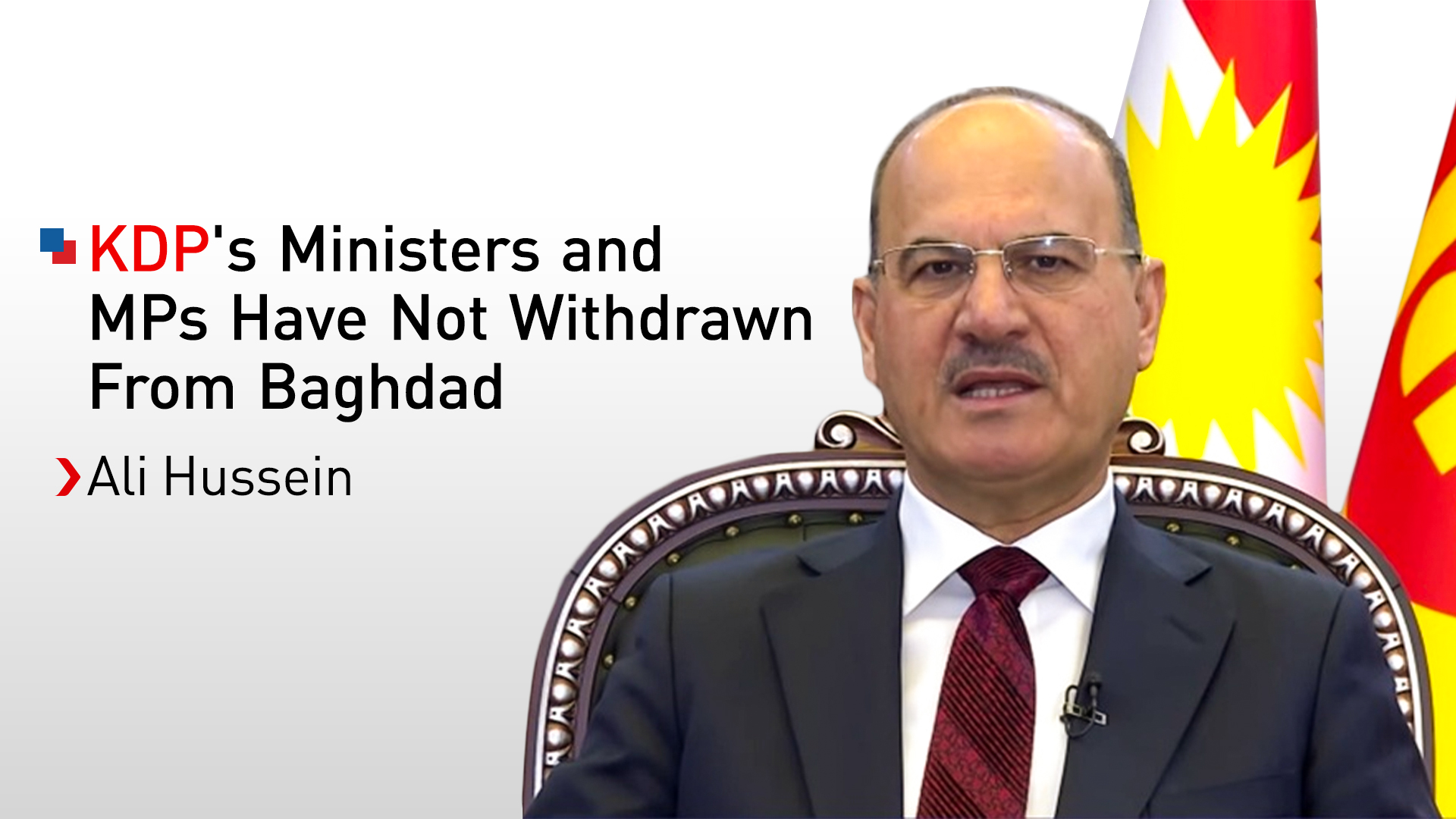
ERBIL (Kurdistan24) - A senior official from the Kurdistan Democratic Party outlined the faction’s formal position on the recent Iraqi presidential election on Tuesday, stating that the party’s objections to the parliamentary outcome are rooted in structural political principles regarding regional representation rather than partisan opposition to the newly elected president or the Patriotic Union of Kurdistan.
The statements follow a contested voting process in the federal legislature that has prompted strategic consultations in Erbil and raised concerns over the political concessions granted to secure the presidency.
Ali Hussein, a member of the Kurdistan Democratic Party Politburo and the head of the Sulaimani- Halabja Organizing Office, addressed the political fallout during a press remark on Tuesday.
Hussein clarified the institutional stance of his party following the election of Nizar Amedi to the presidency, emphasizing that the unilateral mechanisms utilized to secure the position represent a departure from established political customs that have governed the distribution of Iraq's sovereign offices since the institutional restructuring of the country.
Addressing widespread reports regarding the physical absence of Kurdistan Democratic Party representatives in the federal capital following the vote, Hussein explicitly denied that the faction had executed a formal withdrawal from Baghdad. Instead, he articulated that the movement of officials was a calculated internal consultation directed by the highest levels of party leadership.
“We did not withdraw; President Barzani has asked both the parliamentary and governmental factions for consultation and assessment of the situation (to return to Erbil), and yesterday the meeting was held,” Hussein stated.
He noted that internal discussions are ongoing, adding that future decisions by the leadership will be strictly guided by the strategic interests of the Kurdish people and the Kurdistan Region.
The core of the Kurdistan Democratic Party’s grievance, as articulated by the Politburo member, centers on the structural mechanisms of representation in federal Iraq. Hussein stated that the party harbors no inherent dispute with the newly elected president or the rival Kurdish faction that nominated him.
“Our problem is neither with Nizar Amedi nor with anyone else, we do not even have a problem with the PUK as a political party,” Hussein said. Rather, the objection is anchored in what he described as a foundational political principle established in 2003.
Elaborating on this principle, Hussein detailed the customary ethno-sectarian division of Iraq’s highest sovereign offices. Under this established framework, the Presidency of the Republic is allocated to the Kurds, the Presidency of the Parliament is designated for Sunni Arabs, and the Presidency of the Council of Ministers is reserved for Shiite Arabs.
Crucially, Hussein emphasized that each demographic component is traditionally entitled to designate its own representative through internal consensus before presenting the candidate to the broader legislature.
“Each component designates its own representative itself. The Shiites together designate the Prime Minister, and the Sunnis together designate the Parliament Speaker,” Hussein noted. Consequently, the Kurdistan Democratic Party’s demand was that Kurdistani political entities jointly determine the presidential candidate to project unified strength in the federal capital.
Hussein directed criticism toward the strategic approach employed by the Patriotic Union of Kurdistan, asserting that reaching an agreement with Arab factions for the presidency outside the framework of Kurdish unity inherently compromises the Kurdistan Region’s geopolitical standing.
By relying on external alliances to secure a position reserved for the Kurdish component, the negotiation process empowers Arab parties to extract political concessions at the expense of Kurdish institutional interests, according to the official.
To preserve the integrity of Kurdish representation, Hussein suggested that an alternative procedural path should have been utilized in the absence of a direct consensus between the dominant Kurdish parties.
“If the Kurdish parties do not agree on the President, the parliamentarians in the Iraqi Council of Representatives who are Kurds could designate a representative for the President, rather than one Kurdish party deciding on the President alone and reaching an agreement with an Arab party,” he stated.
Hussein warned that federal Iraqi parties prioritize their own strategic interests, reiterating that his party's reservations are solely procedural. “Otherwise, whoever the President is, we do not have a problem,” he added.
To contextualize the current institutional rift, Hussein invoked the historical relationship between the two major Kurdish parties. He noted that the Kurdistan Democratic Party has maintained a clear posture of support for its political counterpart during pivotal phases of Iraq's post-2003 history.
“From the era of Mam Jalal until now, the KDP's stance has been clear; the KDP has supported and backed the PUK at many stages,” Hussein said, referring to the late former Iraqi President Jalal Talabani. He emphasized that his party was prepared to support the Patriotic Union of Kurdistan in this instance as well, but objected fundamentally to the unilateral manner in which the current president was elected.
The implications of bypassing Kurdish consensus extend beyond the presidency, according to Hussein's assessment. He argued that the bilateral agreement forged between the Patriotic Union of Kurdistan and federal Arab parties necessitated significant political trade-offs that jeopardize long-standing Kurdish administrative priorities.
He pointed out that the coalition supporting the presidential vote was formed at the expense of crucial local governance structures, specifically citing the governorship of the disputed province of Kirkuk and other vital administrative achievements.
Describing the strategic and historical significance of the province, Hussein referred to Kirkuk and its residents as the "heart of Kurdistan." He invoked the historical legacy of the Kurdish liberation movement, asserting that the Kurdistan Democratic Party never compromised on the status of Kirkuk, even during intense negotiations with the former Ba'ath regime.
In the current political environment, Hussein emphasized that the designation of the Kirkuk governor must project a unified Kurdistani message. This unity, he argued, is a necessary prerequisite for the implementation of Article 140 of the Iraqi Constitution, the prevention of renewed Arabization policies, and the protection of Kurdish farmers facing systemic oppression in the disputed territories.
Hussein also drew a direct correlation between the fragmentation of Kurdish political unity in Baghdad and the deteriorating security situation in the Kurdistan Region. He addressed the ongoing kinetic threats facing the region, stating that the identities of those responsible for the daily bombardments of Kurdish territory are widely known to the public.
According to Hussein, a consolidated Kurdish political front would have established a sufficient deterrent against such aggression. “We believed that if the Kurds had a unified voice, those people who bombard the Kurdistan Region would not have had the audacity to bombard Kurdistan,” he said.
In a striking assessment of the political alliances that facilitated the presidential election, Hussein linked the political actors in Baghdad to the security threats facing Erbil. He asserted that the parliamentary coalition responsible for securing the presidency overlaps with the factions targeting the region.
“Those who elected the President were the very same ones who were bombarding Kurdistan,” Hussein stated, underscoring the severe strategic consequences of prioritizing federal alliances over regional unity.
Looking forward, the Politburo member indicated that the political landscape in Baghdad will necessitate an operational reassessment by the Kurdistan Democratic Party. He confirmed that the structural steps regarding meetings and bilateral agreements between the two major Kurdish parties will undergo changes as a direct consequence of the recent federal maneuvers.
“Our meetings are continuing to determine our future program and to know how we will deal with the new situation,” he stated, emphasizing that broader regional dynamics will inevitably impact the Kurdistan Region.
Hussein reaffirmed the party's commitment to its overarching political program and its continued efforts to foster political cohesion among Kurdistani factions. He characterized the current institutional disputes not as narrow partisan conflicts, but as a broader defense of the region's constitutional standing.
“We want to decide on fateful issues with unity, because this is not just the fight of one party, but rather the fight to protect the position of the Kurdistan Region and the future of our people,” Hussein concluded.