Deal Paves Way for Turkmen Governor in Kirkuk Amid Political Bargaining
PUK-linked agreement with Sunni and allied factions reshapes power-sharing in disputed province
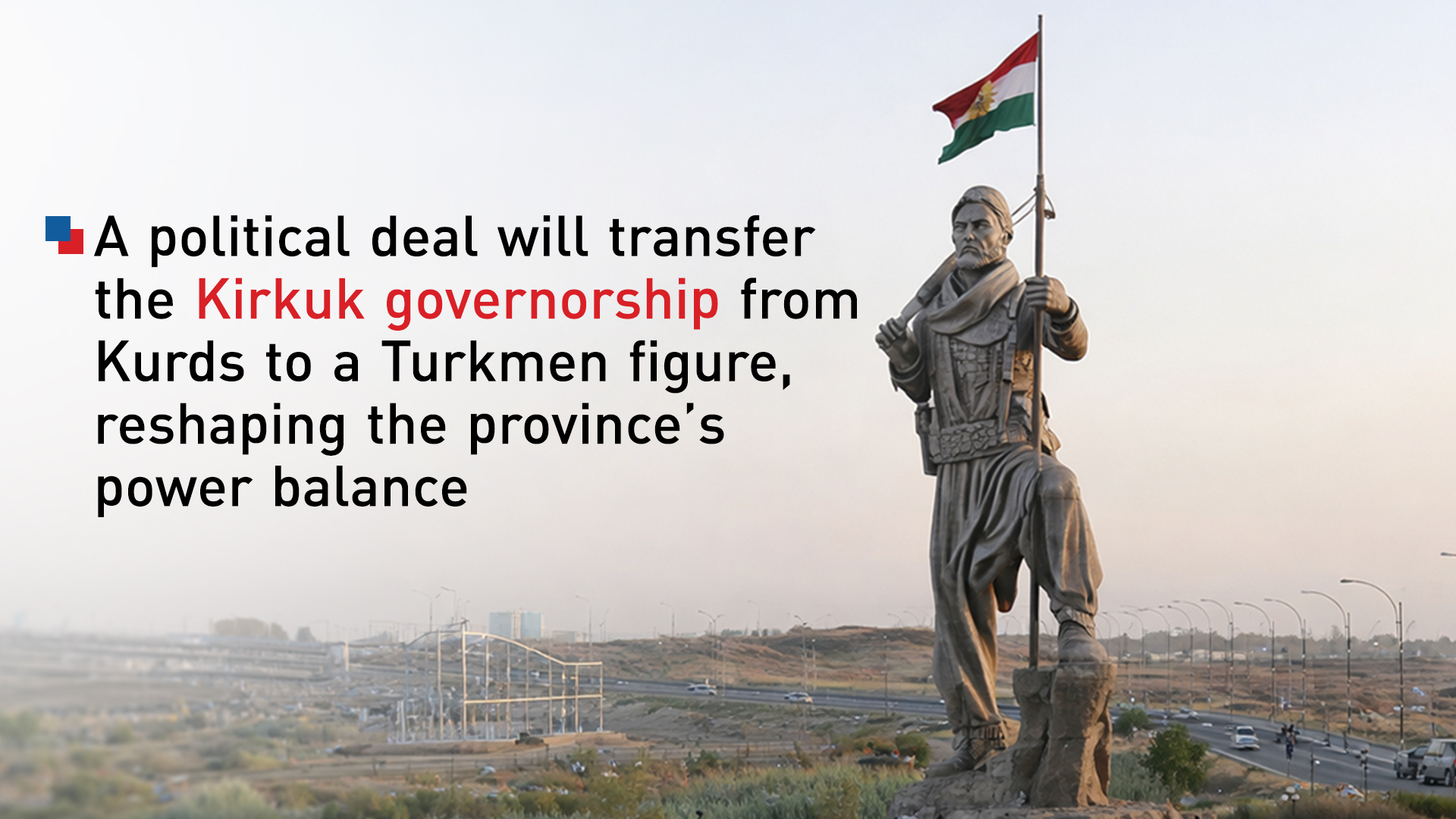
ERBIL (Kurdistan24) — A political agreement involving senior Iraqi and Kurdish leaders is set to transfer the governorship of Kirkuk to a Turkmen figure, according to information obtained by Kurdistan24, marking a significant shift in the province’s fragile power-sharing arrangement.
Under the deal, reached among Bafel Talabani, leader of the Patriotic Union of Kurdistan (PUK), Mohammed al-Halbousi, leader of the Progress Party (Taqaddum), and Rayan al-Kildani, leader of the Babylon Movement, the post of Kirkuk governor will be handed to Mohammed Samaan, head of the Iraqi Turkmen Front, for a period of seven months.
The Kirkuk Provincial Council announced an urgent session scheduled for Thursday at 12:00 p.m., during which current governor Rebwar Taha Mustafa, who is affiliated with the PUK, is expected to step down, clearing the way for Mohammed Samaan to assume office.
According to the reported arrangement, the governorship will subsequently be transferred to a Sunni Arab candidate after the initial seven-month term, with the position remaining in Sunni Arab hands until the next provincial council elections.
In return for conceding the governorship, Talabani has reportedly secured key administrative and security positions for his bloc, including the deputy governor post, the Kirkuk police chief role, and district administrators, including the positions of Dibis and Daquq mayors.
The agreement is understood to be part of broader political bargaining tied to the election of Iraq’s president. Talabani is said to have coordinated with Halbousi, Qais al-Khazali, founder and secretary-general of Asa’ib Ahl al-Haq (AAH), and Kildani to support a unified candidate during the recent parliamentary vote, in which Turkmen lawmakers backed the PUK candidate, Nizar Amedi.
Follow-up contacts between the parties have continued in recent days. On April 13, Samaan met Talabani in Baghdad, later stating on social media that discussions focused on “reorganizing relations and coordination among national forces.”
The development marks a notable shift from earlier positions held by the PUK, which had previously rejected ceding the governorship to other factions following a 2024 meeting in Baghdad’s Rashid Hotel involving multiple political actors.
Kirkuk, a multi-ethnic and oil-rich province claimed by both Baghdad and the Kurdistan Region, has long been a focal point of political contestation among Kurds, Arabs, and Turkmen. Governance arrangements in the province are often the result of delicate power-sharing deals reflecting broader national dynamics.
The provincial council has not convened for over a year since the 2024 political impasse, but Thursday’s session signals a breakthrough driven by shifting alliances and negotiations.
Observers note that the latest agreement could also reflect efforts by the PUK to recalibrate regional ties, including with Turkey, while securing influence through alternative administrative positions.
If implemented, the deal would mark a new phase in Kirkuk’s governance, with implications for ethnic balance, local authority, and Iraq’s wider political landscape.