Trump Describes Iran Conflict as Near Conclusion, Cites Interceptions and Naval Losses
“The war in Iran is going along swimmingly,” the U.S. President Donald Trump said, adding that it “should be ending pretty soon.”
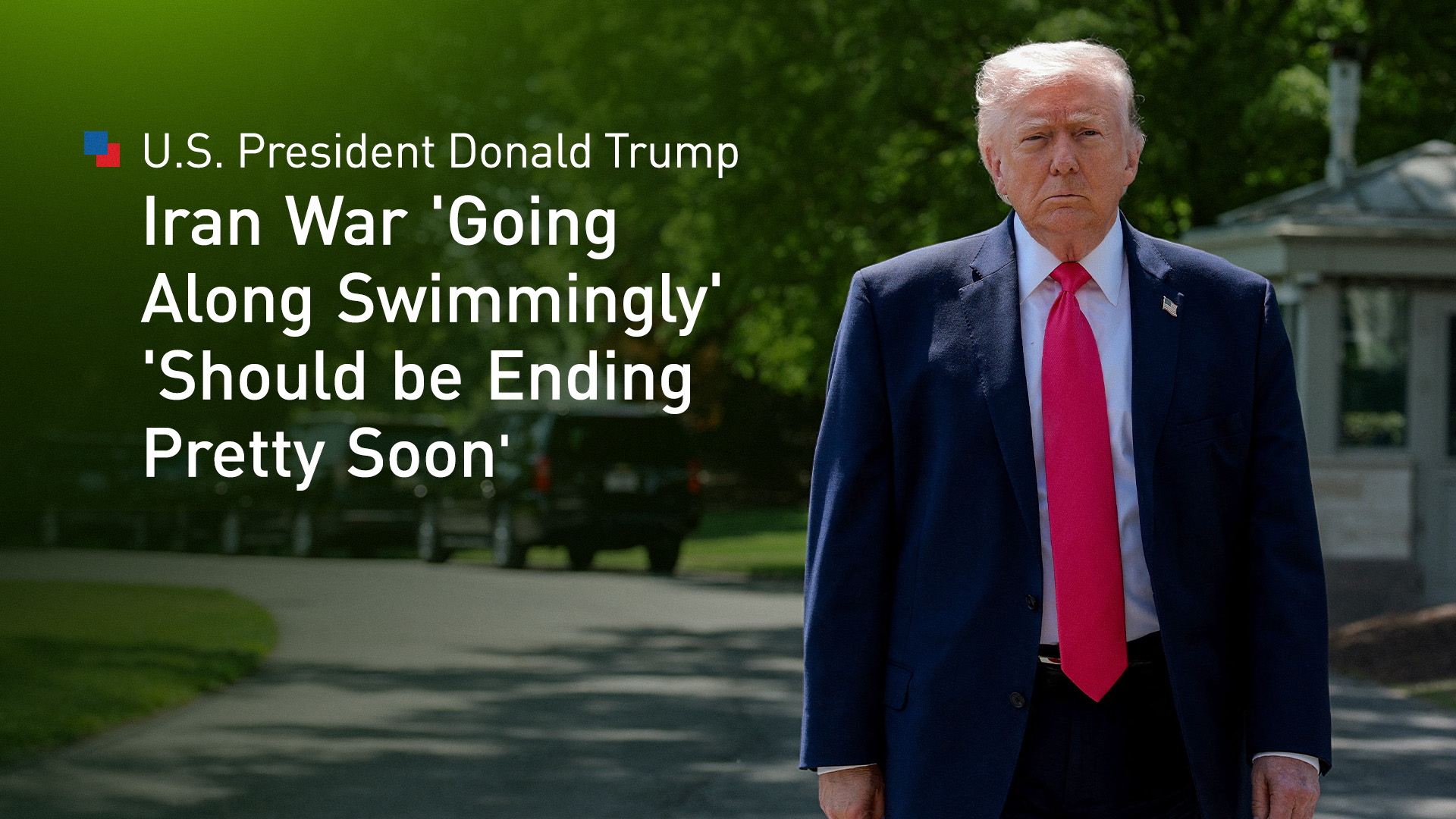
ERBIL (Kurdistan24) - U.S. President Donald Trump said Thursday that the ongoing military conflict involving Iran is progressing toward a near-term conclusion, citing successful missile interceptions and significant losses to Iranian naval forces, according to remarks delivered during a public event in Las Vegas.
Speaking at a Tax Day roundtable on April 16, Trump described the conflict in expansive terms, asserting operational success while offering limited verifiable detail.
“The war in Iran is going along swimmingly,” he said, adding that it “should be ending pretty soon.” The remarks come amid limited independent confirmation of battlefield developments and no comprehensive public briefing from U.S. defense officials outlining the scope or status of operations.
Trump claimed that U.S. naval defenses had intercepted a large-scale missile barrage targeting an unnamed American vessel.
“We had 111 rockets shot at one of our ships,” he said. “Every single one of them… were all shot down.” He further described the missiles as traveling at approximately 3,000 miles per hour, emphasizing what he characterized as the effectiveness of U.S. interception systems. The president did not specify the location of the engagement, the identity of the vessel, or the systems used in the interception.
No immediate corroboration of the incident, including confirmation of the number of projectiles or the success rate of interceptions, has been released by the Pentagon or other official channels. U.S. Central Command has not issued a public statement addressing the claim as of Friday.
In his remarks, Trump framed the broader military campaign as a preventative measure aimed at halting Iran’s nuclear ambitions.
“We had to do that because we can’t let them have a nuclear weapon,” he said, describing the operation as a necessary step to avert what he called “really bad things.”
The United States has long maintained that preventing Iran from acquiring nuclear weapons is a core national security objective, though Tehran has repeatedly stated that its nuclear program is for civilian purposes, according to prior statements by Iranian officials and international monitoring bodies.
The president also referred to the operation as a “little diversion,” suggesting that its scope, while significant, had not fundamentally altered broader U.S. strategic priorities.
He described visible effects on maritime activity in the region, stating that commercial vessels were avoiding contested waters. “You have these massive tankers saying, ‘Let’s get the hell out of here,’” Trump said, characterizing the situation as evidence of U.S. deterrence.
Trump further asserted that Iranian naval capabilities had been substantially degraded.
“They have no Navy left,” he said, claiming that 158 Iranian ships had been destroyed and were “at the bottom of the sea.”
The reference to Iranian military losses was followed by a reiteration of long-standing U.S. claims regarding the role of Qasem Soleimani, the former commander of Iran’s Quds Force, who was killed in a U.S. drone strike in January 2020.
Trump described Soleimani as a central figure in past attacks against U.S. forces, attributing the use of roadside bombs to his influence. “We took him out,” Trump said, adding that the killing had a “big impact on Iran.”
The strike that killed Soleimani, ordered during Trump’s first presidency, marked a significant escalation in U.S.-Iran tensions at the time and prompted retaliatory missile strikes by Iran on U.S. bases in Iraq. Analysts have since debated the long-term strategic effects of his death on Iran’s regional military posture and command structure.
Trump also drew comparisons between the current conflict and previous U.S. military engagements, including the wars in Vietnam and Afghanistan.
He suggested that the timeline of the Iran operation—now, according to his remarks, approximately two months in duration—demonstrated a faster trajectory toward resolution. “We’re going to have victory very shortly,” he said, while noting that he did not want to “claim it before the fact.”
While the president’s remarks emphasized imminent resolution, developments across the region point to a more complex and unresolved operational and diplomatic landscape.
A 10-day ceasefire between Israel and Lebanon took effect at midnight local time Friday, pausing weeks of cross-border fighting between Israeli forces and the Iran-backed Hezbollah group, according to Agence France-Presse and statements from regional officials.
The truce followed sustained exchanges of fire, including rocket attacks into northern Israel and Israeli airstrikes in southern Lebanon in the hours immediately preceding the ceasefire’s implementation.
According to Israeli emergency services, at least two civilians were wounded by rocket fire shortly before the truce began, while Lebanon’s health ministry reported that an Israeli strike on the southern town of Ghazieh killed at least seven people and injured dozens more.
Lebanese state media described the strike as targeting civilians, while Israeli officials have not publicly detailed the specific operational rationale for the attack.
The ceasefire, announced by Trump and confirmed by Israeli and Lebanese officials, is framed by mediators as a provisional measure tied to a broader diplomatic effort involving Iran and the United States. Iran’s foreign ministry welcomed the Israel-Lebanon truce, with spokesperson Esmaeil Baqaei stating, according to state media, that the cessation of hostilities in Lebanon formed part of a wider ceasefire understanding between Tehran and Washington, mediated by Pakistan.
The role of Hezbollah within the ceasefire framework remains partially ambiguous.
A Hezbollah lawmaker told AFP that the group would respect the truce if Israeli attacks ceased, while the organization itself has not issued a formal statement endorsing the agreement. Israeli officials, including Prime Minister Benjamin Netanyahu, have maintained that any long-term settlement will require the disarmament of Hezbollah, framing the group’s military capacity as a central security concern.
Netanyahu described the ceasefire as an opportunity to advance toward a “historic peace agreement” with Lebanon, though he also indicated that Israeli forces would continue to pursue operational objectives, particularly in southern Lebanon. According to statements reported by The Associated Press, Israeli troops have been expanding a security zone along the border, with active operations concentrated in areas such as Bint Jbeil.
Early indications suggested that the ceasefire was holding on Friday, though its durability remains uncertain. According to The Associated Press, displaced residents in parts of southern Lebanon began returning to heavily damaged towns and neighborhoods, encountering widespread destruction of residential buildings and infrastructure. Witness accounts described flattened apartment blocks, debris-filled streets, and disrupted essential services, underscoring the scale of damage accumulated during weeks of fighting.
The humanitarian toll of the broader conflict has been significant. According to compiled figures reported by The Associated Press, at least 3,000 people have been killed in Iran, more than 2,100 in Lebanon, and dozens more across Israel and Gulf states. U.S. military casualties have also been reported, with 13 service members confirmed killed.
Parallel to the ceasefire efforts in Lebanon, negotiations between the United States and Iran remain ongoing but unresolved. Mediators, including Pakistani officials, are working to extend a separate ceasefire agreement set to expire in the coming days.
Key points of contention include Iran’s nuclear program, the status of the Strait of Hormuz, and compensation mechanisms for wartime damages, according to regional officials involved in the talks.
The Strait of Hormuz has emerged as a central strategic pressure point. Iran has previously moved to restrict maritime traffic through the waterway, while U.S. forces have imposed a naval blockade targeting Iranian ports and shipping. According to U.S. Central Command, the blockade has prevented vessels from entering or exiting Iranian ports, with multiple ships reportedly turning back after encountering U.S. naval forces.
Senior U.S. military officials have stated that the scope of operations has expanded beyond the immediate region. General Dan Caine, chairman of the Joint Chiefs of Staff, said that U.S. forces would target Iranian-linked vessels globally, including those carrying goods deemed to support Tehran’s military or economic capacity. The list of restricted cargo includes not only weapons but also dual-use materials such as oil, metals, and industrial equipment.
The enforcement mechanism involves boarding, inspection, and potential seizure of vessels in international waters, a policy that significantly broadens the operational footprint of the conflict. Defense officials have indicated that more than 10,000 U.S. personnel are involved in enforcing the maritime restrictions, supported by naval and aerial assets across multiple theaters.
Iranian officials have responded with warnings of potential escalation. A senior Iranian military figure stated that Tehran could halt trade across the Gulf if the blockade continues, framing the measure as a direct threat to regional and global economic stability. Iranian representatives have also signaled resistance to extending the current ceasefire without concessions, with some advisers to the leadership expressing opposition to prolonging negotiations under existing conditions.
Diplomatic activity has intensified alongside military operations. Pakistan has emerged as a key intermediary, facilitating communication between Washington and Tehran, while regional actors including Saudi Arabia and the United Arab Emirates have engaged in parallel discussions aimed at de-escalation. European governments have also signaled increased involvement, with planned meetings focused on securing maritime routes and stabilizing energy markets.
The economic consequences of the conflict are increasingly global in scope. Disruptions to shipping routes, particularly through the Strait of Hormuz, have contributed to rising energy prices and supply uncertainty. According to The Associated Press, countries in Asia and Africa—heavily dependent on Middle Eastern oil and gas—have begun accelerating nuclear energy programs as a long-term response to supply volatility.
Energy analysts describe the shift as part of a broader recalibration of national energy strategies. While nuclear power development requires long lead times, governments are pursuing both short-term measures, such as increasing output from existing reactors, and long-term investments in new facilities. The trend reflects an effort to mitigate exposure to geopolitical disruptions in fossil fuel markets.
At the same time, financial and economic pressure on Iran has intensified. U.S. officials have outlined plans to impose secondary sanctions on institutions engaged in transactions with Tehran, describing the measures as comparable in impact to military operations. The sanctions framework targets oil exports, financial networks, and associated industries, aiming to constrain Iran’s economic capacity during the conflict.
Despite these overlapping pressures—military, economic, and diplomatic—the trajectory of the conflict remains uncertain. The ceasefire between Israel and Lebanon offers a temporary pause in one theater of the war, but it does not resolve the underlying disputes involving Iran, the United States, and regional actors.
Trump’s assertion that the conflict is nearing an end stands alongside ongoing negotiations, unresolved military engagements, and contested claims about battlefield developments. With ceasefire deadlines approaching and key issues still under negotiation, the coming days are likely to determine whether the current pause evolves into a broader settlement or gives way to renewed escalation.