Pezeshkian Asserts Iran's Nuclear Rights as Ceasefire Negotiations Face Impending Deadline
Iran's President Masoud Pezeshkian emphasized that Iran does not seek to expand the scope of the current hostilities, though he maintained that the nation's nuclear program remains an inviolable sovereign right.
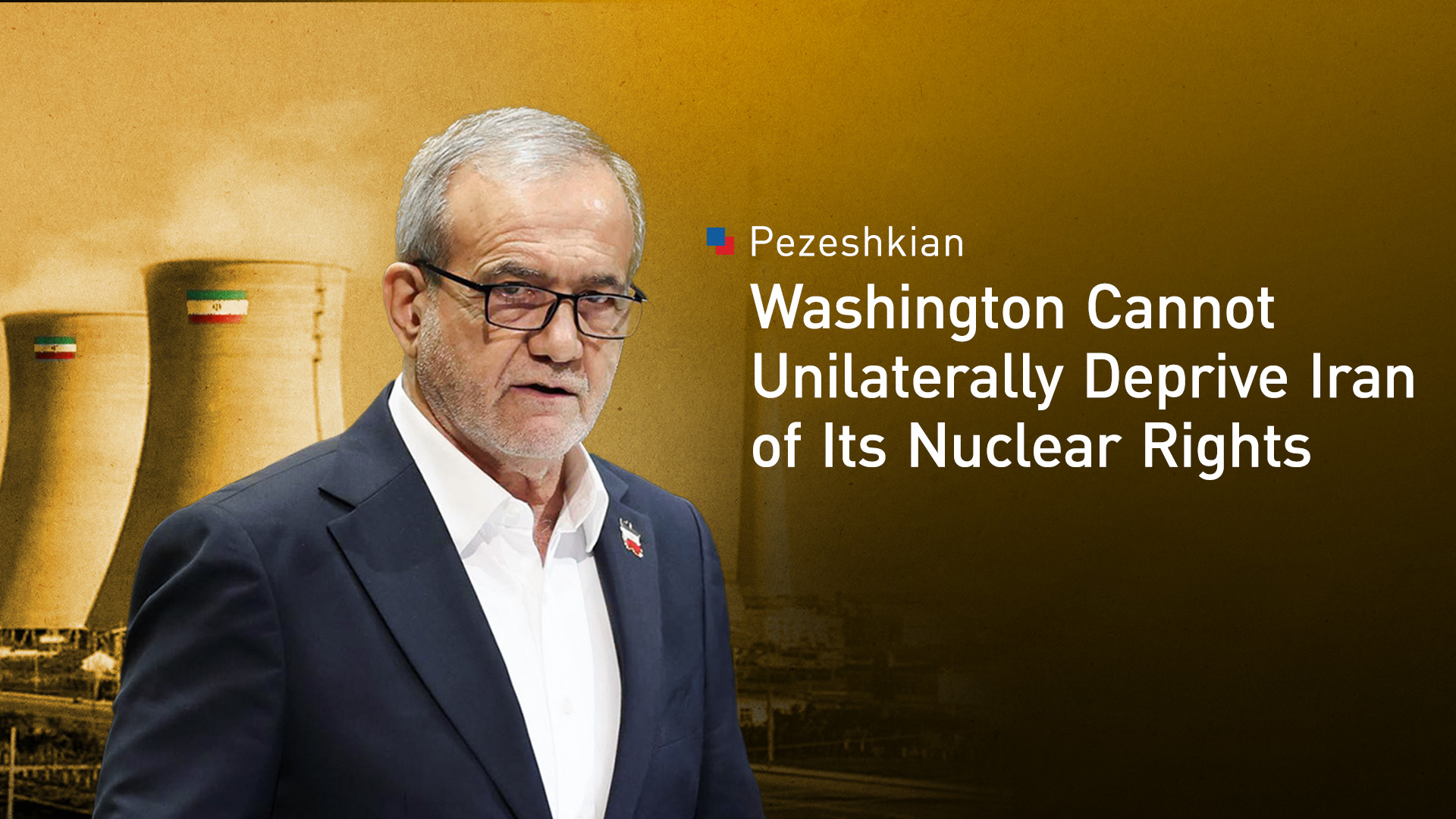
ERBIL (Kurdistan24) - Iranian President Masoud Pezeshkian stated on Sunday that United States President Donald Trump cannot unilaterally deprive Iran of its nuclear rights, establishing a rigid public posture as efforts to extend a fragile two-week ceasefire stall.
The declaration coincides with parallel warnings from Tehran and Washington over operational control of the Strait of Hormuz, further complicating Pakistani-mediated negotiations aimed at permanently concluding the six-week conflict.
The competing declarations regarding nuclear capabilities and maritime sovereignty fundamentally threaten the April 8 truce, which is scheduled to expire this week.
A failure to bridge these structural divides risks transitioning the conflict from localized aerial bombardments into systemic regional warfare, a development that would cement the current blockade on global energy markets and trigger promised allied military strikes against Iranian energy infrastructure.
In remarks delivered to domestic Iranian media on Sunday, Pezeshkian clarified Tehran's strategic framing of the ongoing conflict, which formally commenced on February 28 following joint US and Israeli military strikes.
The Iranian President asserted that his administration has no intention of attacking any sovereign nation and has not initiated any war, categorizing Iran’s military actions strictly as an exercise of its legal and legitimate right to self-defense.
Pezeshkian emphasized that Iran does not seek to expand the scope of the current hostilities, though he maintained that the nation's nuclear program remains an inviolable sovereign right.
Pezeshkian's statements follow direct diplomatic boundaries established earlier by his administration. Iranian Deputy Foreign Minister Saeed Khatibzadeh informed the Associated Press that Tehran categorically refuses to transfer its enriched uranium to the United States, labeling the matter non-negotiable.
Khatibzadeh noted that while a substantial volume of indirect messages has been exchanged between the delegations, the US continues to insist on demands that the Iranian government views as excessive, preventing the transition to direct, face-to-face meetings.
Providing an institutional update on the diplomatic proceedings, Mohammad Baqer Qalibaf, Speaker of the Iranian Parliament, confirmed that while the negotiating team has achieved incremental progress, a substantial gap remains between the Iranian and American delegations.
Iran’s top negotiator corroborated this assessment, stating that only a few specific points of insistence and established "red lines" remain unresolved between the parties.
In Washington, President Donald Trump offered a succinct assessment of the negotiation process, characterizing the indirect discussions as "very good" without elaborating on the specific diplomatic frameworks under review.
However, the US President issued a firm caveat regarding maritime security, emphasizing that Tehran cannot place the United States under pressure regarding the contested status of the Strait of Hormuz.
The strategic waterway, which historically accommodates approximately one-fifth of the world’s globally traded oil and liquefied natural gas, has emerged as the central economic theater of the conflict. Iranian Vice President Mohammad Reza Aref stated on Sunday that while Iran seeks to end all wars in West Asia, Tehran remains the sovereign authority responsible for managing the Strait of Hormuz.
Aref warned that the Iranian government will secure its maritime rights either "at the negotiating table or on the ground."
Currently, the Persian Gulf is effectively paralyzed by reciprocal institutional blockades.
The United States Central Command (CENTCOM) announced that the guided-missile destroyer USS Pinckney is actively patrolling regional waters, enforcing a naval blockade that the US military asserts has completely halted Iran's commercial maritime exchanges.
In direct response, the military spokesperson for Iran’s Khatam al-Anbiya headquarters confirmed that the Strait of Hormuz remains closed to commercial transit under the strict management of the Iranian armed forces, directly tying the resumption of international shipping to the removal of the US blockade.
As the diplomatic delegations exchange parameters, allied military forces are visibly preparing for the potential collapse of the Islamabad-mediated talks. An unnamed senior Israeli military official recently informed the Hebrew-language daily Ma’ariv that the Israeli army and the US military maintain "very close and precise coordination" in anticipation of a sudden rupture in the ceasefire.
The official explicitly warned that in the absence of an agreement, allied forces are prepared to deliver a "very deadly and backbreaking blow" to Iran.
Significantly, the official confirmed that allied military planners have updated their strategic target matrix to prioritize Iranian energy facilities. According to operational data provided by the Israeli army, US and Israeli warplanes deployed more than 37,000 munitions against various targets in Iran during the initial 40 days of active combat, substantially neutralizing the country's immediate defense infrastructure.
The human cost of these bombardments has been extensive. On Sunday, Ahmad Mousavi, head of the state-run Iranian Veterans Foundation, stated that more than 3,500 people lost their lives during the hostilities.
This data aligns closely with April 12 statistics released by the Iranian Forensic Medicine Organization, which recorded 3,375 fatalities.
Independent monitors have presented slightly higher figures featuring greater demographic categorization. The Human Rights Activists News Agency (HRANA) reported that as of April 7, at least 3,636 individuals had been killed.
According to HRANA’s statistical breakdown, the fatalities include 1,701 civilians—among them at least 254 children—alongside 1,221 military personnel and 714 individuals whose status remains undetermined.
Kurdistan24 cannot independently verify these casualty statistics, as independent reporting access within Iranian territory remains heavily restricted by state authorities.
The execution of the conflict and the ongoing negotiations are heavily influenced by domestic political dynamics within the United States.
According to detailed reporting by The Wall Street Journal, the Trump administration is attempting to balance maximalist strategic objectives against the acute risk of substantial American casualties and severe economic repercussions ahead of upcoming midterm elections.
US defense officials reportedly advised the executive branch against deploying American ground forces to seize Kharg Island—the launch point for 90 percent of Iran’s oil exports—due to presidential concerns over unacceptable troop casualties.
Furthermore, traditional European partners and the NATO alliance have formally declined to join the military campaign or assist in forcibly reopening the Strait of Hormuz.
This lack of international burden-sharing has exacerbated US domestic anxieties regarding the economic fallout of prolonged high energy prices, prompting the administration to utilize unpredictable public ultimatums to compel negotiations.
Further complicating the diplomatic architecture, Iranian officials have insisted that any permanent ceasefire must comprehensively include all regional fronts, specifically linking the bilateral US-Iran negotiations to the ongoing border conflict between Israel and the Iran-backed group Hezbollah in Lebanon.
Israeli media, including Channel 12, reported that the Israeli military has established operational control over nearly one-third of the territory between the Lebanese border and the Litani River.
While a parallel 10-day ceasefire was announced for the Lebanese theater, localized combat operations persist. The Israeli military recently confirmed the death of an additional soldier in southern Lebanon, bringing the total military fatalities on that front to 15, according to an Agence France-Presse (AFP) tally.
The instability in southern Lebanon was further underscored by a recent attack on United Nations Interim Force in Lebanon (UNIFIL) peacekeepers, which resulted in the death of a French soldier. While French authorities and initial UN assessments attributed the attack to Hezbollah, the group has formally denied the accusations.
Hezbollah Deputy Secretary-General Naim Qassem previously stated in a televised address that his forces reject a one-sided truce and remain mobilized.
Structurally, the current negotiating environment reflects an intractable convergence of local tactical realities and global strategic imperatives.
By linking the disposition of enriched uranium to the sovereign management of the Strait of Hormuz and the territorial integrity of southern Lebanon, stakeholders have transformed a bilateral security dispute into a multidimensional regional crisis.
This interdependence ensures that a diplomatic breakdown over any single variable—whether nuclear rights or maritime access—possesses the potential to unravel the entire ceasefire framework.
The immediate trajectory of the conflict now depends entirely on the ongoing back-channel discussions in Islamabad and Tehran. With the two-week ceasefire scheduled to expire this week, and both Washington and Tehran publicly reinforcing their respective red lines, the region faces acute institutional uncertainty.
The absence of a formalized schedule for direct, bilateral negotiations leaves the operative status of the Middle East suspended between a high-stakes diplomatic breakthrough and an immediate return to region-wide military engagement.