U.S. Carrier Fleet Expands in Middle East Amid Escalating Maritime Hostilities
According to CBS News, the USS Gerald R. Ford is accompanied by two guided-missile destroyers, the USS Mahan and the USS Winston S. Churchill.
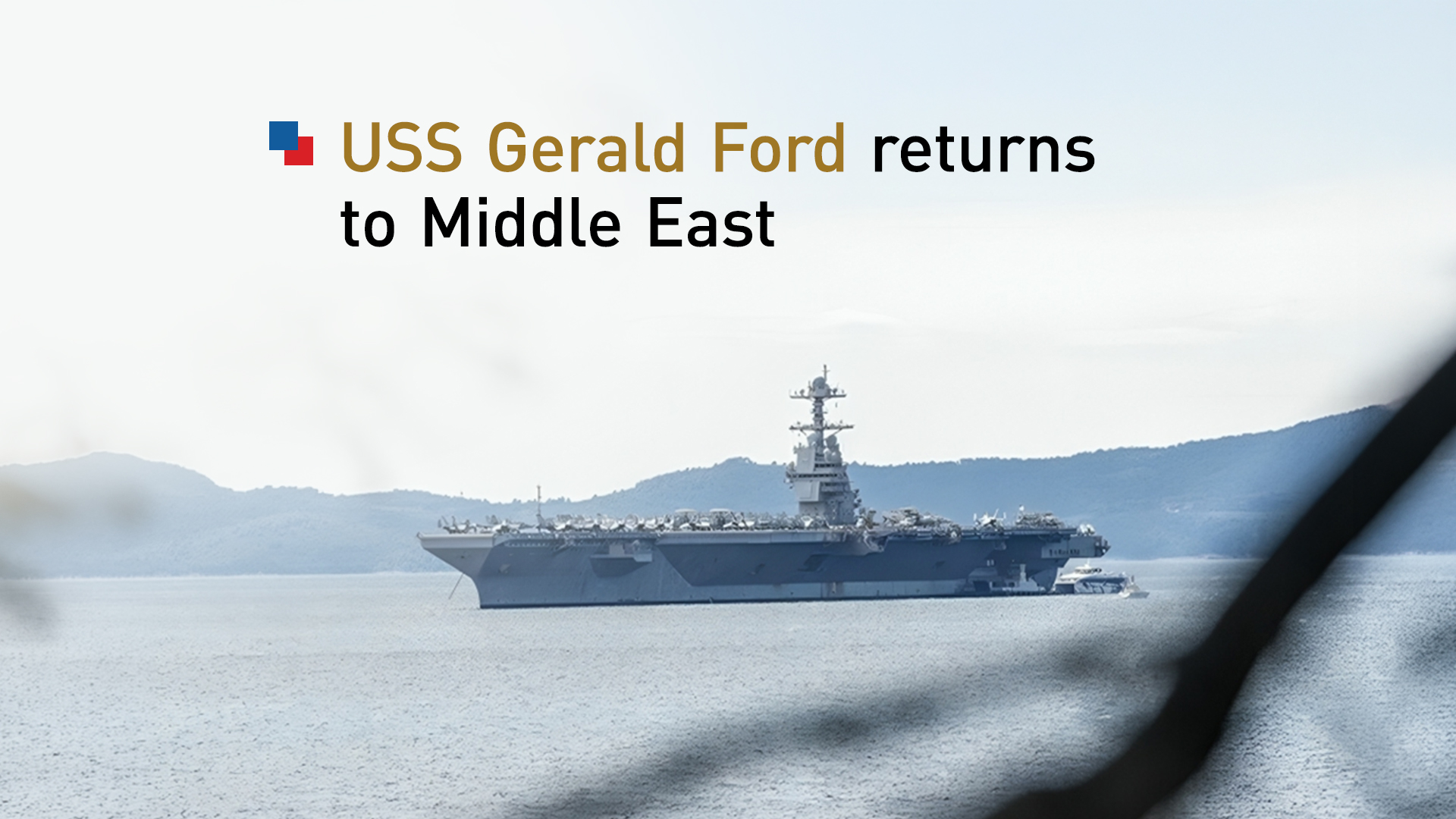
ERBIL (Kurdistan24) - The USS Gerald R. Ford aircraft carrier has transited the Suez Canal into the Red Sea to return to the Middle East, according to a report by CBS News on Monday, joining an unprecedented buildup of American naval power in the region. The deployment coincides with explicit threats of military retaliation from Tehran following the forcible seizure of an Iranian-flagged cargo ship by U.S. Marines in the contested waters of the Gulf of Oman.
The simultaneous massing of three U.S. carrier strike groups and the kinetic interdiction of commercial vessels fundamentally alters the security architecture of the Middle East's maritime corridors.
As a fragile, Pakistani-mediated ceasefire approaches its Wednesday expiration, this naval concentration signals Washington's intent to enforce its blockade of Iranian ports and reopen the Strait of Hormuz through overwhelming military deterrence.
Consequently, the rapid militarization of these vital global energy transit routes threatens to collapse ongoing diplomatic negotiations in Islamabad, risking a transition from localized economic attrition into direct, region-wide conventional warfare.
According to CBS News, the USS Gerald R. Ford is accompanied by two guided-missile destroyers, the USS Mahan and the USS Winston S. Churchill.
The carrier, which has been at sea since June and recently broke the record for the longest continuous U.S. deployment since the Vietnam War, is returning to the operational theater following a brief detour to port for repairs resulting from a fire in its laundry department.
The Ford’s arrival expands the U.S. strategic footprint at a highly volatile juncture. It joins the USS Abraham Lincoln, currently operating in the north Arabian Sea.
Furthermore, the USS George H.W. Bush is actively navigating around the Cape of Good Hope and is projected to arrive by the end of the month. This deployment schedule positions three distinct U.S. aircraft carriers and their accompanying strike groups within the Middle Eastern theater—a rare convergence of naval force.
This buildup occurs as the maritime domain devolves into the conflict's primary choke point. On Sunday, U.S. Marines executed an airborne boarding operation to seize the Iranian-flagged commercial vessel M/V Touska.
The United States Central Command (CENTCOM) confirmed on the social media platform X that the guided-missile destroyer USS Spruance disabled the Touska’s propulsion after the commercial ship failed to comply with repeated warnings over a six-hour period. Marines subsequently departed the amphibious assault ship USS Tripoli by helicopter to secure custody of the vessel.
In a swift reciprocal declaration, Iran’s joint military command characterized the U.S. boarding as an act of “armed maritime piracy.” The spokesperson for Iran’s Khatam al-Anbiya Central Headquarters warned that the Iranian armed forces will retaliate soon, with state media reporting subsequent drone launches directed at U.S. warships.
Iranian Foreign Ministry spokesperson Esmaeil Baqaei labeled the broader U.S. naval blockade an act of aggression and a “war crime” for allegedly inflicting collective punishment on the civilian population.
The core of this escalating confrontation centers on sovereign control over international waterways.
An analysis published in The American Conservative notes that while the removal of Iran’s nuclear infrastructure is frequently cited as Washington’s primary goal, the true nonnegotiable sticking point for the United States is the freedom of navigation through the Strait of Hormuz.
The report highlights that ceding control of the strait to Tehran would establish a catastrophic precedent for other global maritime chokepoints, such as the Strait of Malacca or the Red Sea.
Drawing on historical precedent, the analysis points to the 1980s “Tanker War,” during which the U.S. Navy launched Operation Praying Mantis to systematically neutralize Iranian naval threats in the Gulf, suggesting the current U.S. administration may be prepared to execute a similar strategy.
The strategic friction over maritime access runs parallel to complex diplomatic hurdles regarding Iran’s nuclear material.
As documented by The Wall Street Journal, any potential U.S.-Iran agreement would require the removal of Iran's highly enriched uranium—an operation described by experts as potentially the most complex in history.
Extracting this material from deeply buried nuclear sites previously damaged by allied airstrikes presents immense logistical and political challenges, further complicating the prospect of a swift diplomatic resolution.
The compounding effects of the naval standoff and the broader conflict are inflicting severe economic damage across the region and the globe.
The Wall Street Journal also reported that the United Arab Emirates recently opened talks with the U.S. Treasury Department to obtain a financial backstop—such as a currency-swap line—to protect its economy from the fallout of the war.
Emirati officials expressed deep concern that the conflict, which has previously targeted their oil infrastructure, threatens their standing as a secure global financial hub.
Simultaneously, the economic reverberations are directly impacting U.S. domestic markets.
The Financial Times reported that the Middle East conflict and the closure of the Strait of Hormuz have unleashed a wave of inflation within the United States that economists warn will persist long after hostilities conclude.
Driven by surging fuel and logistical costs, this inflationary shock threatens to disrupt the American economy ahead of upcoming midterm elections, adding acute domestic political pressure to the Trump administration's foreign policy calculations.
Despite these global stakes, diplomatic backchannels remain effectively paralyzed. The White House indicated that an American delegation is scheduled to arrive in Pakistan on Monday for ceasefire negotiations. However, Iranian leadership has signaled deep institutional skepticism.
Iranian President Masoud Pezeshkian warned Pakistani Prime Minister Shehbaz Sharif that U.S. actions and threatening rhetoric have amplified suspicions that Washington intends to “betray diplomacy.” Correspondingly, Iranian state media reported that Tehran currently harbors no plans to participate in the upcoming round of talks.
The diplomatic deadlock occurs against a backdrop of devastating regional attrition. Over the past six weeks, the conflict has resulted in the deaths of at least 3,000 people in Iran, nearly 2,300 in Lebanon, and dozens across Israel and Gulf Arab states, alongside 13 U.S. service members.
In southern Lebanon, the fragile 10-day ceasefire faced a significant breach on Sunday afternoon when the Iran-backed group Hezbollah claimed to have destroyed four Israeli tanks.
With both Washington and Tehran utilizing localized economic attrition—enforced through U.S. naval blockades and Iranian critical waterway closures—military coercion has superseded political negotiation as the primary mechanism for geopolitical leverage.
As the Wednesday deadline for the expiration of the ceasefire rapidly approaches, the institutional architecture of the Middle East remains suspended in a state of high uncertainty.
The convergence of three U.S. aircraft carriers and Iran's refusal to concede control of the Strait of Hormuz leaves the prospect of a negotiated settlement deeply unresolved, signaling an imminent risk of a return to comprehensive, region-wide warfare.