U.S. Weighs Large-Scale Strikes on Iran if Ceasefire Collapses
The United States military continues to refine strike plans targeting Iranian dynamic assets and infrastructure in the event of a ceasefire collapse, according to a report by Israel's Channel 12.
ERBIL (Kurdistan24) - The United States military is formulating advanced operational plans to conduct large-scale strikes against Iranian military assets and energy infrastructure should a tenuous ceasefire between the two nations collapse, according to a report by Israel’s Channel 12 (N12).
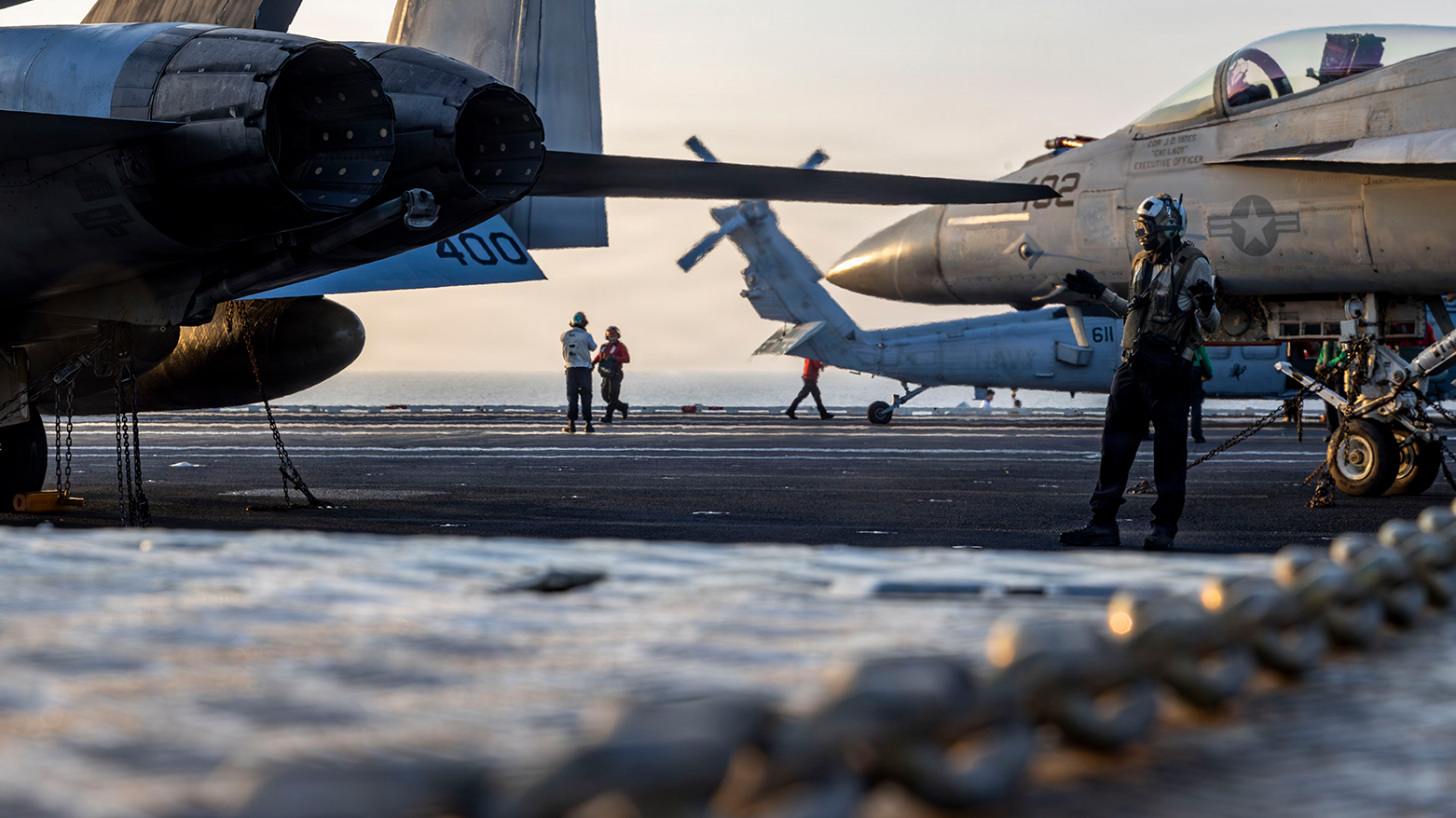
The planning, which incorporates contingencies for crippling Tehran’s strategic grip on the Strait of Hormuz, comes as the U.S. military command confirmed the arrival of a third aircraft carrier, the USS George H.W. Bush, in the Middle East.
While President Donald Trump has publicly stated he is not considering the use of nuclear weapons against the Islamic Republic, describing such a move as unnecessary given the efficacy of conventional operations, military planners are reportedly focused on a list of "dynamic targets" designed to neutralize Iran’s ability to disrupt international shipping.
Strategic Planning and Target Selection
U.S. military officials are currently developing new operational protocols aimed at significantly degrading Iranian capabilities in the Gulf region, CNN reported in a dispatch later cited by Israel’s Channel 12.
According to these findings, the strategy places a heavy emphasis on "dynamic targets" at sea, specifically those assets that allow Tehran to effectively close the Strait of Hormuz. These include fast-attack boats, specialized vessels equipped for naval mine-laying, and other combat assets operating in the vicinity of the waterway.
Beyond immediate naval threats, the formulated plans reportedly include options for damaging Iran’s energy infrastructure and conducting targeted assassinations of regime officials suspected of working to sabotage ongoing negotiations.
Despite these preparations, internal concerns regarding American military readiness have emerged. According to reports from The Wall Street Journal, the depletion of U.S. stockpiles of Tomahawk missiles and various air defense assets is raising questions among officials regarding sustained high-intensity operations.
The move toward military readiness coincides with an intensification of the U.S.-Iran standoff in the Persian Gulf. As reported by The Associated Press, President Trump on Thursday ordered the U.S. military to “shoot and kill” Iranian small boats found to be obstructing the Strait of Hormuz.
In a social media statement captured by the AP wire, the President also noted that the military is intensifying mine-clearing efforts in the waterway, where nearly 20% of the world’s traded oil typically passes during peacetime.
Maritime Hostilities and Naval Deployments
The Strait of Hormuz remained fully closed on Thursday as tensions showed no signs of abating.
The Associated Press noted that the U.S. military announced the seizure of a tanker associated with smuggling Iranian crude oil, the Majestic X, in the Indian Ocean.
This seizure followed an incident a day earlier in which Iran attacked three cargo ships in the Strait, successfully capturing two of them. In a related development, the South American nation of Guyana issued a statement clarifying that the Majestic X was "fraudulently flying the Guyana flag" and was not registered in their national database.
To bolster the American presence during the ceasefire, the USS George H.W. Bush arrived in the U.S. Central Command area of responsibility. It joins the USS Abraham Lincoln in the Arabian Sea and the USS Gerald R. Ford in the Red Sea.
The Bush reached the region after sailing around the Horn of Africa, an unusual route that military analysts told the AP reflects the strategic complexity of the current deployment.
Iranian officials have responded to the U.S. buildup with their own displays of force.
According to N12’s monitoring of regional communications, Gholamhossein Mohseni Ejehi, Iran’s judiciary chief, stated on social media that the Revolutionary Guard’s "swarm fleet" of speedboats and underwater drones is prepared to "saturate" American air defenses.
He warned that Iranian forces are positioned in sea caves on Faror Island, ready to confront "aggressor warships."
Regional Ceasefire Negotiations and Proxy Dynamics
While the U.S.-Iran conflict remains at a stalemate, there have been developments regarding the northern front.
The Associated Press reported that President Trump announced on Thursday that Israel and Lebanon have agreed to extend a temporary ceasefire between the Israeli military and Hezbollah by three weeks.
This announcement followed high-level negotiations at the White House involving Israeli Ambassador Yechiel Leiter and Lebanese Ambassador Nada Hamadeh Moawad.
However, the truce remains fragile. Shortly after the extension was announced, Israel’s military reported striking a missile launcher in Lebanon that had fired into Israeli territory. Hezbollah claimed the attack was in retaliation for an Israeli strike on the village of Yater.
According to details provided to the AP by Lebanon’s Ministry of Public Health, Israeli artillery shelling wounded two people, including a child, while a separate airstrike near Nabatieh killed three individuals whom the Israeli military identified as militants.
President Trump has maintained that a permanent deal between Washington and Tehran is contingent upon Iran ending its financial and military support for proxy groups. When asked if the cessation of funding for Hezbollah was a requirement, the President replied, "Yeah, they’ll have to cut that. That’s a must."
Per AP coverage of the exchange, he also noted that while he is not rushing to end the war, he believes the Iranian leadership is in "turmoil" following the killing of Supreme Leader Ali Khamenei at the start of the conflict.
Internal Tensions and Human Rights Concerns
In Tehran, the government has moved to project an image of stability.
In near-identical social media statements monitored by news agencies including the AP, Iran’s president and parliament speaker denied reports of a leadership rift, asserting that the country remains "united."
Despite these claims, witnesses in Tehran reported hearing air defense systems in action over the western and southwestern parts of the capital on Thursday night. State media attributed the explosions to tests of "hostile target" interceptions.
Concurrently, the United States has increased pressure on Iranian-aligned militias in Iraq.
The Associated Press confirmed that the State Department’s Rewards for Justice program recently placed a $10 million bounty on Hashim Finyan Rahim al-Saraji, the leader of Kataib Sayyid al-Shuhada. Officials allege the group is responsible for killing Iraqi civilians and attacking U.S. diplomatic and military facilities in Iraq and Syria.
The regional instability continues to impact civilian populations. In the West Bank, the Palestinian Ministry of Health reported the death of Awda Awawdeh, a 25-year-old father, who was shot during a clash with Israeli settlers.
According to reports filed by the AP, Awawdeh is the 11th Palestinian killed by settlers in 2026. In Lebanon, the cabinet is reportedly discussing a move to join the International Criminal Court (ICC) for a limited period to allow for the investigation of alleged war crimes committed on Lebanese territory.
Diplomatic and Economic Outlook
Industry experts have expressed caution regarding the resumption of maritime trade.
In a statement obtained by the AP, Jakob Larsen, the chief safety and security officer for BIMCO, the world’s largest international shipping association, stated that shipping companies require "stable ceasefire and assurances" from both Washington and Tehran before transiting the Strait of Hormuz.
He noted that even if a diplomatic breakthrough occurs, the process of clearing naval mines could take several weeks.
President Trump remains focused on a policy of naval blockades to pressure the Iranian administration, a tactic similar to those used against Venezuela and Cuba.
However, as noted in an AP analytical report, Iran’s ability to choke off global energy shipments presents a significantly different economic reality, as prolonged disruptions could lead to higher global gas prices during a U.S. election year.