Barzani, UAE President Hold Talks in Abu Dhabi Amid Heightened Regional Tensions
Meeting comes as Gulf security strains deepen following Iran-linked attacks and stalled U.S.-Iran diplomacy
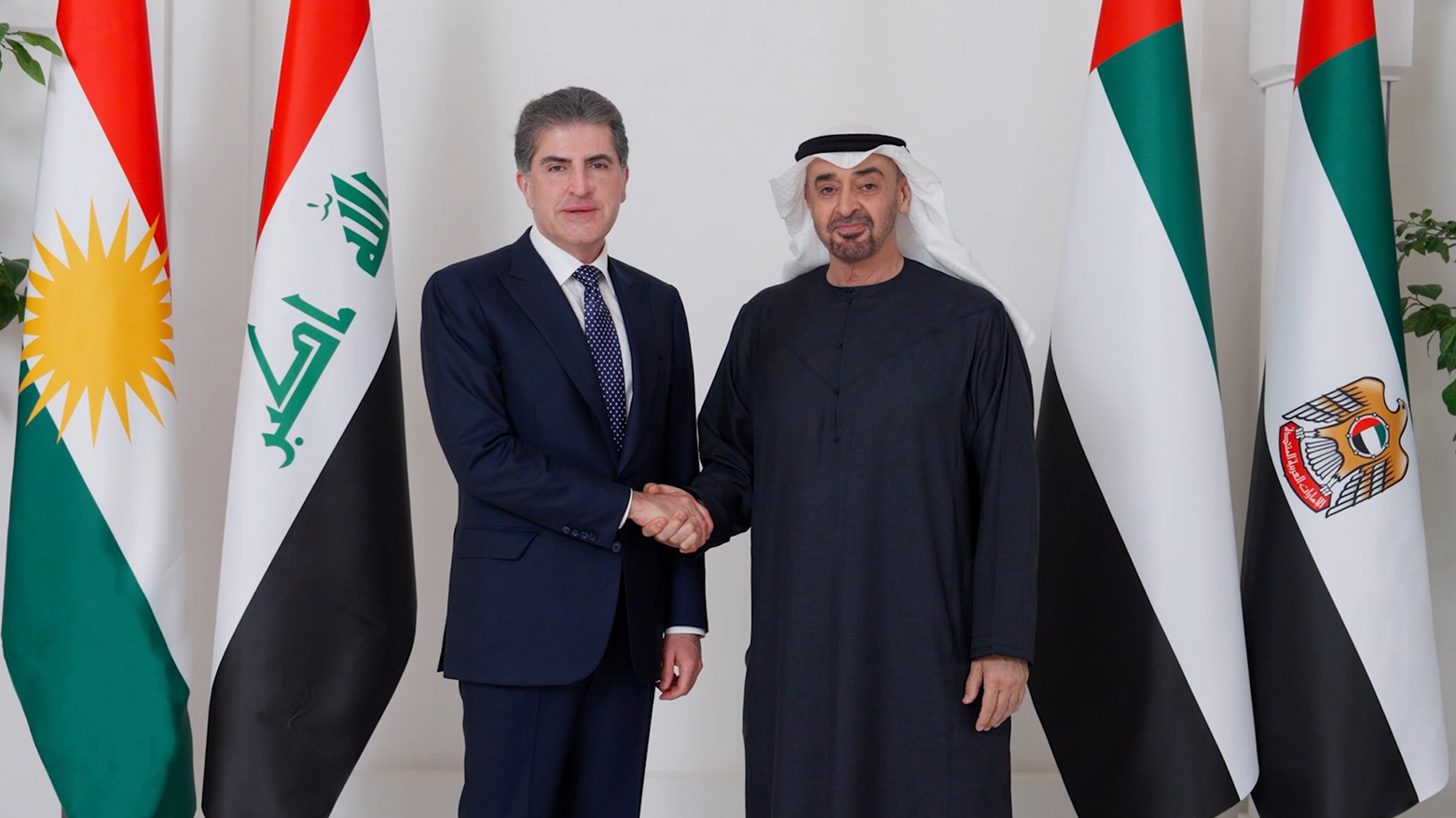
ERBIL (Kurdistan24) — Kurdistan Region President Nechirvan Barzani met with Mohammed bin Zayed Al Nahyan, President of the United Arab Emirates, in Abu Dhabi on Thursday, in a high-level engagement underscored by intensifying regional instability and the aftermath of the ongoing U.S.-Israel-Iran confrontation.
“I’m delighted to meet my brother, His Highness Sheikh Mohammed bin Zayed Al Nahyan, President of the United Arab Emirates, in Abu Dhabi,” Barzani said in a post on X.
“We discussed the state of relations between Iraq, the Kurdistan Region, and the UAE, and exchanged views on the impact of regional developments. We emphasized the importance of reinforcing cooperation to promote stability and security across the region.”
The meeting comes at a particularly volatile moment across the Middle East, as tensions linked to the confrontation between the United States, Israel, and Iran continue to reverberate.
Efforts to de-escalate the conflict have stalled, with diplomatic channels strained and military posturing ongoing. Iran’s disruption of maritime traffic through the Strait of Hormuz—a chokepoint for global oil flows—has compounded economic pressures, while Washington has sought to mobilize international partners to secure shipping lanes and counter Tehran’s actions.
Both the UAE and the Kurdistan Region have found themselves on the frontlines of the broader escalation. During the recent phase of hostilities, the UAE faced direct threats and attacks linked to Iran and its regional proxies, while the Kurdistan Region was repeatedly targeted by Iran-backed militias operating in Iraq, using drones and rockets.
The meeting also coincides with the United Arab Emirates’s recent decision to withdraw from the Organization of the Petroleum Exporting Countries and the broader OPEC+ framework, a move that has sent shockwaves through global energy markets and raised questions about the future cohesion of the Saudi-led cartel.
The timing highlights Abu Dhabi’s broader strategic recalibration, as it seeks greater autonomy over its energy policy and production levels amid ongoing regional instability, further underscoring the significance of high-level engagements such as the Barzani-Mohammed bin Zayed talks.
The relationship between the UAE and the Kurdistan Region has steadily deepened over the past decade, evolving into a multifaceted partnership encompassing trade, investment, and political cooperation.
Emirati companies have played a growing role in sectors such as energy, infrastructure, and real estate within the Kurdistan Region, while bilateral exchanges have expanded at both governmental and institutional levels.
Politically, the UAE has maintained consistent engagement with Kurdish leadership, viewing the Kurdistan Region as a stable and strategically important partner within Iraq. For Erbil, ties with Abu Dhabi offer not only economic opportunities but also a valuable channel for regional diplomacy and international outreach.