From Battlefields to Brigades: How Syria Is — and Isn't — Integrating the Kurdish Forces
Syria's deputy defense minister for the eastern region says four brigades have been formally incorporated into the national army, but warns that the politicization of Kurdish detainee files is "unacceptable" and demands their immediate release.
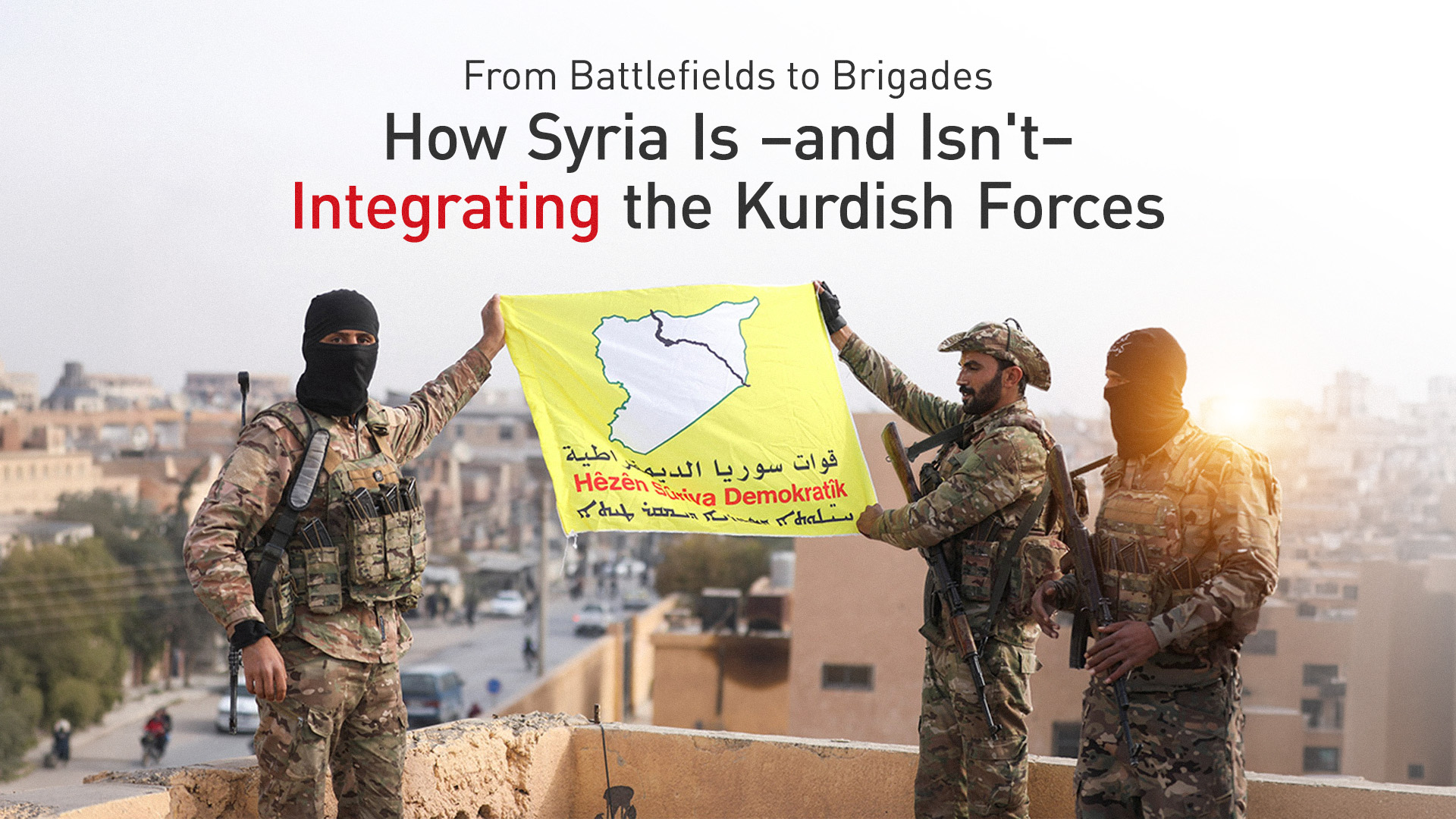
ERBIL (Kurdistan24) - Four months after a landmark integration agreement reshaped the military landscape of northeastern Syria (Western Kurdistan), the process of folding the Syrian Democratic Forces (SDF) into the national army is moving forward — but only partially, unevenly, and against a backdrop of unresolved crises that continue to test the limits of what Damascus and SDF leaders have agreed to build together.
In an exclusive interview with the ANHA news agency, Siban Hamo — also known as Samir Oso — the Syrian Interim Government's Deputy Minister of Defense for Eastern Region Affairs, offered the most detailed public accounting to date of where the integration process stands, where it is faltering, and what the stakes are for “Syria's Kurdish community” as the country charts an uncertain course toward unity.
At the heart of the Jan. 29 agreement was a structured military merger between the SDF and the Syrian Ministry of Defense.
Hamo confirmed that four brigades drawn from SDF ranks have now been formally integrated into the national military structure — one based in Kobani, and three others in Hasakah, Qamishlo, and Derik.
"From an organizational and official standpoint, the merger has taken place, and work is now focused on the practical side," Hamo said, noting that training courses within military academies, field meetings between commanders, and exchanges of expertise are all underway.
But he was candid about the limits of what has been achieved.
The total number of SDF personnel far exceeds the four brigades absorbed so far, and the question of how to accommodate the remainder — whether through additional brigades, battalions, regiments, or attachments to existing units — remains under active discussion.
"So far, divisions, brigades, and other formations have not yet been formally designated," Hamo acknowledged, "but their missions will certainly complement the army according to operational needs."
The Ministry of Defense has organized Syria into five regional commands — Northern, Western, Eastern, Southern, and Central.
The Eastern Region, which falls under Hamo's remit, encompasses the provinces of Raqqa, Deir al-Zor, and Hasakah.
Drafting a unified internal regulatory framework for the entire army, he said, remains a central and ongoing task.
Beyond the four brigades, the SDF encompassed a wider constellation of formations — including the Manbij Military Council and the Northern Democratic Brigade — whose future within the new military structure remains undetermined.
Hamo was careful to frame their choices as voluntary. "The SDF has always recognized the autonomy of the formations within its ranks," he said.
"They joined voluntarily, and now they are also the decision-makers in the current integration phase.
The decision is theirs — whether to join, not to join, or to continue struggle through different methods."
The door to integration remains open, he said, provided any faction meets established criteria including readiness, experience, and recognized field presence.
But he was equally firm on what is not negotiable: "There will be no formations outside the framework of the army."
The Afrin initiative: recognition, not deviation
One of the most politically charged aspects of the integration process involves Kurdish fighters from Afrin — a Kurdish area seized by armed factions in 2018 — factions that have now become part of the Syrian Ministry of Defense, from which the original Kurdish population was largely displaced.
Hamo pushed back firmly against suggestions that proposals to form a Kurdish military presence in Afrin contradict the Jan. 29 agreement.
The Jan. 29 agreement, he noted, covered four specific brigades in defined areas. What is being discussed regarding Afrin is a separate initiative — one he said he personally championed.
"During the struggle of the revolution, Kurdish young men and women from Afrin played a major and central role," he said.
"In order not to waste the sacrifices of that struggle, and as a gesture of loyalty and recognition of their efforts, I personally worked on an initiative."
The initiative, as he described it, is rooted in the right of displaced Afrin residents — including those who served in the SDF — to return home.
Returning fighters would have the choice to join military formations operating within Afrin under the army's umbrella, continue military service elsewhere, or return to civilian life entirely.
He said the proposal received a positive reception within the ministry, and cautioned against efforts to misrepresent it.
"The Syrian state is determined to return all displaced people to their homes, including the people of Afrin," he said.
Hamo did not shy away from the darker realities on the ground in Kurdish areas. Acknowledging that full cohesion within the Syrian army has yet to be achieved, he said some factions continue to reject military orders and pursue infighting.
"In Kurdish areas, whether in Serekaniye, Afrin, or elsewhere, residents were betrayed through displacement," he said bluntly, before adding that Syrians across much of the country had similarly been betrayed.
He framed the resolution of these areas as inseparable from the broader challenge of rebuilding trust — warning that any party refusing to commit to the integration path "will face a serious response from the state."
The completion of unified military regulations, he argued, would be the mechanism through which factionalism is ultimately eliminated.
"The state of division across Syrian geography will disappear, allowing everyone to operate within the framework of a united Syria."
US base handovers and the eastern military vacuum
With the withdrawal of US forces from a number of positions in Western Kurdistan, the question of what fills the vacuum has taken on urgent military and political significance.
Hamo said the process is being managed through the Ministry of Defense, with sites being handed over to the Syrian army.
He noted that some bases were built on privately owned land, which will be returned to its rightful owners, while sites with military value will be repurposed in the service of the national army.
Positions built on state land will be used as observation points or training centers.
"Brigades assigned to the region within the Syrian army will be stationed at these sites in accordance with approved plans," he said, adding that no detailed public announcements regarding specific bases had yet been made.
Of all the issues raised in the interview, it was the file of SDF fighters still held in government detention that drew Hamo's sharpest and most personal language.
He said the Ministry of Defense — including the minister himself — had committed to securing the release of all detainees before Eid al-Fitr.
That deadline passed without fulfillment. He described the minister's frustration as visible and genuine, and his own as no less acute.
"The reality is that when the integration was announced, everyone should have been released from prison immediately — not in batches," Hamo said. "The current mechanism of releasing detainees in stages is, in our view, the wrong approach."
He was equally pointed in condemning what he described as the politicization of the issue. "The issue of prisoners has been heavily politicized, and exploiting the emotions of prisoners' families is something that cannot be accepted under any circumstances."
While responsibility for the detainee file formally rests with the Ministry of Interior and the Integration Committee, Hamo said the Ministry of Defense intervenes whenever delays are detected. He called on all parties to accelerate the process without condition.
"The Kurdish people and the families of detainees have every right to hold us accountable for the failure to release their sons so far," he said. "No logic can justify this."
For the families of SDF fighters killed in battles against ISIS and in defense of their communities, Hamo outlined an emerging framework for official recognition.
Fallen fighters are to be classified as martyrs of Syria, granted official Syrian documentation, and their families supported through dedicated directorates being established in each province — beginning with Hasakah.
War-wounded fighters, he said, will be treated on par with other wounded veterans of the Syrian conflict, with the Ministry of Defense overseeing their care and the Ministry of Social Affairs managing the families of the fallen.
"This work is still ongoing at present," he acknowledged, signaling that the institutional architecture is being built in real time.
A message to Kurds — and to Arabs
Hamo closed the interview with an extended appeal directed at both Kurdish and Arab communities in Syria, framing the current moment as a historic opportunity that carries equally historic risks.
"My message to the Kurdish community in Syria is that we must be allies of sound policies," he said, arguing that Kurds can secure their rights and protect their identity within the framework of a united Syria — but that policies based on division "will create serious risks."
He called for Kurdish participation in the drafting of a new Syrian constitution as a non-negotiable priority, describing the gains of the past years — including the ability to speak openly about Kurdish identity in Syria — as the fruit of struggle, not coincidence.
"Some ask: have we lost? Have we returned to zero? The answer is no," he said. "Today, the world is discussing the Kurdish issue."
To Arab Syrians, his message was equally direct: "the Arab society and Kurdish communities, from both religious and historical perspectives, are bound by brotherhood alongside the rest of Syria's components. We and Arab society are rooted in one another and cannot be separated."
Syria's future, he concluded, depends on whether its communities can accept one another's particularities. "If we are able to do that, we will build a strong Syria that can become a platform for peace and love across the region."