Kurdistan Region Expands Water Security Infrastructure with Billions in Investment
The Ninth cabinet of Kurdistan ramps up dams, wells, and water networks to strengthen long-term supply and support agriculture.
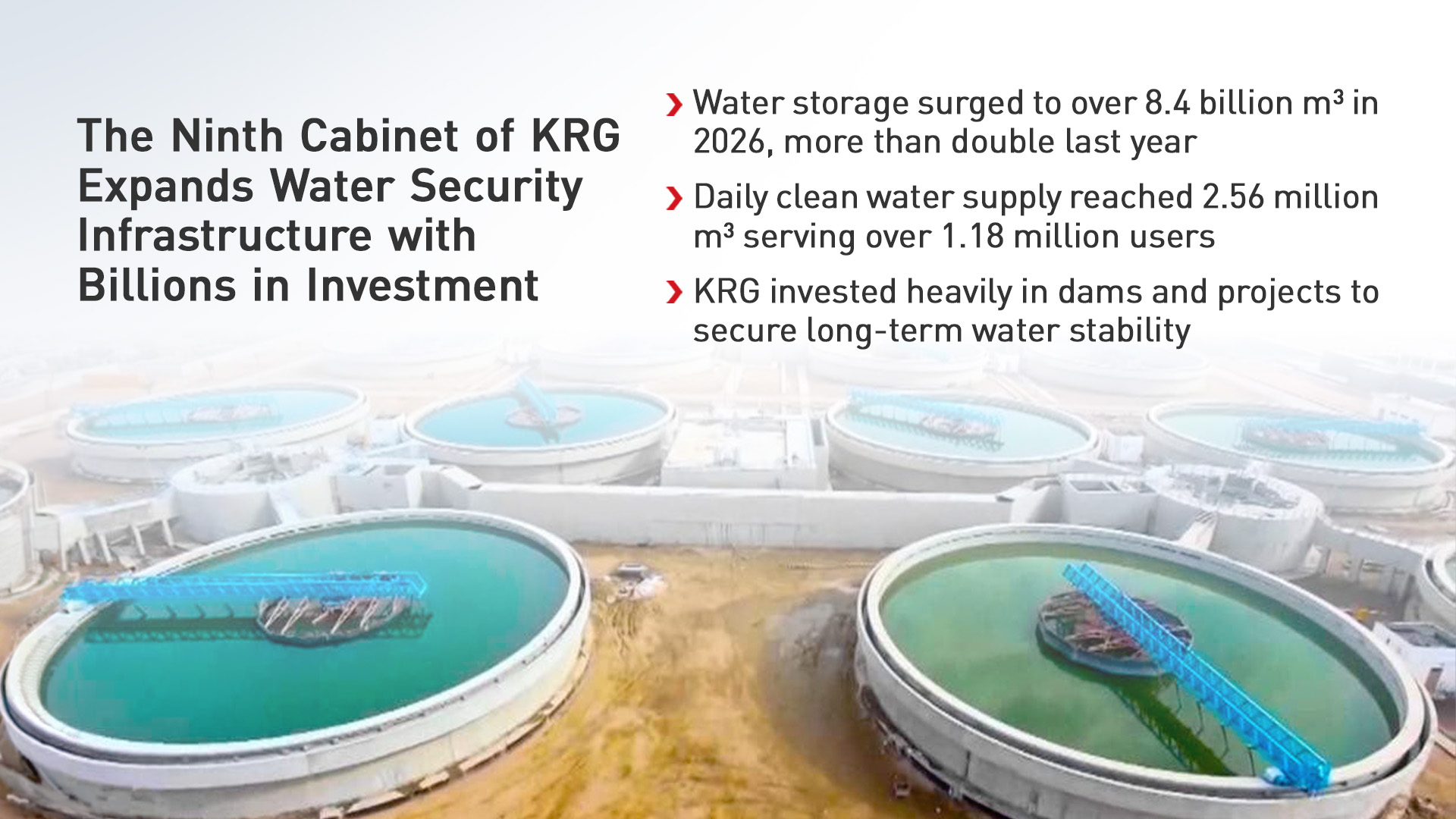
ERBIL (Kurdistan 24) - The Kurdistan Regional Government (KRG) has carried out a major expansion of water infrastructure between 2019 and April 2026, significantly increasing storage capacity, improving daily water supply, and strengthening long-term water security, according to a comprehensive official report released on Tuesday.
The report reflects a broad and coordinated strategy that combines dam construction, groundwater management, and the expansion of water distribution systems, as authorities respond to years of drought, declining groundwater levels, and growing demand across the region.
One of the most significant developments highlighted in the report is the sharp increase in stored water, which rose from approximately 3.59 billion cubic meters in 2025 to more than 8.41 billion cubic meters in 2026, driven largely by improved rainfall and expanded storage capacity.
The Kurdistan Region now has 36 dams, including 25 operational and 11 under construction, in addition to 178 ponds distributed across different areas, creating a multi-layered water storage system.
MAJOR DAMS such as Dukan and Darbandikhan continue to account for the bulk of water reserves, with Dukan alone reaching around 5.6 billion cubic meters this year, compared to 1.8 billion cubic meters last year, while Darbandikhan increased to 2.5 billion cubic meters from 1.7 billion.
Smaller and newly constructed dams have also contributed to strengthening resilience, with nine dams and 23 ponds built during the current cabinet, adding more than 252 million cubic meters of additional capacity.
Authorities have also outlined plans to construct 18 more dams, including several strategic projects, alongside dozens of additional ponds currently under implementation, based on the report information.
THE KEY BENEFITS of the construction of ponds and dams across the Kurdistan Region have delivered a wide range of strategic benefits that directly support both the population and key economic sectors. These projects have played a critical role in protecting and replenishing groundwater resources, while also reducing the risk of floods in urban and rural areas.
At the same time, improved water availability has strengthened the agricultural and livestock sectors, ensuring more stable production and supporting rural livelihoods.
Authorities say the expansion of water infrastructure has also enhanced access to clean water for citizens, contributed to environmental protection, and supported the growth of green spaces.
In addition, reservoirs and surrounding areas have increasingly become destinations for tourism, helping to revitalize local economies and promote sustainable development across the region.
WATER SUPPLY capacity has also expanded significantly, with the region now producing around 2.56 million cubic meters of clean water per day.
This supply is delivered through a wide network that includes filtration plants, thousands of wells, and hundreds of natural springs, serving more than 1.18 million subscribers across urban and rural areas.
Per capita water availability has reached approximately 350 liters per day, exceeding estimated average needs and placing the Kurdistan Region above several countries in the region in terms of water access.
LARGE-SCALE PROJECTS have played a central role in this transformation, particularly in urban areas.
The Erbil Emergency Water Project, with a capacity of 480,000 cubic meters per day, has effectively eliminated water shortages in the capital and is expected to secure supply for decades.
Other major projects in areas such as Qushtapa, Chamchamal, Akre, and Barzan are at various stages of completion, while additional infrastructure, including pipelines and wastewater treatment systems, is being developed to further expand capacity and efficiency.
GROUNDWATER MANAGEMENT has become a key focus of the government's water strategy, as reliance on wells is gradually reduced in favor of surface water sources.
According to official data, around 900 wells in Erbil and 109 wells in Qushtapa have been taken out of service.
This move is aimed at restoring groundwater levels after years of overuse, marking a clear shift toward more sustainable water management as supply increasingly depends on dams and large-scale water projects.
WATER INFRASTRUCTURE has also contributed to increased energy production, with hydropower generation rising to 175 megawatts in 2026, compared to 61 megawatts the previous year.
Officials say these developments are supporting key sectors such as agriculture, livestock, and tourism, while also helping to reduce environmental risks, including flooding and desertification.
WATER CONSUMPTION patterns in the Kurdistan Region highlight both progress in service delivery and ongoing challenges in efficiency.
According to official data, each citizen requires approximately 181 liters of clean water per day, while the Kurdistan Regional Government currently supplies an average of 350 liters per person daily, significantly exceeding actual needs.
This places the region among the highest in per capita water consumption compared to neighboring countries, where usage ranges between 150-200 liters in Türkiye, 120-180 liters in Syria, 250-300 liters in Saudi Arabia, 80-120 liters in Jordan, and 130-200 liters in Egypt.
Despite the government's approach of ensuring uninterrupted access to water, the gap between supply and actual demand has raised concerns about water wastage and long-term sustainability, particularly as climate pressures and resource management challenges continue to grow.
WATER PRODUCTION COST in the Kurdistan Region continues to place a significant financial burden on the government, reflecting a policy of prioritizing public access over cost recovery.
According to official data, the total annual cost of producing, supplying, and transporting clean water is estimated at around 500 billion Iraqi dinars, including both direct and indirect expenses.
In contrast, annual revenue from water services amounts to only 60 billion dinars, leaving the government to cover a subsidy of approximately 440 billion dinars.
This substantial gap underscores the KRG's commitment to ensuring uninterrupted access to clean water, while also highlighting long-term challenges related to financial sustainability and resource management.
The report underscores a significant transformation in the Kurdistan Region's water sector, as authorities move toward a more integrated and long-term approach to managing resources.
While progress has been substantial, officials stress that continued investment and careful planning will be essential to sustain these gains, particularly in the face of climate variability and increasing demand for water.
Edited by Kamaran Aziz