Sadr Signals Readiness to Dissolve Saraya al-Salam Under Security Transition Plan
Sadr outlines strict conditions for Iraq’s next government, including disarming militias, excluding armed parties from cabinet, anti-corruption action, and rejecting foreign interference.
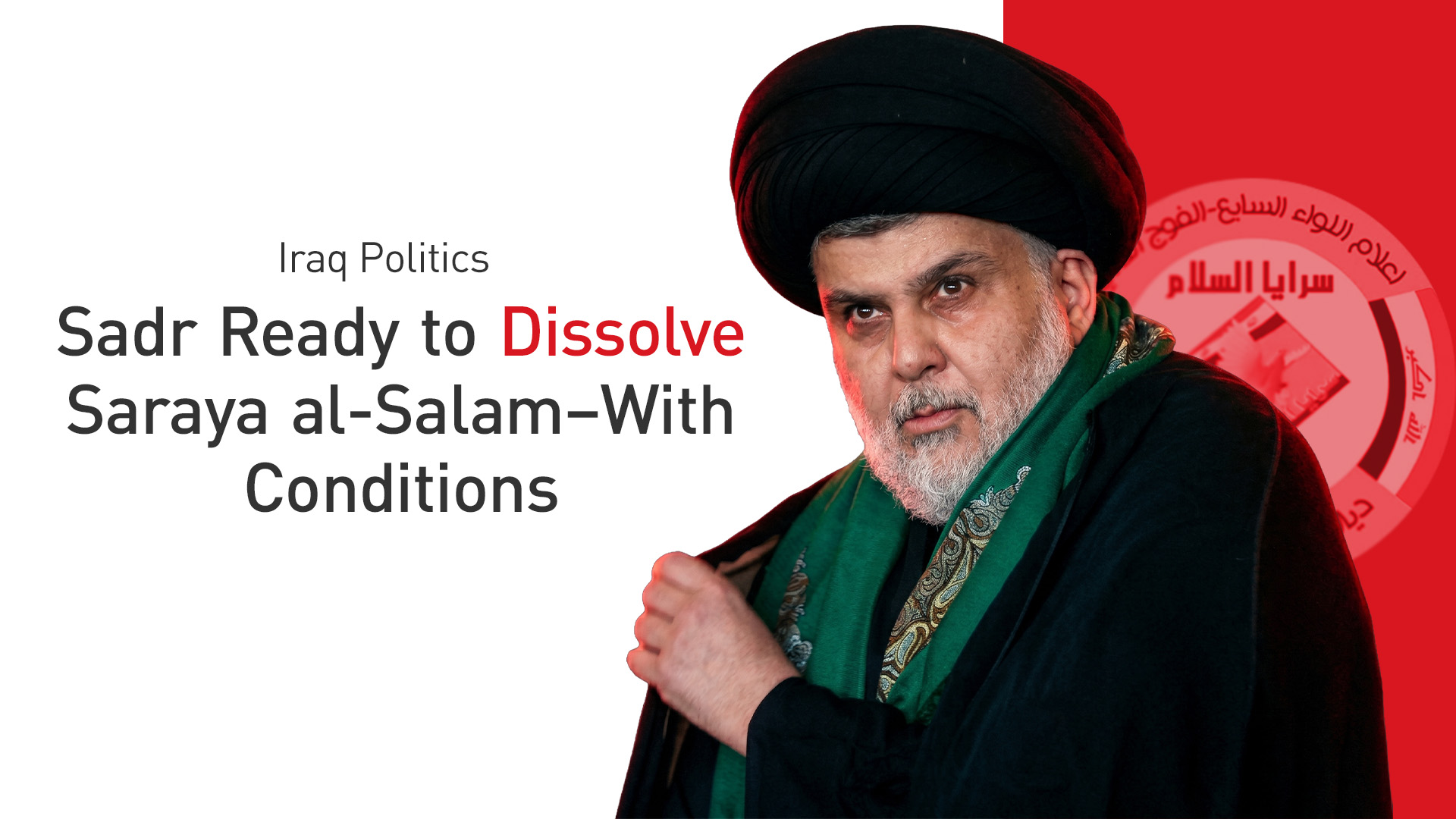
ERBIL (Kurdistan24) - Prominent Iraqi political and religious leader Muqtada al-Sadr has issued a comprehensive and highly detailed official statement outlining his strict prerequisites for the formation of Iraq's upcoming federal government.
Released on Friday, the statement establishes stringent administrative, security, and diplomatic demands directed explicitly at the prime minister-designate.
According to the statement, strict adherence to these outlined conditions is absolutely essential for the incoming administration to secure political legitimacy and public approval during the ongoing executive transition in Baghdad.
The pronouncement carries significant political weight for the trajectory of Iraqi governance, setting an exceptionally high institutional standard for the current coalition-building negotiations.
According to the statement by Muqtada al-Sadr, any incoming administration must fundamentally alter the existing political landscape by categorically excluding political parties that maintain armed affiliates from participating in the ministerial cabinet.
This strict exclusion criterion threatens to complicate conventional power-sharing mechanisms in the capital, as it directly challenges the established integration of paramilitary organizations within the formal governing apparatus.
By drawing a firm boundary against the inclusion of militarized political blocs, Sadr's terms pose a substantial institutional hurdle for the prime minister-designate tasked with achieving parliamentary consensus.
Furthermore, the statement emphasized a rigid policy of self-imposed political isolation regarding executive appointments.
Sadr declared that no members of the National Shiite Movement will participate in the new cabinet.
He explicitly stated that no prospective minister in the incoming government will represent his political movement, effectively distancing his faction from direct ministerial responsibility while simultaneously demanding sweeping systemic reforms from the political actors who assume power.
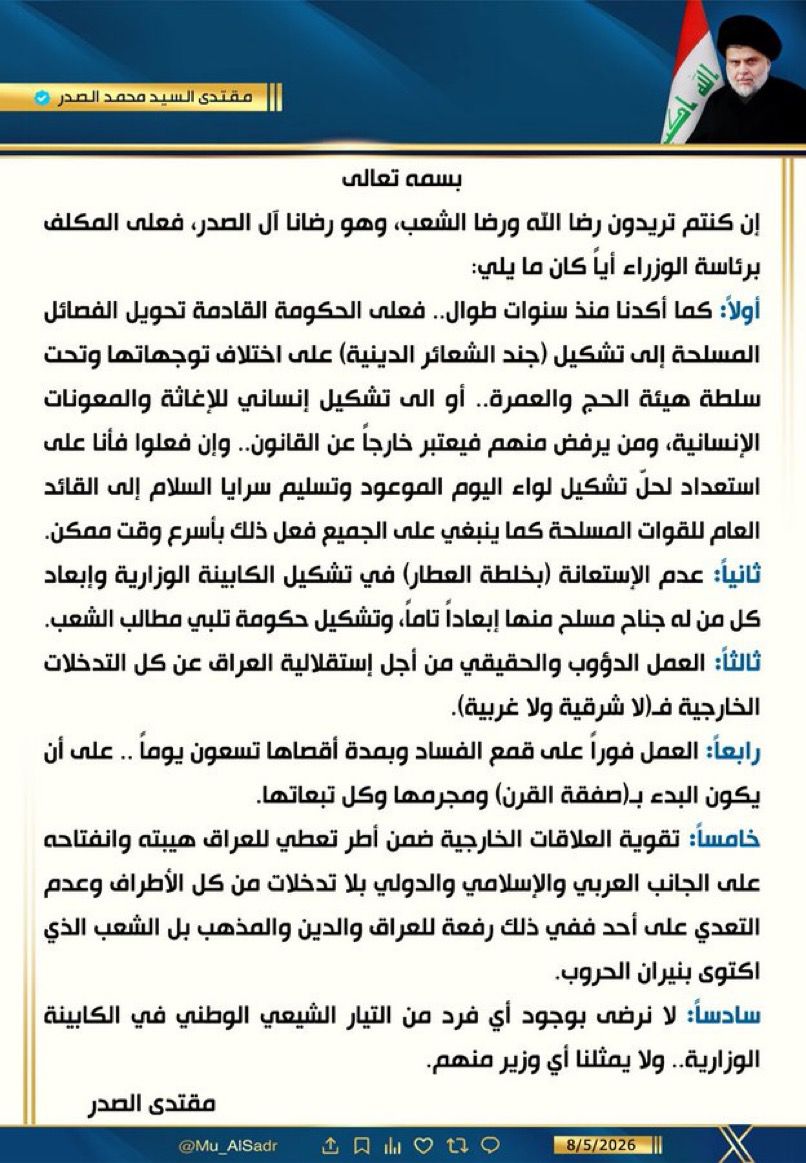
Statement by Muqtada al-Sayyid Muhammad al-Sadr
"In His Name, the Almighty
If you desire the pleasure of God and the pleasure of the people—which is our pleasure, the Sadr family—then the individual designated to form the government, whoever he may be, must adhere to the following:
First: As we have emphasized for many long years, the next government must convert all armed factions, regardless of their affiliations, into a formation called the "Soldiers of Religious Rituals" (Jund al-Sha'a'ir al-Diniyyah) under the authority of the Hajj and Umrah Commission, or into a humanitarian formation for relief and aid. Anyone who refuses shall be considered an outlaw. If they do this, I am prepared to dissolve the Promised Day Brigade and hand over the Peace Companies (Saraya al-Salam) to the Commander-in-Chief of the Armed Forces, as everyone should do as quickly as possible.
Second: Refraining from resorting to the "herbalist's mix" [an Iraqi political idiom referring to arbitrary quota-based political appointments] in forming the cabinet, completely excluding any party with an armed wing from it, and forming a government that meets the demands of the people.
Third: Diligent and genuine work toward securing Iraq's independence from all foreign interventions, so that it is "neither Eastern nor Western."
Fourth: Acting immediately to crack down on corruption within a maximum period of ninety days, starting with the "deal of the century" [referring to the massive tax deposit theft scandal], its perpetrators, and all of its repercussions.
Fifth: Strengthening foreign relations within frameworks that restore Iraq's prestige and openness toward Arab, Islamic, and international partners, free from any external interference, and without committing aggression against anyone. In this lies the elevation of Iraq, religion, and the sect, as well as the people who have been scorched by the fires of war.
Sixth: We do not accept the presence of any individual from the National Shiite Movement in the ministerial cabinet, and no minister among them represents us.
Muqtada al-Sadr
Date of publication: May 8, 2026"
Calls for Security Sector Restructuring
A central and potentially disruptive component of the statement involves a sweeping proposed overhaul of the country's security environment.
Muqtada al-Sadr stipulated that the forthcoming administration must transition all armed groups, irrespective of their political or ideological affiliations, into strictly civilian or state-regulated administrative entities.
According to the document, these armed factions must be completely repurposed.
The statement demanded they be transformed into organizations dedicated either to managing religious observances, specifically placed under the administrative jurisdiction of the national commission responsible for pilgrimage affairs, or completely reorganized as humanitarian relief and aid agencies.
Sadr argued that any group refusing this demilitarization and restructuring process must be officially designated by the state as operating outside the bounds of the law.
To demonstrate his commitment to this security sector initiative, the statement outlined Sadr's willingness to unilaterally dismantle his own affiliated armed formations.
He noted his readiness to dissolve his specialized paramilitary brigade and transfer the command and operational control of his primary armed companies directly to the Commander-in-Chief of the Iraqi Armed Forces.
However, the text specified that this transfer of authority is entirely contingent upon all other armed factions executing similar disarmament and integration measures as rapidly as possible.
Conditions for Government Formation
Regarding the structural composition of the next executive branch, the statement established rigid criteria for selecting government ministers.
Sadr demanded an absolute end to the traditional practice of distributing cabinet portfolios through entrenched, quota-based political compromises, criticizing the arbitrary and factional nature of historical coalition agreements.
Instead, the document stressed that the government must be formed based solely on meeting the broader demands of the Iraqi populace, rather than satisfying the partisan interests of established political elites.
According to Sadr's conditions, enforcing a strict ban on the participation of any political entity possessing a military wing is a non-negotiable prerequisite for a legitimate government.
This mandate effectively targets the overlapping military and political command structures that have frequently characterized successive Iraqi federal administrations.
The statement argued that excluding these dual-structured parties is a foundational requirement for achieving an effective federal cabinet.
Anti-Corruption Timeline Proposed
The statement by Muqtada al-Sadr also placed a heavy emphasis on immediate governance reforms and legal accountability.
The political leader outlined a strict, time-bound mandate for the incoming government to address systemic graft within the state apparatus, presenting anti-corruption enforcement as a core test of the new administration's viability.
According to the text, the new prime minister must initiate a comprehensive and aggressive crackdown on corruption within a maximum timeframe of ninety days following the government's official formation.
Sadr specified that this anti-corruption campaign must prioritize investigating a high-profile, massive tax deposit theft scandal that severely compromised the national treasury.
The document emphasized that the administration must actively pursue the individuals responsible for the embezzlement and address all resultant financial and legal repercussions of the scandal without delay.
The imposition of a ninety-day deadline introduces a strict accountability metric for the prime minister-designate's early tenure.
Foreign Policy Orientation Outlined
On the international front, the statement outlined a clear and uncompromising trajectory for Iraq's foreign policy and national sovereignty.
Sadr emphasized the absolute necessity of securing Iraq's complete independence from all forms of foreign intervention.
The document explicitly called for a geopolitical posture that avoids alignment with major geopolitical blocs in either hemisphere, advocating for a strictly non-aligned approach to national decision-making that prioritizes domestic sovereignty above external alliances.
Furthermore, the text outlined expectations for restoring Iraq's diplomatic prestige on the global stage.
According to Sadr, the next government must strengthen its external relations by fostering open, transparent, and balanced partnerships with Arab, Islamic, and broader international counterparts.
The statement argued that these relationships must be cultivated free from any external dictation or undue diplomatic pressure.
The document also enshrined a strict principle of regional non-aggression as a cornerstone of future foreign policy.
Sadr noted that a successful diplomatic strategy must ensure that Iraq does not commit acts of hostility against any other nation.
He argued that maintaining peaceful and independent international relations is essential for elevating the country's status and providing sustained relief to a domestic population that has historically suffered the devastating and cascading impacts of regional warfare.