Kurdish Lawyers Protest Removal of Kurdish From Hasakah Court Signage
Lawyers and activists in Hasakah, Western Kurdistan, staged a sit-in against the removal of Kurdish from Palace of Justice signage, as SDF commander Mazloum Abdi urged negotiations to resolve disputes over language rights and court integration with Damascus.
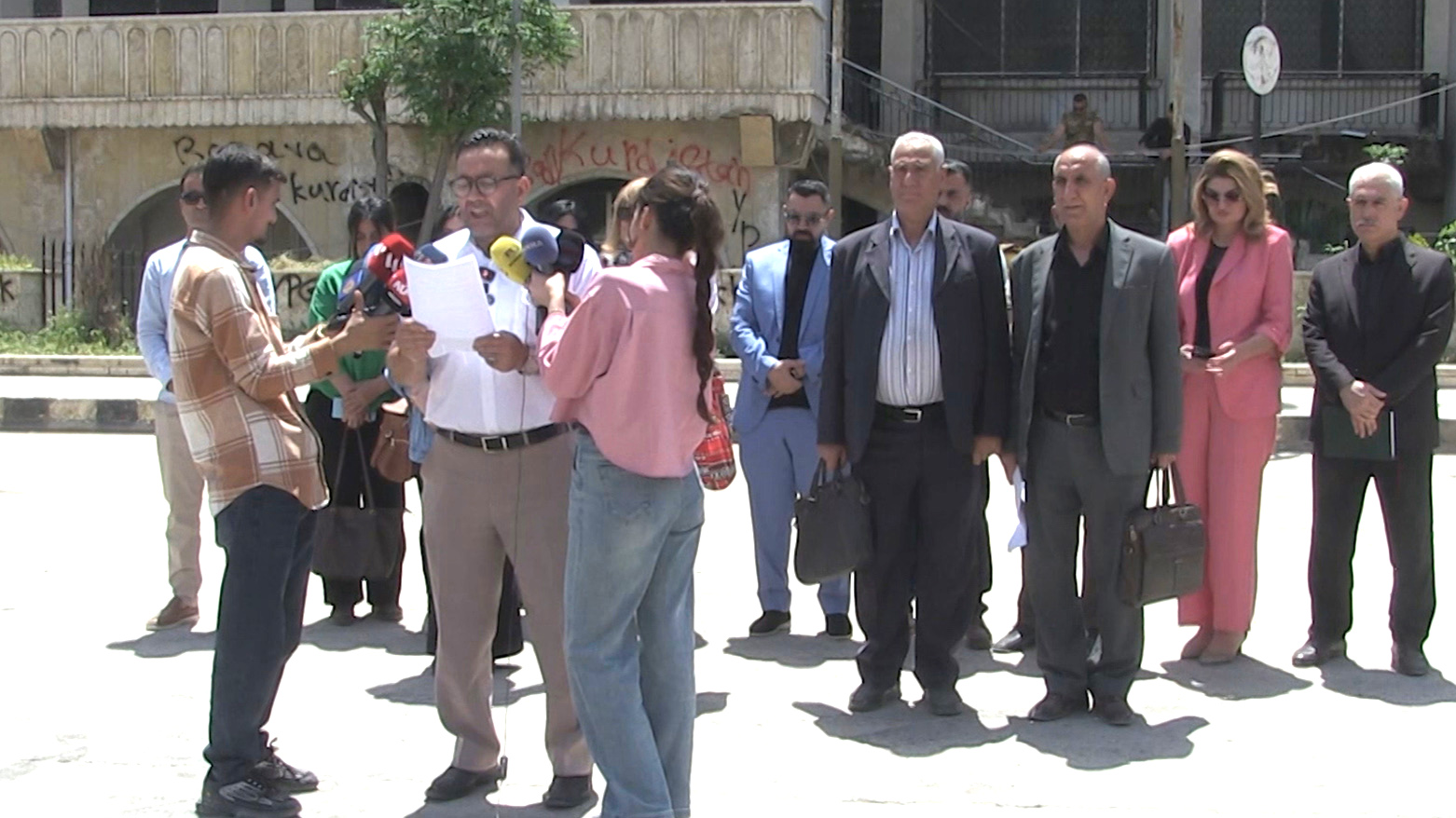
ERBIL (Kurdistan24) - A group of lawyers and regional activists gathered in front of the Palace of Justice in the city of Hasakah, Western Kurdistan (northeastern Syria), on Monday to express their professional and cultural opposition to the removal of the Kurdish language from official institutional signage.
The sit-in, organized by the local Lawyers' Union, underscored the deep connection between linguistic recognition and the legal identity of the community.
According to reports from the scene, participants emphasized that the Kurdish language is a foundational element of the region's social and legal fabric and should maintain its status alongside Arabic in public administration and judicial buildings.
The gathering occurred in response to a shift in institutional policy following a broader agreement between regional forces and the central government.
In various sectors, previous bilingual signage featuring both Kurdish and Arabic has been replaced with signs limited to Arabic and English.
This administrative change has sparked concern among legal professionals and civil society members, who view the exclusion of the Kurdish language as a significant step toward cultural marginalization.
The legal and cultural significance of the issue is heightened by the role the Palace of Justice plays as a central authority for the administration of rights and the documentation of citizen identity.
The debate surrounding language rights in Hasakah is not an isolated event but a recurring point of institutional tension.
Reports noted that this marks the fourth occasion where the signage at the Palace of Justice has become a focal point for public dissatisfaction.
Every instance in which the government has installed monolingual Arabic signs has been met with formal protests from Kurdish legal experts and youth activists.
These groups maintain that linguistic parity is essential for the legitimacy of state institutions in a diverse society and have pledged to continue their advocacy until the Kurdish language is restored to the signs of all government departments.
Mazloum Abdi Calls for Negotiations on Court and Language Disputes
The ongoing tension in Hasakah has prompted a call for restraint and diplomatic prioritization from senior regional leadership.
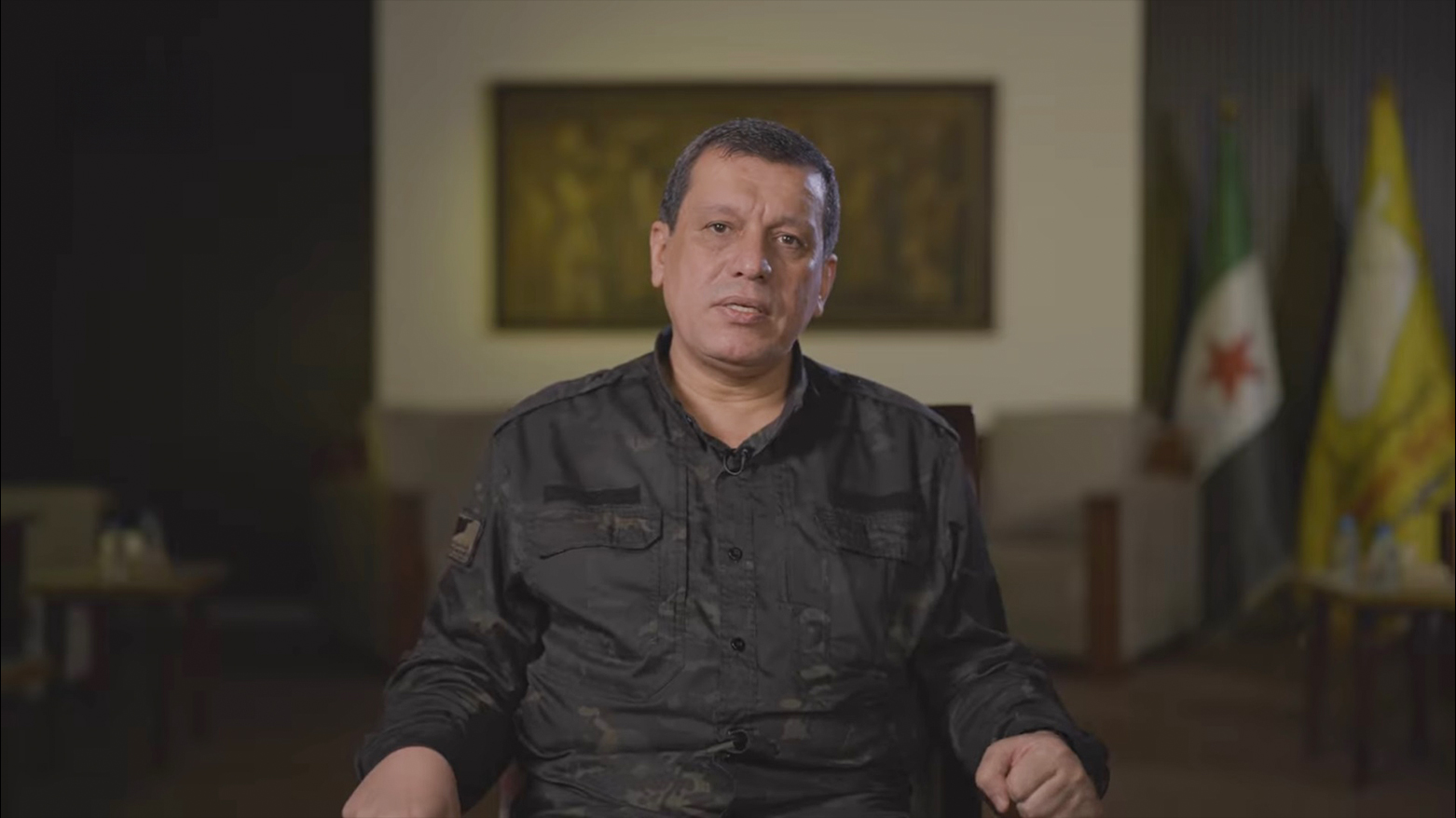
Mazloum Abdi, the Commander-in-Chief of the Syrian Democratic Forces (SDF), has urged the public, and particularly the younger generation, to maintain a calm posture to ensure the success of broader negotiations with the central government.
Abdi's remarks situated the local dispute within the complex judicial framework of the January 29 agreement, a landmark accord aimed at harmonizing regional administrative structures with the national state system.
According to Abdi, the judicial dossier remains one of the most sensitive components of the integration process.
The current crisis reveals that the disagreement over signage is inextricably linked to broader institutional negotiations regarding the status of Autonomous Administration judges and the legal standing of regional courts.
Abdi explained that recent frictions were exacerbated by the absence of a defined mechanism for incorporating regional judicial personnel into the national system.
However, he revealed that following recent high-level meetings in Damascus, a compromise has been reached that ensures Autonomous Administration judges will be integrated into the state courts following the completion of specialized training programs.
Lawyers Rally Around Kurdish Language Issue
The perspective of the legal community in Hasakah is rooted in the belief that language is more than a tool for communication; it is a vehicle for the protection of rights.
Lawyer Mihemed Ferhan, a participant in the sit-in, told Kurdistan24 that the protection of the dignity of the Kurdish language is the primary objective of their activities.
Ferhan stated that the presence of the language on the sign of the Palace of Justice is a non-negotiable requirement for the recognition of the community's legal standing.
He emphasized that as the language of the local society, Kurdish must be acknowledged in all formal capacities to ensure that justice is accessible and representative.
The activists involved in the protest, such as Beşîra Cemaledîn, clarified that their dissatisfaction should not be interpreted as a rejection of national integration or political agreements.
According to the report, Cemaledîn noted that while the community supports the move toward a unified administrative framework, such integration must not result in the erasure of Kurdish identity.
She warned that the modern Kurdish citizenry, particularly its youth, is highly aware of the risks of linguistic assimilation and will resist policies that seek to belittle or ban their native tongue in the public sphere.
This grassroots pressure highlights the institutional sensitivity of language rights. For the lawyers in Hasakah, the Palace of Justice serves as a symbolic and functional test case for the government's willingness to respect the pluralistic nature of the state.
The exclusion of Kurdish from such a prominent "sovereign" building is seen as a signal regarding the future of minority rights within the evolving political settlement.
Debate Over Court Procedures Continues
The removal of the Kurdish language from the Hasakah Palace of Justice was a deliberate policy choice by the central government.
In an interview detailing the negotiations, Mazloum Abdi stated that Damascus considers the judiciary a primary sovereign institution and, as such, insisted that its official markers be written exclusively in the national language, Arabic.
Abdi revealed that regional negotiators accepted this condition on a temporary basis to prevent a breakdown in the wider peace talks. This pragmatic concession allowed for the continuation of the integration process but left the signage issue as a lingering point of public contention.
Despite this temporary acceptance, the issue remains active on the negotiating table.
Abdi noted that a differentiated approach is being applied across the region. In cities such as Kobane, Qamishlo, Derik, and Amuda, institutional signs will continue to feature both Kurdish and Arabic.
Regarding the specific case of Hasakah, the government has reportedly issued promises that the Kurdish language will be added to the Palace of Justice signage at a later stage of the implementation process.
This phased approach is intended to balance the government's sovereignty claims with the regional demand for cultural recognition.
The administrative importance of the Palace of Justice further complicates the standoff. Abdi pointed out that the current suspension or disruption of work at the facility has direct negative consequences for the daily lives of citizens.
The judicial file is described as a "key" that unlocks essential state services, including the issuance of travel documents, the registration of property, and the administration of elections.
The leadership's call for calm is predicated on the belief that blocking the integration process over signage would ultimately harm the populace by preventing the resolution of these urgent administrative needs.
Language Rights and Legal Institutions
The struggle for linguistic recognition in Hasakah reflects a broader regional movement to secure the status of the Kurdish language within the formal legal institutions of the state.
The SDF Commander-in-Chief emphasized that the public's sensitivity to this issue is a source of regional pride and reflects a commitment to long-term cultural survival. He stated that the permanent goal of his administration is to ensure that the Kurdish language is officially recognized and established within the national constitution in the future.
The interaction between legal institutions and identity questions remains a primary driver of political discourse in the region.
Lawyers gathered outside the Palace of Justice argued that a judicial system that does not reflect the language of its people cannot truly serve as a sanctuary for rights.
According to the statement, participants see the restoration of Kurdish to official signage as a prerequisite for a legitimate and inclusive legal order. This perspective views the judicial administration not just as a technical bureaucracy, but as a space where the state must validate the cultural identity of its citizens.
The institutional implications of the dispute also involve the future of the regional judiciary.
The agreement to train and integrate Autonomous Administration judges into the national system is seen as a significant step toward institutional stability. However, the success of this integration depends on the ability of both sides to resolve the "language of the law" problem.
If court proceedings and documentation remain strictly monolingual in a bilingual society, the barriers to justice may persist even after personnel are integrated.
Negotiation Prospects and Institutional Challenges
As the region moves forward with the implementation of the January 29 agreement, the role of legal dialogue and political channels remains paramount.
The calls for negotiations to resolve the court file and the signage issue suggest that both regional leadership and the central government are aware of the risks of re-escalation.
Abdi's emphasis on maintaining the "integration process" highlights a strategic choice to prioritize administrative functionality and long-term constitutional gains over immediate symbolic victories.
However, the institutional challenges remain significant.
The recurring nature of the signage protests in Hasakah indicates a gap between the elite-level negotiations and the expectations of the local population. While leaders in Damascus and the region may view temporary concessions as a necessary part of diplomacy, the lawyers and activists on the ground perceive them as a threat to their identity.
Reconciling these different tempos of change is a critical task for those overseeing the transition.
In conclusion, the situation in Hasakah demonstrates that linguistic rights are a central pillar of the regional security and political architecture.
The gathering of lawyers at the Palace of Justice serves as a reminder that legal institutions are the primary arena where the terms of coexistence are defined. While the leadership urges calm and places its faith in the negotiation track, the community remains vigilant in its demand for a legal identity that includes its native tongue.
Negotiations and structured legal dialogue will continue to be the essential mechanisms for resolving these deep-seated disputes surrounding language and judicial administration.