President Barzani Marks 33rd Anniversary of Lalish Center Establishment
President Masoud Barzani congratulated the Lalish Center on its 33rd anniversary, praising its role in preserving Ezidi traditions and contributing to Kurdistan culture through decades of educational and cultural work.
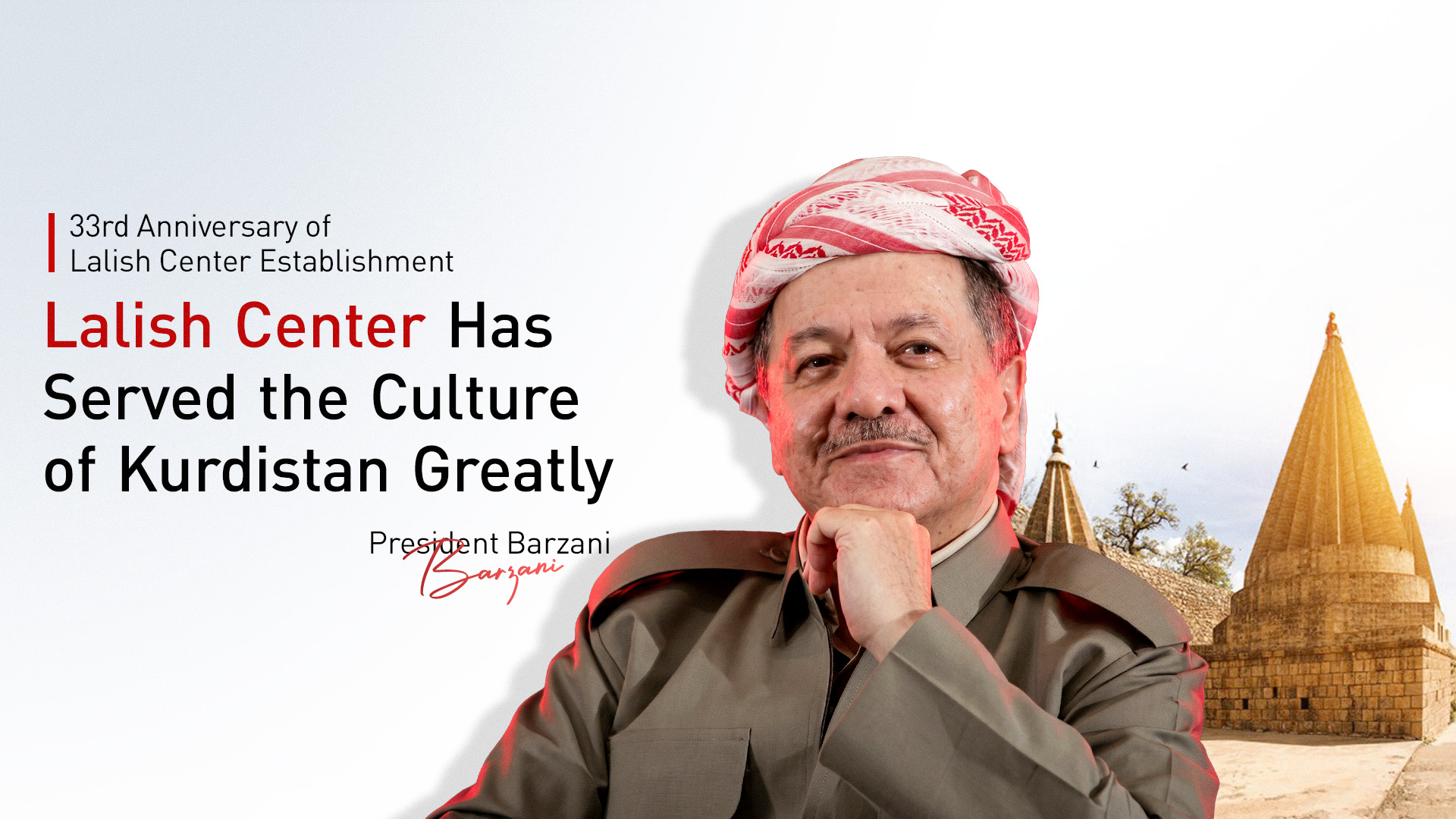
ERBIL (Kurdistan24) - President Masoud Barzani issued a congratulatory message on Tuesday marking the 33rd anniversary of the establishment of the Lalish Cultural and Social Center, a foundational institution for the Ezidi (also referred to as Yazidi or Yezidi) community.
In his address, President Barzani recognized the specialized role the center has played since 1993 in protecting Ezidi traditions and contributing to the broader cultural landscape of the Kurdistan Region.
The anniversary highlights a significant period of institutional work dedicated to heritage preservation, academic research, and the support of Ezidi youth.
President Barzani extended his greetings to the center's high board, its active members, and the wider Ezidi community.
He characterized the institution's three decades of operation as a period of dedicated service, noting that the efforts of Ezidi intellectuals and cadres have been instrumental in maintaining the community’s unique identity.
The message underscored the importance of cultural continuity, with the President expressing his hope for the center's further progress in fulfilling its mission.
The significance of the Lalish Center extends beyond ceremonial recognition, as it serves as a primary platform for the preservation of Ezidi identity and the advancement of educational opportunities.
According to Sema TV, the center has evolved into one of the most active cultural bodies in the region, focusing on research, publishing, and social advocacy.
The institution's role reveals that the center acts as an essential bridge between the Ezidi community's ancient heritage and the contemporary needs of its students and survivors, particularly through its coordination with governmental and academic bodies to ensure long-term stability and social cohesion.
President Barzani Marks Lalish Center Anniversary
In his message, President Barzani articulated his appreciation for the collective work performed by the institution's staff.
President Barzani said in his message that it is a source of satisfaction to see the Lalish Center providing a significant service to the Ezidi sisters and brothers. He emphasized that the preservation of Ezidi traditions is not only a service to the community itself but also a contribution to the multifaceted culture of the people of Kurdistan.
The President's message, which opened with an invocation of peace and happiness for the Ezidi people, reaffirmed the regional leadership's support for minority-led cultural institutions.
By recognizing the center's 33-year history, the statement situated the Lalish Center as a resilient entity that has navigated decades of challenges to remain a cornerstone of Ezidi public life.
President Barzani's concluding remarks wished for the continued advancement of the center's programs, highlighting an institutional commitment to the community's well-being.
Preserving Ezidi Heritage and Identity
The historical and symbolic importance of the institution was further detailed by the community's highest religious leadership.
According to Sema TV, His Holiness the Baba Sheikh of the Ezidis, Sheikh Ali Sheikh Elias, also issued a statement marking the anniversary. The Lalish Center was described as a historic platform that has provided outstanding services in the cultural and social fields.
Baba Sheikh emphasized that the center has become an important vehicle for introducing the Ezidi cause to a wider audience and for safeguarding the national and religious identity of the people.
According to the report, the center's network of branches and offices throughout all Ezidi-populated regions allows it to maintain a direct presence within the community, fostering a localized approach to cultural awareness.
The religious leader noted that the center's work over the past 33 years has left a definitive mark on the cultural scene in the Kurdistan Region.
Founded on May 12, 1993, the center began its work during a critical era of regional development.
Over the years, it has focused on documenting Ezidi history and beliefs through rigorous research and publishing initiatives. This intellectual output is aimed at countering cultural erasure and ensuring that the authentic heritage of the Ezidis remains a living part of the region's pluralistic society.
Educational Mission Continues
A primary pillar of the Lalish Center's modern activities involves the support of the younger generation through extensive educational programs.
According to a detailed report from the center's Student Department, as broadcast by Sema TV, education is viewed as the foundation for societal building and advancement. For over three decades, the institution has prioritized the needs of Ezidi students, offering financial assistance and academic guidance during periods of regional instability.
Dr. Muneb Saido Shingali, the Head of the Student Department, stated that the center has maintained continuous coordination with the Ministry of Higher Education and the Ministry of Education to resolve student-related issues.
One significant academic project cited in the report is the center's role in following up on the printing and distribution of the "Ezidiyati" (Yazidism) textbook, ensuring that Ezidi religious and cultural studies are integrated into the school curriculum.
The educational mission has recently received high-level governmental support.
According to Sema TV, a directive by the Prime Minister of the Kurdistan Regional Government, Masrour Barzani, has empowered the center to facilitate the return of Ezidi survivors to their studies free of charge.
This initiative also includes converting the status of students in evening and parallel-study programs into free education at public universities across the Kurdistan Region. Dr. Shingali noted that these efforts are currently being implemented in coordination with the Universities of Duhok, Zakho, and Duhok Polytechnic.
Culture, Community, and Continuity
The Lalish Center's student outreach also incorporates service-level support and scientific development.
The report by Dr. Shingali indicated that the center provides dormitory accommodations and direct financial aid to students in need.
Furthermore, the center incentivizes academic excellence through financial rewards for postgraduate students whose research focuses on Ezidi-related topics, ensuring that the study of the community's affairs remains a vibrant part of regional scholarship.
Recent initiatives highlight the center's efforts to prepare Ezidi youth for a modern economy. Sema TV noted that in coordination with an international school, the center launched a programming and artificial intelligence course for Ezidi children.
This three-month initiative aims to provide students with the technological skills necessary for future careers, reflecting an evolution in the center's mission from traditional heritage preservation to modern skill acquisition.
On a social level, the institution organizes cultural camps and community gatherings. The report noted that in coordination with the Barzani Charity Foundation, the center recently held camps for over 150 students and graduates.
These activities are designed to foster a sense of community and solidarity among young Ezidis, while also honoring outstanding students for their academic achievements.
Institutional Support and Regional Pluralism
The continued activity of the Lalish Center is situated within a broader regional context of supporting minority communities. In the Kurdistan Region, cultural and educational centers are viewed as essential mechanisms for maintaining the social fabric.
The institutional support provided to the Lalish Center, from presidential recognition to Prime Ministerial decrees regarding education, reflects a governance model based on the acceptance of diverse identities.
The center's focus on introducing the Ezidi cause and preserving religious identity serves as a counter-narrative to historical pressures.
Educators and administrators stated that by providing a safe and organized space for cultural expression, the center prevents the erosion of heritage among the diaspora and younger generations.
The institution's role as a platform for research and research-based publishing ensures that the history of the Ezidi people is recorded by the community's own intellectuals.
Ultimately, the 33rd anniversary of the Lalish Center serves as a reminder of the importance of community-led institutions in a multicultural society.
Through its dual focus on ancient heritage and modern education, the center remains a vital resource for the Ezidi people.
The anniversary of the Lalish Cultural and Social Center underscores the enduring role of community institutions in preserving heritage and supporting the educational aspirations of minority groups.
As the center enters its 34th year, its ongoing coordination with regional authorities continues to provide a framework for cultural continuity and institutional stability within the Ezidi community.