NYT: US, Israel Explored Ahmadinejad Role in Wider Iran Government Change Plan
A New York Times investigation claimed Israeli and US officials initially envisioned a multistage strategy aimed at destabilizing Iran’s government and potentially elevating former President Mahmoud Ahmadinejad as part of a postwar political transition
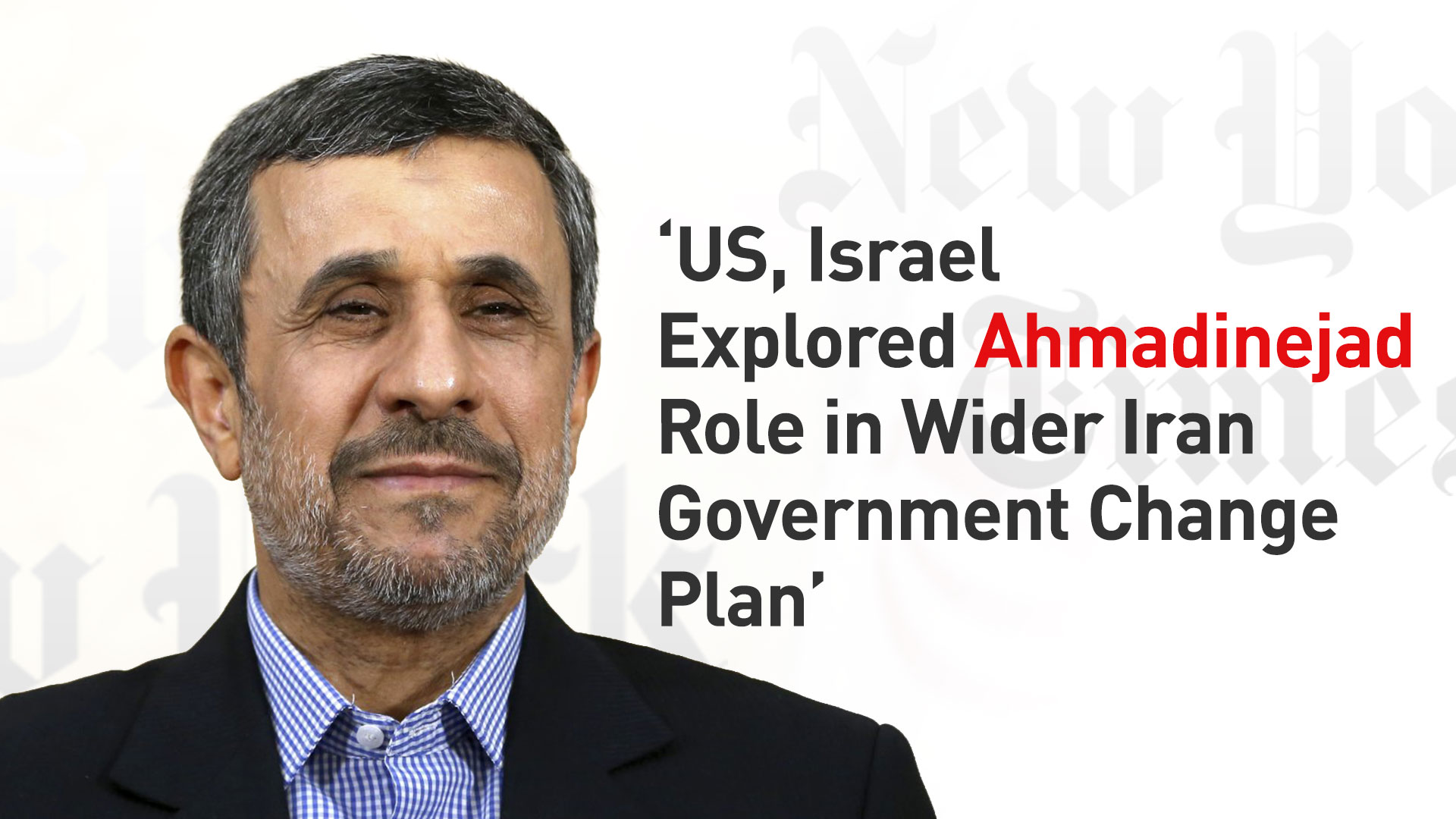
Erbil (Kurdistan24) - The Middle East was still absorbing the shock of the February 2026 war's opening salvos when a far more audacious dimension of the conflict began to emerge. The New York Times reported on Wednesday that the United States and Israel had gone into the fighting with a specific man in mind to lead Iran afterward, and that man was Mahmoud Ahmadinejad, once notorious for calling to "wipe Israel off the map." US officials and an associate of the former Iranian president confirmed to the Times that Washington and Tel Aviv had developed a concrete plan to install him as the head of a new Iranian government once the Islamic Republic of Iran collapsed.
The plan had not been previously disclosed by any outlet, the Times reported. According to two Israeli defense officials familiar with the operational planning who spoke to the Times, the strategy was built in phases: a devastating air campaign to eliminate Iran's supreme leadership, a Kurdish ground mobilization to apply military pressure, a sustained influence operation to erode public confidence in the government, and finally, a leadership transition to what Israeli planners internally referred to as an "alternative government."
On the war's first day, Israeli strikes killed Ayatollah Ali Khamenei at his compound in central Tehran, the Times reported. The same assault, according to the Times, struck a gathering of senior Iranian officials whom the White House had assessed as potentially open to a negotiated transition, eliminating several of them. Simultaneously, the Israeli Air Force carried out a strike on Ahmadinejad's home in the Narmak district of eastern Tehran, not to kill him, but to eliminate the Revolutionary Guard members holding him under house arrest and free him to assume a political role, US officials told the Times. He survived but was injured in the strike, and satellite imagery reviewed by the Times showed the security outpost at the entrance to his street had been destroyed.
After the strike, an associate of Ahmadinejad confirmed to the Times that the former president understood the attack as an attempt to liberate him, and that American officials had viewed him as someone with the capacity to manage "Iran's political, social and military situation." The associate likened his envisioned role, the Times reported, to that of Delcy Rodriguez in Venezuela, who took power following US intervention and went on to cooperate closely with the Trump administration. Following the near-miss, however, Ahmadinejad reportedly grew disillusioned with the government change scheme, according to the Times. He has not appeared publicly since, and his whereabouts and condition remain unknown.
The choice of Ahmadinejad was not without controversy inside Washington. Some American officials told the Times they were openly sceptical about the viability of the plan, given his ideological record, a presidency defined by Holocaust denial, calls for Israel's destruction, violent suppression of dissent, and aggressive advancement of Iran's nuclear enrichment program. Yet in the years after leaving office in 2013, Ahmadinejad had increasingly clashed with the government, the Times reported. Iran's Guardian Council blocked him from running for president in 2017, 2021, and 2024; his aides were arrested, and his movements were confined to his home. In a 2019 interview with the Times, he praised Trump as "a man of action" and called for rapprochement between Tehran and Washington. Trips to Guatemala in 2023 and to Hungary in 2024 and 2025, both countries with close ties to Israel, as detailed by New Lines magazine, deepened speculation about his shifting allegiances, and he returned from Budapest just days before the war began, the Times reported.
Asked to comment on the government change plan on Wednesday, May 20, the White House did not address it directly, the Times reported. Spokeswoman Anna Kelly told the Times that Trump's objectives for what the administration called Operation Epic Fury had been clear from the outset: destroying Iran's ballistic missiles, dismantling its production facilities, sinking its navy, and weakening its proxy networks. "The United States military met or exceeded all of its objectives," she said, with the Times noting that she added negotiators were now working to permanently end Iran's nuclear capabilities. Mossad declined to comment, the Times reported.
Beyond the Ahmadinejad operation, the broader Israeli plan largely failed to unfold as designed, the Times reported. The Kurdish ground mobilization did not produce the anticipated destabilization, and the Islamic Republic of Iran did not collapse, with its resilience confounding the planners' assumptions, according to the Times. Mossad chief David Barnea, however, told associates, the Times reported, that he remained convinced the agency's strategy, built on decades of intelligence collection and covert operations inside Iran, would have succeeded had it received full authorization to move forward.
The February 2026 conflict was not the first time Israel and Iran had exchanged direct blows. In April 2024, the two countries exchanged missiles directly for the first time in the 45-year history of the Islamic Republic of Iran, the Jewish Telegraphic Agency reported.
That confrontation foreshadowed a far larger escalation: on June 13, 2025, Israel launched what became known as the 12-Day War, striking Iranian nuclear facilities, military infrastructure, and government leadership while US-Iran nuclear talks were still ongoing, Al Jazeera reported.
The United States joined the offensive on June 21, 2025, targeting the most fortified sites in Iran's nuclear program that Israel lacked the arsenal to destroy independently, Britannica reported, before a ceasefire was announced on June 24.
The 12-Day War demonstrated Israel's ability to overwhelm Iran's air defenses and left the Islamic Republic of Iran militarily weakened, Britannica noted. Diplomatic efforts to reach a new nuclear agreement in 2025 and again in early 2026 failed to produce a breakthrough, according to Britannica, while widespread protests inside Iran in early 2026 signaled deepening public frustration with the government, providing the political backdrop against which Washington and Tel Aviv launched the February offensive.
Neither Israeli nor Iranian officials have publicly commented on the Ahmadinejad report. Whether any version of the government change plan remains alive in Washington or Tel Aviv has not been disclosed.