Washington Puts $15 Million Bounty on Iranian Military Finances Amid Widening Blockade
The U.S. State Department is offering $15 million for intelligence on the IRGC's financial networks, targeting shadow fleets and illicit oil trade. This move follows Treasury's "Economic Fury" campaign, which has crippled Iranian exports and sanctioned the regime's maritime authorities.
ERBIL (Kurdistan24) - The U.S. Department of State has significantly escalated its campaign to dismantle the financial foundations of the Islamic Revolutionary Guard Corps (IRGC), issuing a public call for intelligence backed by a multi-million dollar bounty.
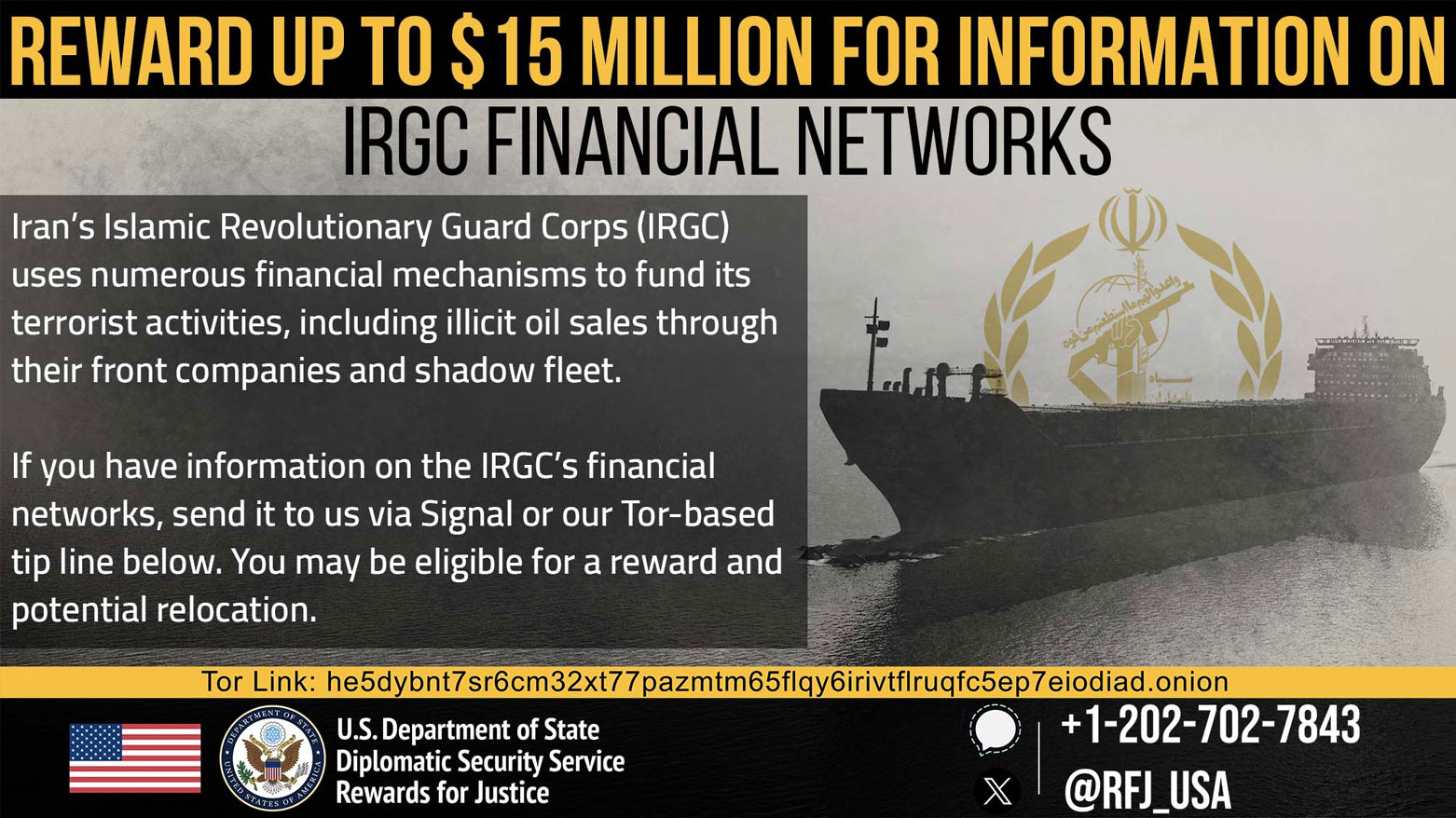
In a graphic poster and accompanying digital campaign published Saturday, May 30, the State Department's Rewards for Justice (RFJ) program offered up to $15 million for information leading to the disruption of the IRGC's financial mechanisms.
The move signals a shift toward intelligence-driven enforcement as Washington seeks to plug the remaining gaps in its "Economic Fury" campaign against Tehran.
The RFJ poster explicitly identifies the IRGC's reliance on "numerous financial mechanisms" to fund its operations, specifically highlighting the use of front companies and a "shadow fleet" to facilitate illicit oil sales.
In an accompanying statement on X, the RFJ official account warned that these maritime tactics, which they dubbed the "Aya-tollbooth", would no longer be tolerated.
"The IRGC's dark fleet and Aya-tollbooth will take a toll on international shipping," the post read. "Help us stop these schemes. Send us a tip."
Beyond financial incentives, the program is offering potential relocation assistance to whistleblowers who provide actionable data through secure, encrypted channels, including Signal and a Tor-based tip line.
The Context of 'Economic Fury'
The reward offer arrives as the Trump administration intensifies what officials describe as a total economic blockade.
Treasury Secretary Scott Bessent, in a statement published Thursday, via his official X account, characterized the "Economic Fury" campaign as a strategy of maximum attrition intended to force Tehran back to the negotiating table.
According to Secretary Bessent, the pressure is manifesting in the collapse of basic state functions within Iran. He claimed that the Iranian economy and currency are in "free fall," noting reports that Iranian security forces and troops are facing pay delays.
A central component of this pressure is the "Wall of Steel", a U.S. naval blockade that Bessent claims has driven Iranian crude exports to record lows and effectively shut down operations at Kharg Island, Iran's primary oil export terminal.
Bessent also announced the sanctioning of the Persian Gulf Strait Authority (PGSA), an entity Washington dismisses as a "joke" and a tool for extortion.
The Secretary issued a stern warning to international corporate and state entities against complying with Iranian demands for transit tolls in the Strait of Hormuz, regardless of whether they are disguised as aid or "charitable" payments. "Only a satisfactory outcome in negotiations will end the downward spiral," Bessent asserted.
Dismantling the Shadow Supply Chain
The drive for financial intelligence follows recent revelations regarding how Tehran bypasses Western technology restrictions. A previous Kurdistan24 report detailed a Treasury Department crackdown on a sophisticated procurement network that allegedly defrauded U.S. technology firms to arm the Iranian military.
That network, allegedly orchestrated by Ali Majd Sepehr and his firm, Sorena Hushmand Samaneh Company, specialized in "corporate identity theft."
By impersonating American small businesses, the group reportedly acquired restricted encryption software and hardware for the benefit of Iran's Ministry of Defense and Armed Forces Logistics (MODAFL).
The investigation into Sepehr's network revealed a complex logistical web involving intermediaries in the United Arab Emirates and Italy, who managed the storage and re-export of fraudulently obtained U.S. goods.
These revelations have underscored the necessity of the $15 million RFJ bounty, as Washington looks to identify the specific banking channels and front companies that pay for such clandestine procurement operations.
A Strategy of Maritime and Financial Attrition
The State Department's focus on the "dark fleet" reflects a growing concern over the IRGC's ability to move commodities through covert trade. By targeting the maritime "tollbooth" schemes, the U.S. aims to eliminate the IRGC's role as a regional gatekeeper in the Persian Gulf.
The Rewards for Justice initiative is designed to complement existing sanctions by encouraging insiders to expose the specific "shadow banking" networks that handle the proceeds of illicit oil sales.
These networks often involve a mix of traditional fiat currency, digital assets, and informal swaps that are difficult to track through standard regulatory oversight.
U.S. authorities have made it clear that the scope of these enforcement actions is global.
The Treasury Department has previously signaled its readiness to impose secondary sanctions on foreign financial institutions, including those linked to China's independent "teapot" refineries, that continue to facilitate IRGC-linked commerce.
The Road to Negotiations
While the Rewards for Justice program presents a punitive face to the world, the administration continues to frame these measures as a means to a diplomatic end.
By targeting the personal wealth of IRGC leadership and the operational budgets of their military wings, Washington hopes to create a crisis of resources that necessitates a change in regional policy.
The offer of $15 million and relocation suggests that U.S. officials believe there is significant internal friction within these financial networks that can be exploited.
As the "Wall of Steel" restricts physical movement in the Gulf and the "Economic Fury" campaign isolates the Iranian central bank, the hunt for the IRGC's "dark money" has become the next critical frontier in Washington's strategy.
For international shipping companies and financial entities, the message from the State Department and Secretary Bessent is clear: the cost of engaging with Iranian-linked maritime or financial schemes now includes not only the risk of sanctions but the active surveillance of a multi-million dollar whistleblower program.