U.S. Report Highlights Peshmerga Lack Air Defense Against Aerial Threats
U.S. OIR report warns the Kurdistan Region's Peshmerga lack air defense systems, leaving the Kurdistan Region exposed to drone and missile attacks amid broader regional tensions.
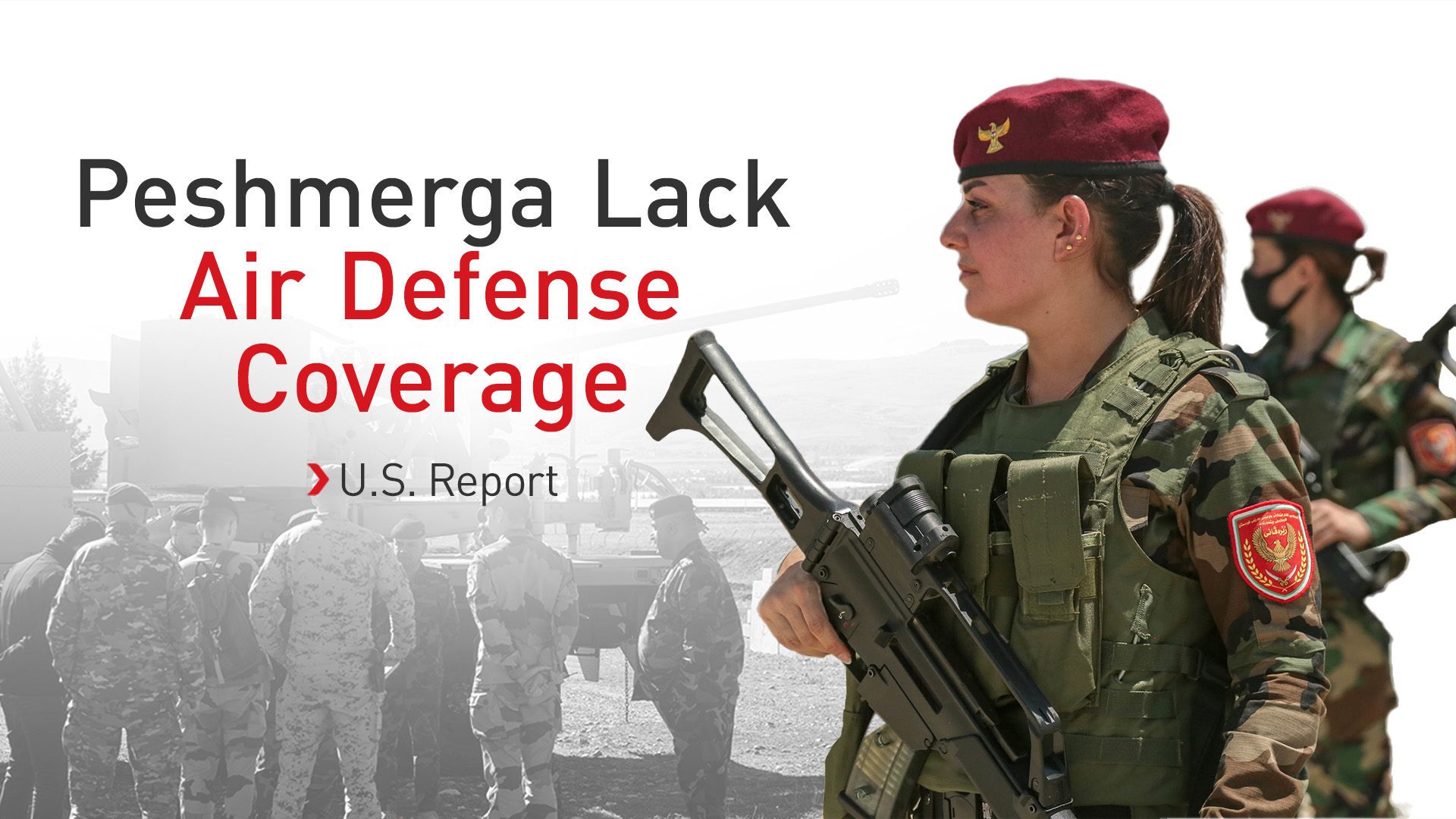
ERBIL (Kurdistan24) - While U.S. forces actively operated air defense systems to protect American facilities in Erbil, findings detailed in the newly released 44th Lead Inspector General Report to the United States Congress on Operation Inherent Resolve (OIR) highlighted that the Peshmerga forces currently lack significant air defense coverage. This systemic gap has left Kurdistan Region security forces, civilians, and vital energy infrastructure dangerously exposed to external aerial attacks, the report noted.
These stark vulnerabilities are among the most pressing findings detailed in the newly released 44th Lead Inspector General Report to the United States Congress on Operation Inherent Resolve (OIR).
Covering the period from Jan. 1 through Mar. 31, 2026, the comprehensive assessment documents an eventful quarter for the Kurdistan Region.
In addition to underscoring critical vulnerabilities in the Kurdistan Region's defensive posture, most notably the absence of a dedicated air defense system for the Peshmerga to counter aerial threats, the report outlines a shifting security landscape defined by escalating Iran-aligned militia strikes, the temporary drawdown of U.S. advisory support to the Peshmerga, and the looming threat of an Islamic State (ISIS) resurgence following mass prison escapes in neighboring Syria.
Security Frontlines and Militia Threats
While ISIS remains territorially defeated, the report starkly highlights a number of immediate external threats. Following the Feb. 28 launch of the U.S. Central Command's Operation Epic Fury (OEF), a widespread campaign targeting the Iranian security apparatus, the report highlights that the Kurdistan Region faced intense retaliatory strikes.
Iran and Iran-aligned militias repeatedly targeted the U.S. military presence at the Erbil Air Base with waves of missile and drone strikes.
Despite repeated statements by the Kurdistan Region's leadership affirming its neutral stance in the conflict between the United States and Iran, the violence took a deadly toll on Peshmerga forces. For instance, on Mar. 24, a rocket attack on a Peshmerga base martyred six soldiers and wounded at least 30 others.
The violence also took a toll on civilians, with a number of civilians martyred amid the wider conflict between the United States and Iran.
The Lead Inspector General's report underlined that the aggression escalated further when explosive drones targeted the private residences of Kurdistan Region President Nechirvan Barzani and President Masoud Barzani in late March.
The report exposes a critical vulnerability within the region's defense architecture.
While U.S. forces actively operated air defense systems to protect American facilities in Erbil, the Kurdish Peshmerga currently lack significant air defense coverage. This systemic gap has left Kurdish security forces, civilians, and vital energy infrastructure dangerously exposed to external aerial attacks.
Evacuations and Economic Disruption
The security environment, during the height of the U.S.-Iran conflict, deeply impacted the U.S. diplomatic footprint and the local economy.
The report highlights that faced with regular drone attacks, U.S. Mission Iraq initiated an ordered departure of all non-essential personnel from the U.S. Consulate General in Erbil starting on March 5. Military contractors in Erbil were also affected; while some management staff evacuated, the report cites media notes that other support personnel were relocated to local hotels with limited security options.
The broader conflict also had a huge impact on the Kurdistan Region's energy sector.
The ead Inspector General's report notes that the targeted attacks and heightened security risks forced multiple oil and gas companies to issue force majeure declarations. The temporary closure of the Khor Mor gas field reduced essential supplies to power plants, negatively impacting electricity generation across the region.
However, the report also notes that a rare collaborative breakthrough mediated by U.S. diplomats occured beyween the Iraqi federal government and the KRG to reach an emergency economic agreement.
This arrangement allowed Baghdad to transport at least 250,000 barrels per day of crude oil from Kirkuk through the Kurdistan Region's pipeline network to Türkiye's Ceyhan port, creating a vital economic lifeline while the Strait of Hormuz remained virtually closed to shipping.
Looking Ahead
Looming over the immediate regional conflict is the enduring threat of ISIS.
Read More: U.S. Oversight Report Warns of Looming ISIS Resurgence as Security Alliances Shift in Syria and Iraq
The report warns that the group is highly likely to attempt a resurgence, exploiting the chaos that followed the Syrian government's takeover of northeastern Syria and the subsequent collapse of the Syrian Democratic Forces.
At least 150 ISIS fighters escaped detention facilities during the quarter, and thousands of ISIS-affiliated individuals fled the al-Hol displaced persons camp before its closure.
While ISIS has shown little ability to orchestrate mass escapes in Iraq thus far, the influx of extremists across the border remains a paramount concern for local security forces.
For the Kurdistan Region, which continues to host the vast majority of the 351,000 Syrian refugees and asylum-seekers in Iraq, the convergence of a possible threat of an ISIS resurgence in Syria and unmitigated militia attacks at home creates a volatile landscape.
The Lead Inspector General's report underscores the necessity of adequately equipping the Peshmerga and closing critical structural gaps in air defense capabilities.