Peshmerga Promotes 1,385 Officers in Major Step Toward Military Unification
A promotion of 1,385 officers may look routine, but it reveals a far bigger transformation underway, one that could redefine the future of the Peshmerga and Region's security.
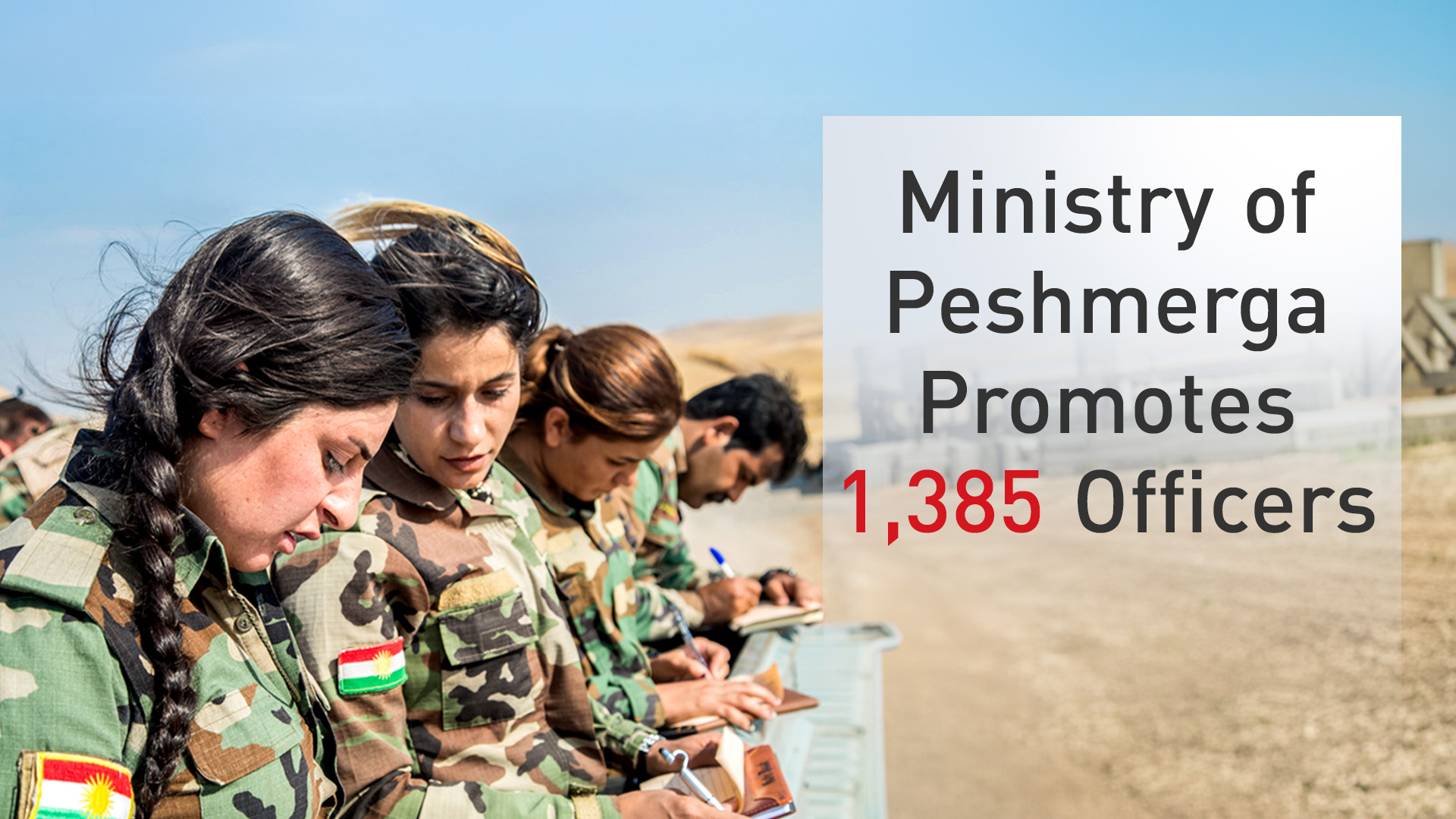
ERBIL (Kurdistan24) - When the Ministry of Peshmerga recently announced the mass promotion of 1,385 officers, the decision represented far more than a routine administrative maneuver. It marked a critical milestone in a massive, multi-year effort to restructure the Kurdistan Region's most vital security institution, moving it away from its historically fragmented roots toward a unified, professionalized military force.
The promotion orders, signed by Minister Shorsh Ismail, elevated officers across the 70 Unit Command, Support Forces 1 and 2, and the Defense and Emergency Command. Yet, the true significance of the announcement lay in how the promotions were executed.
"We are pleased that our efforts to organize and normalize the promotion process for Peshmerga officers have been successful," Ismail stated after signing the orders. "The process is now being implemented legally and systematically within its designated timeframe."
For a military force that has historically operated along partisan lines, the establishment of regularized, merit-based, and legally standardized promotions is a foundational step in military institutionalization. By replacing ad hoc personnel decisions with a unified institutional procedure, the Ministry of Peshmerga is actively attempting to reshape the operational culture of the force.
Building a Unified Force
The promotions arrive at a pivotal moment for the Peshmerga. Under intense domestic pressure and heavy encouragement from international partners, the Kurdistan Regional Government (KRG) is racing to meet a critical deadline: the complete unification of its armed forces by September 2026.
Lieutenant General Issa Ozer, Chief of Staff of the Ministry of Peshmerga, recently confirmed that the integration process is in its final stages.
"So far, the Ministry of Peshmerga has successfully formed eight divisions, and work on the First Regional Command has also been completed," Ozer told reporters.
He expressed strong optimism that the creation of a single national force under the umbrella of the KRG and the Presidency of the Kurdistan Region will be finalized by September 25.
The promotion of 1,385 officers serves as a mechanism to support this integration.
A unified military requires a cohesive chain of command, where officers from previously distinct units share equivalent ranks, responsibilities, and institutional loyalty.
The minister explicitly connected the promotions to this objective, stating that the new phase in the officers' careers should serve as motivation "to ensure the success of the reform process, unifying our forces under the single umbrella of the Ministry of Peshmerga."
Read More: Peshmerga Unification Process to Be Completed by September, Chief of Staff Says
A Tradition Meets Modernization
This modernization effort is occurring within an institution that holds profound historical and cultural weight for the Kurdish people.
The Peshmerga are deeply intertwined with the Kurdish national identity, having served as the primary defense force during decades of political struggle and, more recently, during the grueling war against the Islamic State (ISIS).
President Masoud Barzani recently highlighted this legacy, marking the 64th anniversary of his own enlistment in the Peshmerga forces.
Describing his service as "the highest honor," the Kurdish leader paid tribute to the historical sacrifices of the fighters.
Read More: President Barzani Marks 64th Anniversary of Joining Peshmerga, Calls Service "Highest Honor"
The challenge for contemporary military reformers is to preserve this powerful tradition of sacrifice while shedding the partisan divisions that characterized past eras.
The current reform agenda seeks to honor the Peshmerga's historical legacy by transforming it into a modern, state-level institution capable of meeting 21st-century security demands.
International Support and Strategic Expectations
The institutionalization of the Peshmerga is not merely a domestic concern; it is a strategic priority for the international coalition. Foreign partners view a professionalized, unified Peshmerga as essential for maintaining stability in a highly volatile region.
Dilshad Shahab, spokesperson for the Presidency of the Kurdistan Region, recently underscored this international backing following Kurdistan Region President Nechirvan Barzani's diplomatic tour in Europe.
Shahab noted that Italy, a key coalition member, has reaffirmed its commitment to supporting the Peshmerga through ongoing training and institutional restructuring assistance.
For Western allies, investing in the Peshmerga's personnel management, command structures, and operational readiness is viewed as a necessary safeguard against the resurgence of extremist groups and the destabilizing influence of proxy militias.
Modern Threats Expose Remaining Challenges
However, personnel reforms and officer promotions alone cannot secure the Kurdistan Region against an evolving spectrum of modern threats. The urgency of Peshmerga modernization was starkly outlined in the recently released 44th Lead Inspector General Report on Operation Inherent Resolve (OIR) to the United States Congress.
Read More: U.S. Report Highlights Peshmerga Lack Air Defense Against Aerial Threats
The U.S. oversight report warned that while the Peshmerga are undergoing structural reforms, they remain critically under-equipped to handle asymmetric aerial warfare.
Specifically, the report highlighted that the Kurdish forces lack significant air-defense systems, leaving security personnel, civilians, and vital energy infrastructure dangerously exposed to drone and missile attacks from Iran-aligned militias.
This vulnerability was tragically demonstrated earlier this year when a rocket attack on a Peshmerga base resulted in the deaths of six soldiers and the wounding of 30 others.
The disparity between the Peshmerga's administrative progress and their physical defensive capabilities illustrates the complex reality facing the KRG.
While the Ministry of Peshmerga can successfully normalize promotions and unify divisions, true military readiness will require significant international investment in modern defensive hardware.
The Next Phase of Reform
As the 1,385 newly promoted officers assume their enhanced roles, they step into a military organization undergoing profound change. The coming months leading up to the September unification deadline will serve as a critical test of the ministry's ability to convert bureaucratic milestones into operational reality.
The promotions signal that the administrative machinery of a unified Ministry of Peshmerga is beginning to function as intended.
Yet, the true measure of these reforms will be whether this newly structured, professionalized command can effectively secure the Kurdistan Region against the complex array of threats looming on its borders.
For the Peshmerga, the transition from a revered historical fighting force to a modern, state-level military institution is no longer just a political aspiration; it is now an urgent operational necessity.